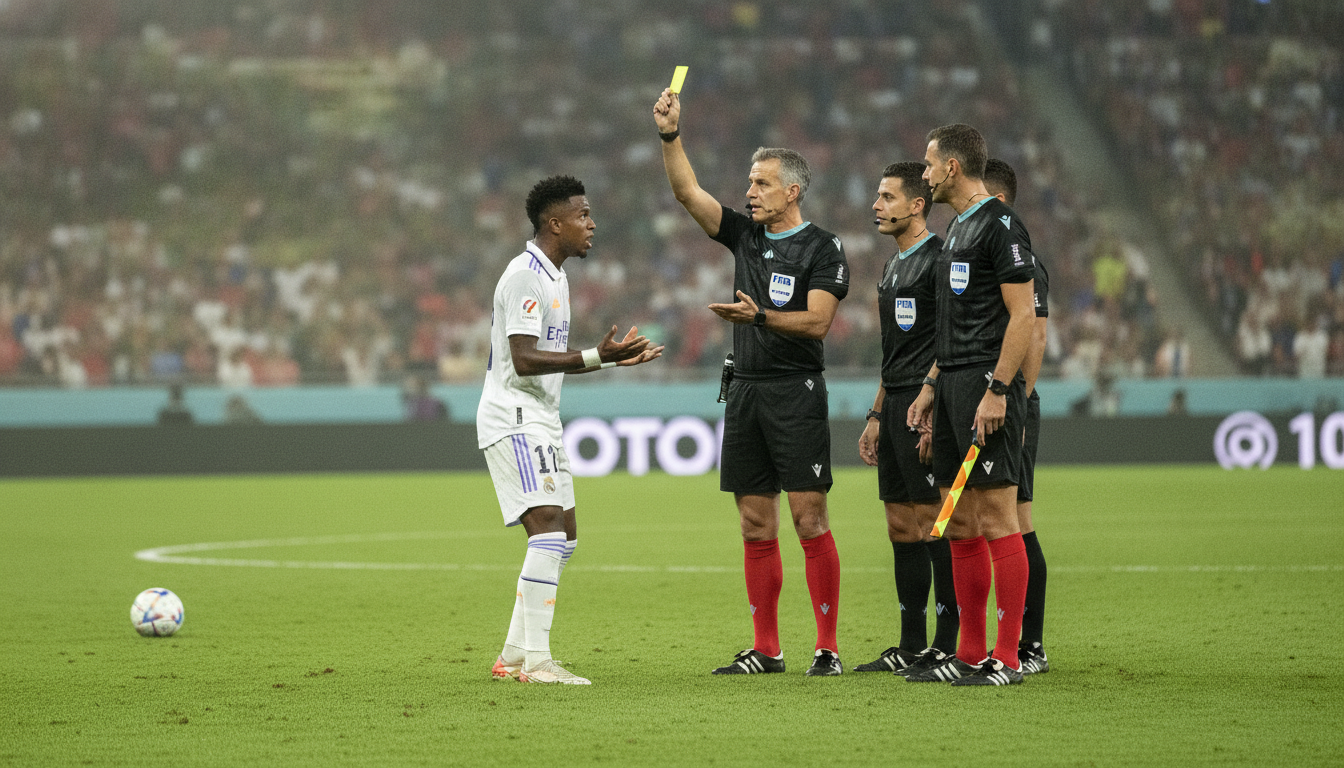
Referees’ preseason in Las Caldas to debate application of the “Ley Vinicius” in Spanish competitions
Spanish referees convene July 28–August 1, 2026, in Las Caldas to review new Laws of the Game and decide whether to adopt FIFA’s “Ley Vinicius” domestically.


The Spanish refereeing body opens its official preseason on Tuesday, July 28, 2026, when Primera División referees gather in Las Caldas for a multi-day course that runs through August 1, 2026.
The Comité Técnico de Árbitros (CTA) will use the meeting to reinforce the updated Laws of the Game and to weigh a key policy decision: whether to apply FIFA’s recently introduced “Ley Vinicius” in Spain.
Preseason schedule and participants
The CTA has scheduled the Primera División cohort to attend the Las Caldas seminar from July 28 until August 1, 2026.
On August 1, 2026, the course transitions to include referees from the Segunda División, who will begin their preparatory sessions that day.
The annual preseason gathering brings together match officials for fitness testing, practical refereeing drills, and detailed rule briefings ahead of the domestic season.
CTA emphasis on the updated Laws of the Game
This year’s agenda places particular emphasis on changes to the Laws of the Game that referees must implement for the coming season.
Officials will receive classroom instruction and on-field simulations to ensure consistent interpretations across match officials at both top-tier and second-tier levels.
The CTA has signaled that referees will be reminded of subtle procedural adaptations as well as newly clarified misconduct definitions that can affect match control and disciplinary outcomes.
Scope and intent of the “Ley Vinicius”
FIFA introduced the measure commonly referred to as the “Ley Vinicius” in April 2026; the rule prescribes dismissal for players who cover their mouths when directing words at an opponent.
FIFA framed the rule as an effort to combat aggressive language and protect the integrity of player conduct, making the gesture an act that can lead to a red card if deemed to be directed at another participant.
The regulation has already been enforced in high-profile international fixtures, with expulsions recorded during recent global tournaments involving players disciplined after covering their mouths in confrontations.
UEFA’s public position and the tension with FIFA’s directive
During the same global competition cycle, UEFA publicly confirmed it will not implement the “Ley Vinicius” across its club or national team competitions.
UEFA officials justified their stance by expressing concerns that the rule could impinge on players’ freedom of expression and that its interpretation risks subjectivity in enforcement.
That divergence between FIFA and UEFA creates a practical dilemma for national federations and technical committees when deciding whether to follow the global directive or align with continental policy.
Decision-making at the CTA and consultation with UEFA
The CTA, chaired by Fran Soto, has formally consulted UEFA to clarify the continental body’s approach and to inform its deliberations on domestic implementation.
Because the “Ley Vinicius” is a FIFA-sanctioned change to the Laws of the Game, Spanish referees could apply it regardless of UEFA’s refusal to use the measure in its competitions.
Fran Soto and his technical team have indicated that the Las Caldas sessions will be used to analyze whether the rule strengthens match discipline in Spain or whether it introduces unnecessary ambiguity into refereeing practice.
Practical implications for Spanish league matches
If the CTA elects to apply the “Ley Vinicius” in LaLiga and the Segunda División, referees will need clear, shared criteria to determine when a mouth-covering gesture merits a red card.
Clubs, coaching staffs, and players would also need briefing to understand the conduct that could now prompt immediate dismissal, which may alter on-field behavior and psychological dynamics.
Match commanders will be asked to balance strict enforcement with proportionality, ensuring that sanctions reflect intent and context rather than producing inconsistent outcomes across fixtures.
Training, communication and disciplinary pathways
The CTA’s preseason will include video review sessions and scenario-based drills designed to standardize referees’ reading of mouth-covering incidents.
Disciplinary committees would also play a role after matches, assessing whether a dismissal under the new rule was appropriate and whether subsequent appeals are warranted.
Clear communication from the CTA to clubs and the public will be essential to minimize controversy and to explain the technical rationale behind any decision to adopt or reject the rule domestically.
Timing and what to expect before the league kick-off
A final determination by the CTA is expected to be made in the coming weeks and, in any case, before the start of the Spanish league season.
That timetable gives referees time to internalize whatever approach is adopted and provides clubs with the opportunity to adjust training and disciplinary guidance to players.
Observers will watch whether the CTA’s decision mirrors FIFA’s global directive, follows UEFA’s cautionary approach, or takes a hybrid position tailored to Spanish football’s needs.
Spanish refereeing authorities face a consequential policy choice at a moment when consistency across competitions and clarity for players both carry significant weight.
The outcome will influence how on-field confrontations are policed this season and may set a precedent for other national committees weighing similar conflicts between FIFA and UEFA positions.