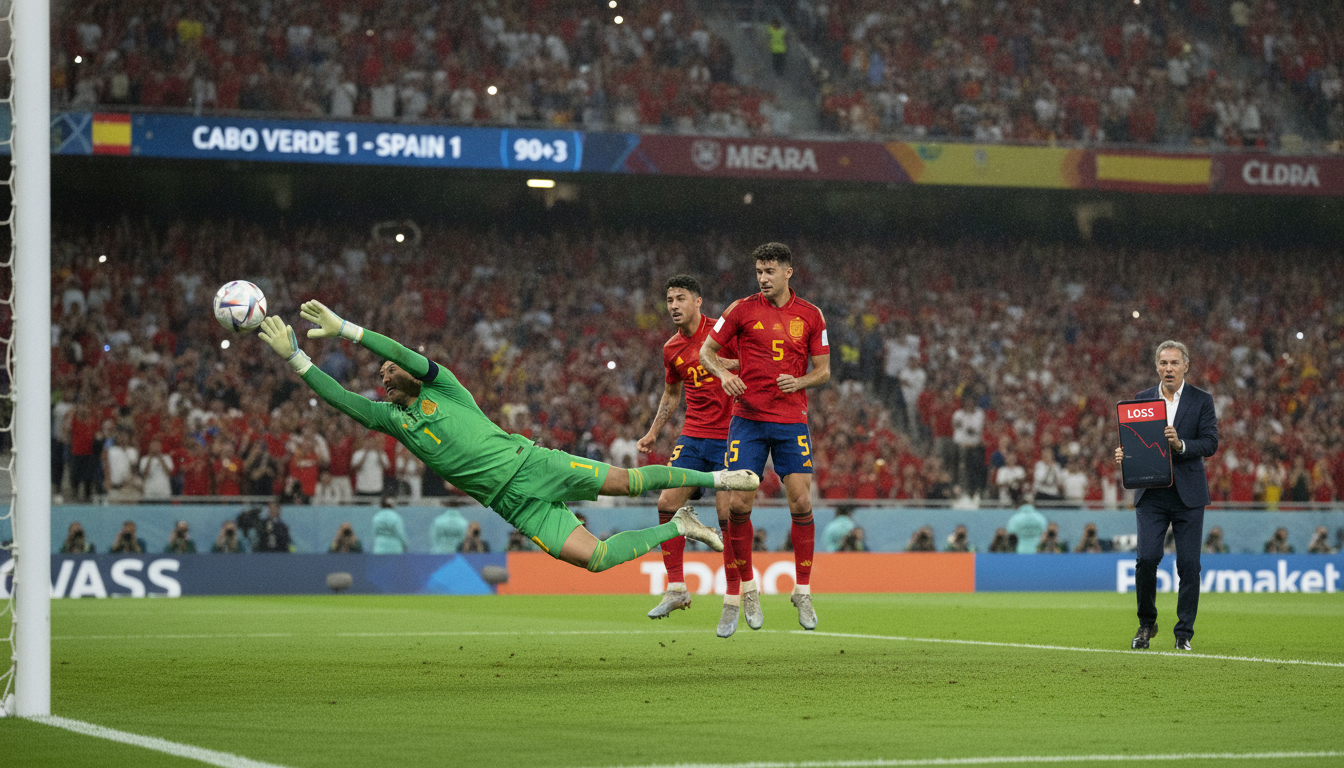
Cabo Verde draw with Spain shocks World Cup as Polymarket bettor loses nearly $1M
Cabo Verde draw with Spain shocks World Cup — goalkeeper Vozinha stars and a Polymarket bettor loses nearly $1M, sending ripples through betting markets.


Cabo Verde’s 0-0 draw with Spain produced one of the tournament’s most startling results, a match that combined stubborn defending, a vintage goalkeeping display and an unexpected financial casualty on the prediction markets. The result, a draw for Cabo Verde against the European heavyweights, left bettors and bookmakers scrambling to reassess risk as a single stake on Polymarket that had been placed on a Spanish victory evaporated. Central to the outcome was 40-year-old goalkeeper Josimar José Évora Dias — widely known as Vozinha — whose string of saves ensured a historic point for a debutant nation. The draw alters early expectations for the group and injects fresh uncertainty into World Cup forecasts.
Market Shock as Single Trader Loses Nearly $1 Million
A single wager on a Spanish victory turned catastrophic for one trader on Polymarket, one of the larger prediction market exchanges, according to trading records reviewed after the game. The bettor’s position had been placed when markets priced Spain as overwhelming favourites, a factor that magnified the payout exposure when the match failed to deliver the expected result. Polymarket has grown in profile as fans and speculators use it to lay bets on sporting outcomes, and high-profile losses like this underline how quickly market sentiment can reverse. The episode will likely prompt scrutiny of position sizes and risk controls among retail market participants.
The scale of the loss is notable because such markets typically attract smaller stakes than conventional bookmakers, yet concentrated positions can still produce outsized swings. Market liquidity, the timing of trades, and last-minute shifts in match probability all played a part in how the exposure accumulated. The event is a reminder that even seemingly small probabilities can come to pass at the World Cup, with serious financial consequences for those taking large, concentrated risks. For bookmakers and automated models, the match will feed into recalibrations of how underdog performances are priced in the earliest stages of a tournament.
Vozinha’s Seven Saves and Emotional Exit
At the heart of the result was Vozinha, Cabo Verde’s veteran goalkeeper, who repeatedly denied Spain with a sequence of key saves that kept his side level throughout the match. The 40-year-old produced what teammates and commentators described as a combative and technical performance, making multiple interventions in key moments and commanding his box with authority. His efforts culminated in a visibly emotional exit from the pitch, an end-to-match scene that captured the significance of the point for a nation making its World Cup debut. Vozinha’s display will be remembered as a defining individual performance at this tournament’s opening stages.
Beyond the raw number of saves, it was the timing and quality of those interventions that mattered most, disrupting Spain’s rhythm and forcing the favorites to probe longer and harder for openings. Strategic positioning, sharp reflexes and veteran reading of the game allowed Vozinha to thwart attempts that on paper looked likely to result in goals. For Cabo Verde, the goalkeeper’s contribution went beyond shot-stopping: his presence steadied a back line that had to repel continuous pressure. Such goalkeeping performances often act as tournament catalysts for underdog teams, providing belief and a platform to build from in subsequent matches.
Spain Entered as Tournament Heavyweights
Spain arrived in the competition widely regarded as one of the favorites, a position reflected in pre-tournament probability models that placed the European champions among the sides with the highest chances of lifting the trophy. A high-profile model from Goldman Sachs, cited before kick-off, estimated Spain’s chances of winning at roughly 26 percent, underscoring the market and analytic confidence in their tournament prospects. That context made the draw all the more surprising to observers, who expected a side with Spain’s depth and recent form to break down a debutant opponent. Tactical control and possession dominance were both anticipated outcomes that ultimately failed to translate into goals.
The match highlighted some of the persistent challenges favored teams face when encountering compact, low-block defensive setups combined with inspired goalkeeping. Spain’s inability to convert possession into clear scoring opportunities will be the subject of analysis by coaches and analysts, who will probe passing patterns, final-third penetration and creative decision-making under pressure. For Spain, a point dropped to a non-traditional footballing nation is not catastrophic in isolation, but it represents a missed chance to assert early dominance and place psychological pressure on group rivals. Expect adjustments in personnel and approach aimed at sharpening finishing and breaking down resolute defensive opponents.
Cabo Verde’s First World Cup and Squad Profile
For Cabo Verde, the result carries historic weight: the nation was making its first appearance at a World Cup finals and fielded a squad without household-name stars in major European leagues. That relative anonymity, however, concealed a team shaped by cohesion, defensive organization and a willingness to adopt disciplined, pragmatic tactics when facing superior opposition. The ability to secure a clean sheet against Spain speaks to a preparation and mindset geared toward compact defending and seizing the brief chances that arrived. For small footballing nations, leveraging organization and match discipline remains a potent pathway to competitive results on the global stage.
The squad’s performance also highlights how national teams can harness collective spirit and clear tactical identity to counterbalance a lack of marquee individual talent. Coaches of emerging nations increasingly emphasize structure, set-piece planning and transitional play to offset opponents’ technical advantages. Cabo Verde’s players, many of whom ply their trade in smaller leagues or abroad without constant media attention, showed that cohesive teamwork can produce outcomes that disrupt pre-match expectations. The point will likely galvanize domestic interest and international attention, underscoring the unpredictability that makes World Cup soccer compelling.
Wider Tournament Upsets and Betting Ripples
The draw was only the latest example in a tournament kickoff that has already featured surprising results, including a late comeback by Japan to salvage a draw with the Netherlands the previous day. Such early shocks have contributed to heightened volatility in prediction markets and prompted betting platforms to reassess liabilities and in-play pricing mechanisms. The combination of dramatic on-field moments and large, concentrated online wagers is producing notable headlines and forcing market participants to rethink assumptions about match certainty. The immediate consequence is a recalibration of risk management and a reminder that early-tournament narratives can shift rapidly.
Institutional models and retail platforms will be watching subsequent fixtures closely for similar anomalies, and traders may reduce concentration risk or hedge positions more aggressively in coming rounds. The publicity around large single losses, such as the near-$1 million hit on Polymarket, could have a deterrent effect on would-be high-stakes retail speculators, at least temporarily. At the same time, underdog successes drive engagement and viewership, sustaining interest in both the sporting competition and the markets that orbit it. Regulators and platform operators may also take note of how exposure accumulates on decentralized or rapid-execution exchanges and whether additional consumer protections are warranted.
What happens next for both teams will influence market sentiment; a follow-up result could either reinforce the belief that early shocks were anomalies or indicate a persistent trend of unpredictable outcomes. Traders who absorb losses will likely alter strategy, while casual observers may increasingly pay attention to live markets where odds can swing with every dramatic moment. The interaction between real-world sporting surprises and the financial behavior of bettors underscores the evolving relationship between sport and markets in the digital age.
Implications for Group Standings and Tournament Outlook
From a competition standpoint, the draw reduces Spain’s margin for error in the group phase while providing Cabo Verde with a significant platform from which to pursue qualification ambitions. A single point can be a pivotal result in a tight group and may alter how teams approach subsequent fixtures, with favorites increasingly conscious that complacency can carry a competitive cost. For tournament organizers and broadcasters, the result enhances the narrative drama and elevates interest in matches that might otherwise have been viewed as predictable. Tactical adaptations and squad rotations in the coming matches will be scrutinized for signs of strategic recalibration.
Longer-term implications include a potential boost to Cabo Verde’s footballing profile, which could affect player recruitment, investment in domestic infrastructure and the country’s international standing in the sport. Spain will face questions about finishing and creative output, areas where marginal gains could prevent similar outcomes in future fixtures. For fans and analysts, the early stages of the World Cup offer a reminder that pre-tournament probabilities, while informative, cannot account for every variable on match day — from individual brilliance to tactical discipline and the occasional market-moving upset.
Cabo Verde’s result serves as a case study in how underdog teams can leverage strategic discipline and outstanding individual moments to upset expectations and reshape both competitive and financial landscapes surrounding major tournaments.
The draw between Cabo Verde and Spain will be replayed in analysis rooms and betting reports for weeks to come, a compact drama that combined a veteran goalkeeper’s standout night with a high-profile financial loss on a major prediction market. As the group stage progresses, both teams will have opportunities to respond and define their trajectories, while bettors and markets adjust to the reminder that at the World Cup, certainty is often an illusion.