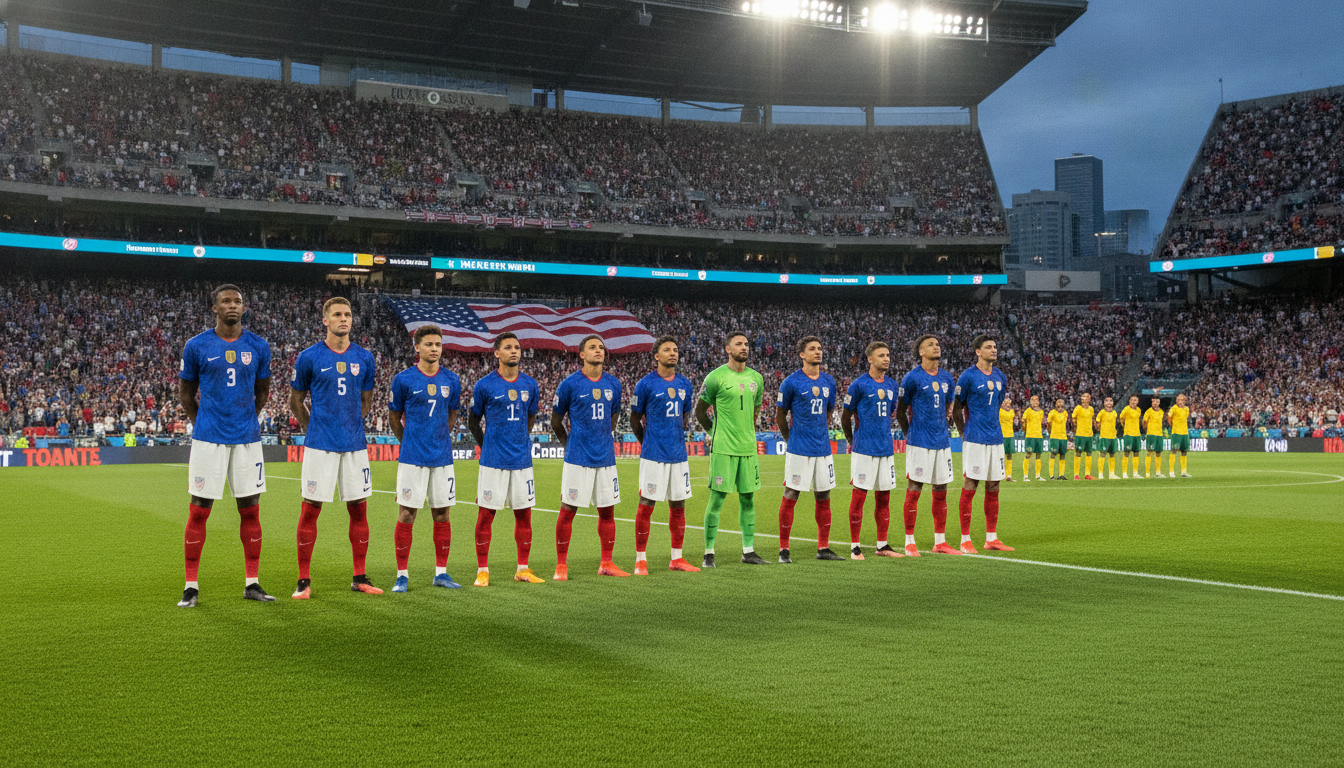
United States vs Australia: Lineups, injuries and tactical battle as co-hosts clash in Seattle
United States vs Australia preview: lineups, injuries and tactical battle as co-hosts meet in Seattle with a Round of 32 spot at stake on June 19, 2026.


Hosts meet with Round of 32 place on the line
The United States vs Australia match in Seattle on June 19, 2026, pits the World Cup co-hosts against one another with a place in the Round of 32 at stake. Both nations arrive off eye-catching opening wins: the United States dismantled Paraguay, while Australia produced a notable victory over Turkey. The fixture carries more than local pride; progression from the group hinges on a result at Lumen Field.
Momentum and early tournament form will shape expectations for managers Mauricio Pochettino and Tony Popovic going into the fixture. Pochettino’s side offered one of the tournament’s most commanding attacking displays in their 4-1 win. Popovic’s Australians responded with a compact, effective 2-0 performance that exposed defensive issues in their opponents.
Squad news and surprise benchings
Team news ahead of kickoff revealed several selection surprises that will shape the tactical battle in Seattle. Australia’s Tony Popovic elected to bench two players who featured prominently in the first match: Nestory Irankunda, widely praised for his performance against Turkey, and Connor Metcalfe, who scored the decisive goal. Both remain in the matchday squad but start from the bench, a choice that signals tactical flexibility from Popovic.
On the United States side, Mauricio Pochettino has made similarly eyebrow-raising calls, with Gio Reyna — scorer of a spectacular trivela in the opener — named among the substitutes. Christian Pulisic, who suffered a calf injury in the first half against Paraguay, is absent from the squad, ruling him out of any immediate contribution. These selection decisions highlight the managers’ differing approaches to rotation and risk management at this stage.
Confirmed starting lineups and formations
The United States will begin with a back-four that blends domestic and Europe-experienced defenders, while Pochettino opts for a midfield anchored by Malik Tillman. The starting XI reads: Freese in goal; Freeman, Chris Richards, Tim Ream (captain) and Sergino Dest across the back; Tyler Adams, Tillman, and Robinson in midfield; Weston McKennie, Daryl Dike or Balogun, and Ricardo Pepi leading the attack. This group combines pressing intensity with direct options up front.
Australia’s lineup features goalkeeper Beach and a back five built for aerial robustness and transition speed, with Souttar captaining the side. The starting forwards include Mathew Leckie getting a start and Mohamed Toure leading the line, supported by wide attackers Okon-Engstler and Velupillay. Popovic’s chosen shape suggests he will invite pressure to exploit counterattacking opportunities where pace and physicality can be decisive.
Tactical battle and coaches’ game plans
Pochettino is expected to set his team to control possession through the middle while probing with wide runners, aiming to draw Australia out and create space for late midfield arrivals. The Americans’ midfield balance will be critical; Tillman’s ability to link play and Adams’ transitional work could determine whether possession becomes sustained or merely circulates without penetration. Upfront, Pepi and Balogun offer contrasting strengths — movement in behind and hold-up play — which Pochettino can exploit against a backline that will occasionally step high.
Popovic’s plan appears designed to frustrate and then strike quickly on the break, using Leckie’s experience and the dribbling threat of Velupillay to stretch the American full-backs. Australia’s defensive unit is structured to win second balls and limit through-runs, with central defenders instructed to stay compact and force longer passes. Set-pieces also play into Australia’s hands; their physical center-backs present a clear scoring option from dead-ball situations.
Key individual matchups to watch
The duel between the United States full-backs and Australia’s wide attackers could define the game. Sergino Dest will likely face Velupillay, and how he balances forward runs with defensive responsibilities will be crucial. Both players possess the speed to transition quickly, and their one-on-one battles could produce decisive moments, especially if either side turns possession into rapid overloads.
In midfield, the contest between Malik Tillman and Australia’s engine players will set the tempo. Tillman’s composure on the ball and passing range must counteract Australia’s tendency to compress central spaces. Up top, Ricardo Pepi’s movement versus Australia’s central defenders promises to be an early focal point; if Pepi stretches the defense, it will open channels for overlapping full-backs and late-arriving midfielders.
Refereeing team and VAR assignment
A German refereeing team will oversee the match, with Felix Zwayer taking charge as the on-field referee on his World Cup debut in the competition. Zwayer will be supported by a compatriot crew, and Bastian Dankert is assigned to the VAR role. The appointment of an all-German officiating team brings experience from one of Europe’s top leagues and adds a familiar procedural style for players used to UEFA refereeing standards.
Refereeing decisions and VAR interventions could be influential given the physical nature of a match between co-hosts. Both teams have shown a willingness to press hard and commit to challenges in recent games, increasing the likelihood of stoppages and reviewable incidents. Managers will watch the whistle closely and may adjust tactical aggression based on the officials’ early leniency or strictness.
What a result means for both teams
A win for either side in Seattle would swing group dynamics significantly and leave the victor in pole position for qualification to the Round of 32. For the United States, victory would consolidate a dominant start and reduce pressure ahead of the final group fixture. For Australia, a positive result would underline the team’s resilience and tactical clarity, presenting a pathway to progress while maintaining home-nation momentum.
A draw would keep the group open and likely shift qualification scenarios to goal difference and the final round of games. Conversely, a loss would place the defeated co-host in a precarious situation, forcing the manager to chase results rather than control them. Beyond progression, the fixture carries psychological weight: the winning nation claims bragging rights among hosts and gains a boost in confidence for the knockout stages.
The match also offers a platform for individual players to enhance their international credentials. Younger squad members and those returning from bench roles can stake a claim for more regular minutes, while established veterans can reinforce leadership within the group. Selection reactions after the final whistle will be telling for squad dynamics as the tournament progresses.
Both managers will have to weigh the immediate competitive advantages of today’s result against the longer-term management of player fitness. With Christian Pulisic sidelined by a calf complaint, the United States must monitor recovery timelines and rotation needs. Australia’s decision to omit recent starters from the XI suggests Popovic values tactical unpredictability and plans to use his bench as a weapon across the remaining group fixtures.
The environment at Lumen Field promises an intense atmosphere as local support for both teams is strong in Seattle. Ticket allocations and fan interest translate into significant crowd noise, which can affect communication and tactical execution for both sides. How well teams manage set-piece defending and repeated phases of play in a charged stadium could be the difference in a close contest.
Concluding observations and immediate context
The United States vs Australia encounter in Seattle is more than a co-host clash; it is a consequential group game with a direct path to the Round of 32. Managers have made bold selection decisions that underscore differing tournament philosophies and hint at tactical surprises. With an experienced German refereeing team overseeing proceedings, the match is likely to be tightly contested and strategically nuanced.
Both teams possess the personnel to win in different ways: the United States with possession control and varied attacking angles, Australia through counterattacks and set-piece power. The result will reverberate across the group and set the tone for each nation’s remaining World Cup fixtures on June 19, 2026, at Lumen Field in Seattle.