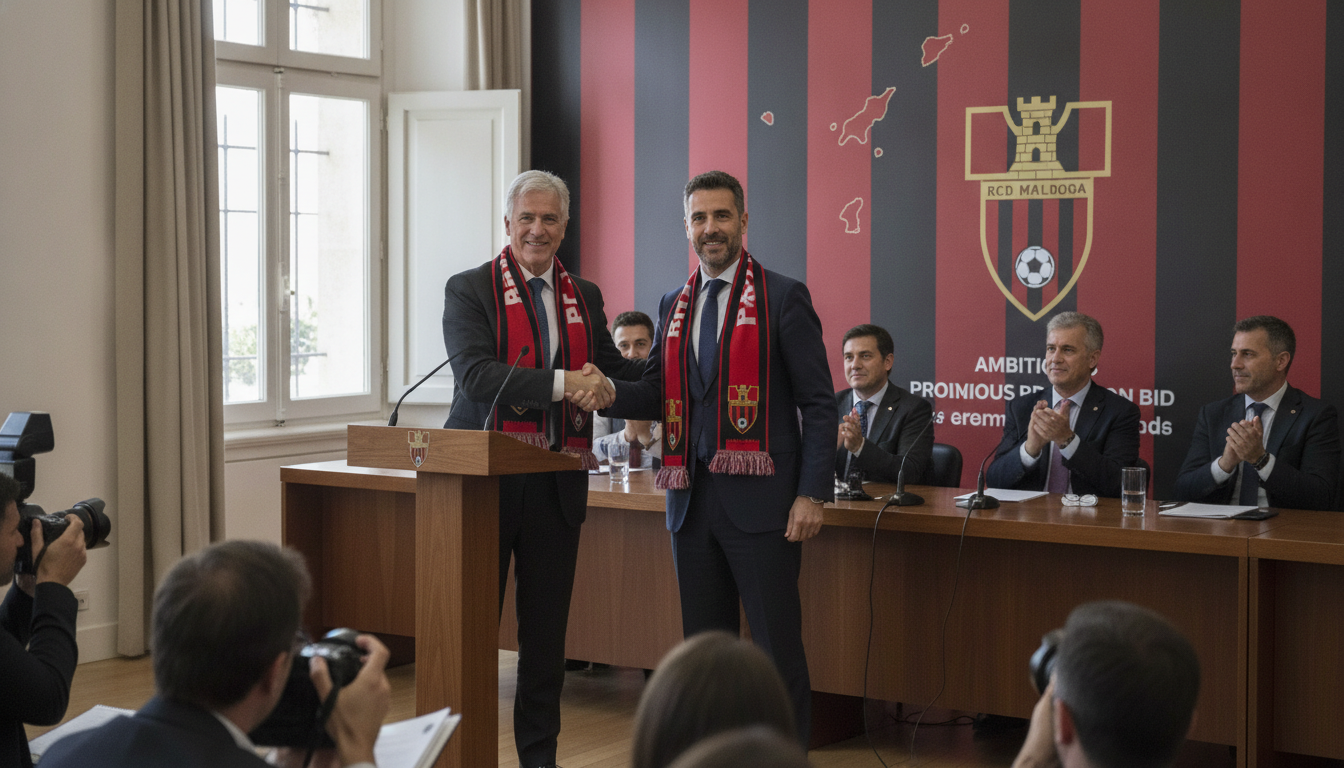
Luis García Returns to RCD Mallorca as Head Coach, Calling Project "Beautiful and Exciting" and Targeting Promotion
Luis García returns to RCD Mallorca as head coach, calling the project ‘beautiful and exciting’ and outlining tactical and mental plans for a Segunda promotion.


Luis García has been unveiled as the new head coach of RCD Mallorca and described his return as a move to "a place I consider my home." The coach told club media he was attracted by what he called a "very beautiful and exciting" project and stressed the responsibility that comes with steering a club of Mallorca’s recent profile. García made clear his immediate objective is to prepare a squad capable of competing for promotion from the Segunda División while building a team identity that reflects continuity with the club’s values.
García describes the Mallorca project as very beautiful and exciting
Luis García said the emotional pull of returning to Mallorca was a decisive factor in accepting the job, highlighting a strong personal connection to the club and its supporters. He emphasized that the ownership has invested significantly, creating a platform that justifies ambition and careful planning. García framed his appointment as both a homecoming and an opportunity to build on a recent era of top-flight stability.
He underlined that his previous season with the club left him with fond memories and a clear sense of what the project requires. The coach used the words "illusión" and "responsibility" to convey both excitement and seriousness about the task ahead. That balance between optimism and realism set the tone for his initial public comments and for how he plans to approach the coming months.
Promotion objective and squad construction for Segunda División
García made the club’s primary aim explicit: to construct a squad tailored to the demands of the Segunda División with the ultimate objective of returning to the Primera. He spoke of a step-by-step approach, acknowledging that the second tier presents a unique set of challenges that require careful recruitment and squad management. Building a roster that can cope with the physicality, fixture congestion, and tactical variety of Segunda is central to his plan.
The coach stressed the need to assemble a competitive group rather than relying on isolated signings, pointing to depth and balance as non-negotiable priorities. He noted that while the financial backing of the ownership provides resources, success will depend on shrewd choices and clear roles for players. García also indicated that continuity—retaining players who understand the club’s culture—would be as important as bringing in new faces.
García acknowledged the difficulty of predicting the transfer market but insisted the technical staff will prioritize players who fit the team’s desired profile. The emphasis will be on versatility, temperament, and the capacity to perform both in possession and under defensive pressure. That recruitment philosophy, he said, will support a cohesive season-long campaign rather than short-term fixes.
Tactical identity centered on possession, verticality and defensive aggression
On the pitch, García outlined a tactical blueprint that emphasizes control of the ball combined with decisive vertical play when opportunities arise. He stated a preference for a team that wants the ball and is comfortable constructing phases of play, but that also knows how to transition quickly and attack vertically. That duality—possession with the capacity for rapid forward movement—will be a recurring theme in training and recruitment.
Defensive aggression featured prominently in his description of the desired playing style, with García indicating a preference for a side that presses and remains compact away from the ball. He said the team should be "aggressive, the further from the ball the better," suggesting an emphasis on coordinated pressing triggers and proactive defending. The coach insisted that the team must be organised to concede little space for opponents to exploit during transitions.
García also highlighted the importance of tactical flexibility, noting that the Segunda División comprises diverse styles that require adaptability. He expects his team to be able to switch between control-oriented and counter-attacking approaches depending on the opposition and match context. The coach plans to prioritize training that builds both technical fluency and collective defensive understanding.
Mental balance identified as a decisive factor for promotion
A central theme in García’s comments was the psychological dimension of competing in the Segunda División, which he described as a competition dominated by streaks and momentum. He warned that a run of wins can be followed by a run where results do not come, and that the ability to remain steady during downturns is critical. Maintaining "equilibrium"—both individually and collectively—emerged as a strategic priority for the coaching staff.
To cultivate that mental resilience, García stressed the value of unity between the squad and the fanbase, arguing that strong internal cohesion will mitigate the pressure of fluctuating results. He proposed measures to ensure players understand the challenge ahead and to build a mentality that treats every opponent with respect. The coach believes that clear communication, consistent routines, and measured responses to setbacks will form the backbone of a promotion campaign.
García added that Segunda’s unpredictability means that every match must be approached with concentration and humility, regardless of the opponent’s budget or reputation. He urged players and supporters alike to accept the league’s volatility while focusing on controllable factors—preparation, effort, and tactical discipline. That pragmatic approach is intended to reduce panic during rough stretches and keep the team aligned on long-term goals.
Ownership investment and stability after five Primera seasons
The coach praised the club’s owners for the financial commitment made in recent seasons, noting that such investment has helped Mallorca sustain itself at the highest level for multiple campaigns. García cited five consecutive seasons in the Primera as evidence of a structure that can support long-term sporting projects. He framed the present moment as one where careful stewardship must match the club’s recent achievements.
While acknowledging the advantages of solid backing, García tempered expectations by reiterating that investment alone does not guarantee sporting success. He stressed that the challenge now is to translate resources into coherent squad construction and consistent performances over a demanding season. The coach underlined the need for responsibility and ambition to go hand in hand.
The thread of continuity—both in leadership and club identity—came through in his remarks, with García emphasizing that success will rely on aligning the technical approach with the club’s broader strategic outlook. He suggested that a shared vision across management, coaching staff, and players will be essential to navigate the transition back to Segunda and to mount a credible promotion challenge.
Fan engagement and expectations for the season ahead
García addressed the supporters directly, asking for their patience and involvement as the team adapts to a different competitive landscape. He invoked the image of Mallorca as a collective enterprise where unity between the club and its fanbase can become a competitive advantage. The coach made clear that building a strong relationship with supporters will be an ongoing priority aimed at reinforcing home advantage and resilience.
He also recognized that expectations will be high, given the club’s recent history and the owners’ investment, but urged supporters to measure progress over the course of the campaign rather than demand instant results. García signalled an intention to foster a shared sense of purpose and to keep communication channels open as the team develops. That approach is designed to align public expectations with the realities of a difficult league.
García’s message to fans was one of optimism tempered by realism: Mallorca should be ambitious and visible in matches, but also coherent and united in setbacks. He believes that a strong bond with supporters will help the team through the inevitable trials of a long season and create the kind of atmosphere that boosts performance.
Luis García’s return to RCD Mallorca combines a personal connection with a clear professional mandate: to construct a team capable of earning promotion while establishing a playing identity rooted in control, verticality and defensive aggression. The coach’s emphasis on mental balance and measured squad building reflects an awareness of Segunda’s challenges and of the responsibility that comes with recent investment. As preseason approaches, Mallorca’s task will be to translate García’s words into recruitment, training routines and early-season form that can sustain a promotion push.