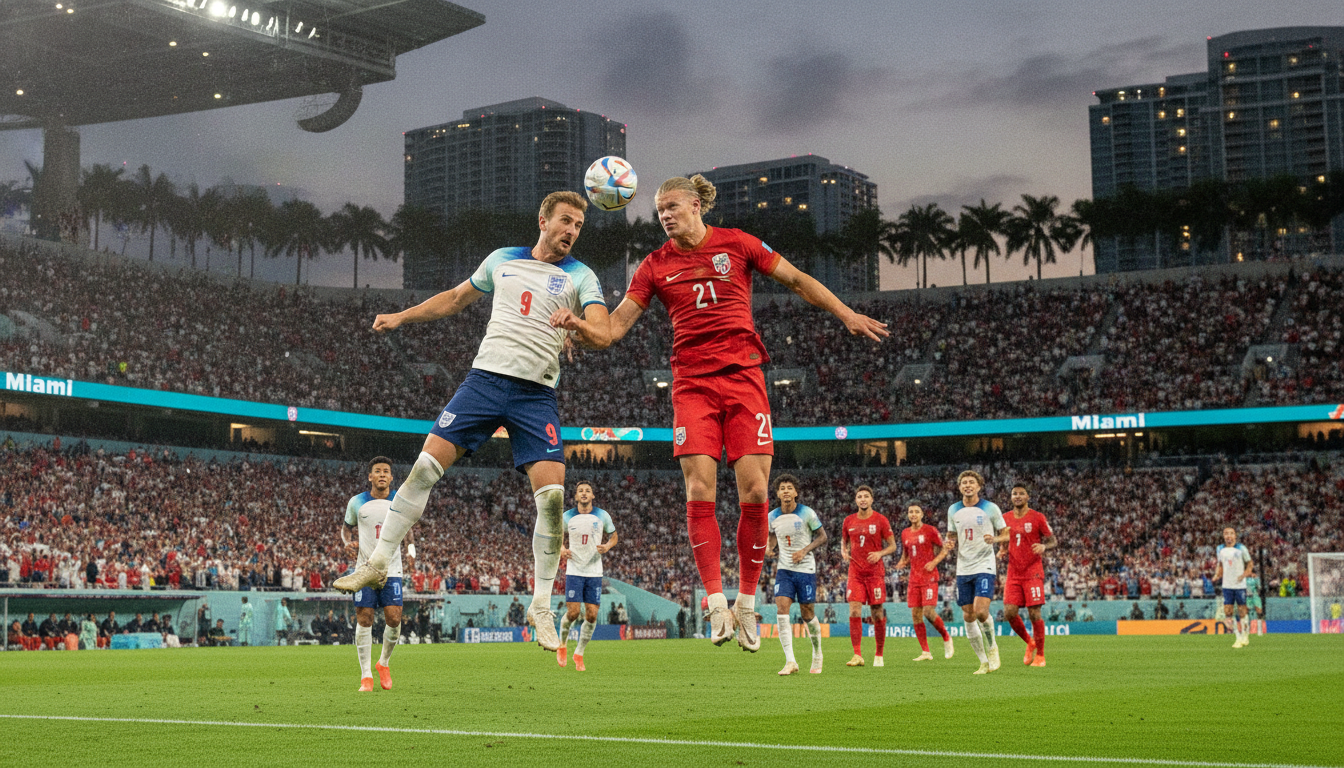
England vs Norway: World Cup quarter-final in Miami pitches Kane against Haaland for a semi-final spot
England vs Norway quarter-final at Miami Stadium sees Tuchel’s England face Solbakken’s Norway with Kane and Haaland central to the Golden Boot race.


England and Norway met in Miami on Saturday with a place in the World Cup semi-finals at stake in a fixture that pitted Harry Kane’s England against Erling Haaland’s Norway. The tie, billed as a heavyweight clash of finishing talent and tactical discipline, produced end-to-end moments and a tense opening 45 minutes that left the contest finely poised. (apnews.com)
Match setting and stakes
The quarter-final was staged at Miami Stadium with both teams playing for a semi-final berth in a tournament that has already produced unexpected results. Fans and pundits had framed the match as a showdown between two of the tournament’s most potent striking threats, with global attention on how each side would set up to contain the opposition’s forwards. The winner would advance to face the survivor from the Argentina–Switzerland/other quarter-final in the last four.
Beyond progression, the fixture had broader implications for individual honours and national narratives, with select players able to significantly boost their reputations on the biggest stage. Managers on both benches were tracking fitness and discipline issues that would shape their choices for the remainder of the competition.
Confirmed lineups and tactical choices
England started with Jordan Pickford in goal behind a back four of Nico O’Reilly, John Stones, Marc Guéhi and Ezri Konsa. The midfield featured Elliot Anderson and Declan Rice, while Anthony Gordon, Jude Bellingham and Noni Madueke supplied support for captain Harry Kane in a line-up that emphasized balance between control and quick transitions. Norway fielded Ørjan Nyland in goal with David Møller Wolfe, Torbjørn Heggem, Kristoffer Ajer and Julian Ryerson across the back, and a midfield of Patrick Berg, Sander Berge and Martin Ødegaard supporting Andreas Schjelderup, Erling Haaland and Alexander Sørloth. (eurosport.no)
Tactically, England sought to leverage Bellingham’s ability to advance between the lines while Kane occupied central defenders and created space for runners. Norway appeared set up to play through Haaland’s power and movement, with Sørloth and Schjelderup expected to press England’s centre-backs and exploit any gaps on the flanks. Substitutions and match management would likely determine which team found the decisive edge in the closing stages.
Quansah suspension leaves England light at the back
England’s defensive options were reduced after Jarell Quansah received a two-match suspension for the studs-up challenge that earned him a red card in the round-of-16 win over Mexico. The ban forced manager Thomas Tuchel to reshuffle his defensive resources and lean on the available centre-backs for the tournament’s decisive matches. (aljazeera.com)
Quansah’s absence removed a young, ball-playing option from the rotation and placed added emphasis on the fitness and composure of Stones and Guéhi against Norway’s physical front line. The disciplinary ruling also generated debate about the consistency of sanctions in the competition and how governing decisions influence squad planning in the knockout phase.
Haaland and Kane headline the Golden Boot chase
The quarter-final carried subplots beyond national rivalry, with Erling Haaland and Harry Kane prominent in a competitive Golden Boot race that also features Kylian Mbappé and Lionel Messi. The four forwards have been among the tournament’s most prolific scorers, and their performances in the knockout rounds were set to have a direct impact on the award for top scorer. (fifa.com)
Haaland’s blend of power and positioning and Kane’s clinical finishing have made both men consistent threats, but the supporting casts and tactical frameworks around them will be crucial. Goalscoring form in tight knockout ties often hinges on small margins — set-piece delivery, late substitutions and decisive defensive errors — factors that can tip the balance in the race for personal honours.
Coaching backgrounds and Bundesliga connections
Both sides were led by coaches with strong links to German football: England’s Thomas Tuchel, who arrived with a reputation forged in the Bundesliga and at elite European clubs, and Norway’s Ståle Solbakken, who has experience of managing in Germany and across Scandinavia. Tuchel’s appointment as England coach earlier in the cycle signalled a tactical shift and a high-profile gamble by the national FA as they sought to mount a serious World Cup challenge. (fifa.com)
Solbakken’s tenure has been defined by steady progress and a pragmatic approach to squad building, which helped Norway advance through the group stages and knock out stronger opponents en route to this tie. Both managers brought contrasting temperaments to the touchline — Tuchel’s meticulous game plans against Solbakken’s emphasis on collective structure — creating an intriguing managerial duel.
First-half action and key incidents
Norway struck first when Andreas Schjelderup scored before the break, carving a pathway through England’s midfield and taking advantage of a momentary lapse at the back. England answered in stoppage time of the first half as Jude Bellingham found the net to level the tie and shift momentum heading into the interval. The exchanges were physical and refereeing decisions, including a disallowed goal earlier in the match, punctuated the opening 45 minutes. (apnews.com)
Set-pieces and the ability to manage transitions emerged as defining elements of the contest, with both teams creating chances from second balls and aggressive pressing. The managers’ halftime adjustments would therefore be monitored closely, with substitutions likely to be used to introduce fresh legs or tweak formations.
Squad depth, substitutions and the closing outlook
England’s bench included experienced cover across defence and attack, with options such as Bukayo Saka, Marcus Rashford and Reece James available to alter the dynamics late in the game. Norway’s substitutes offered a mix of pace and aerial presence intended to unsettle a compact English defence, and tactical changes from Solbakken could emphasise direct routes to Haaland. Match-day management, including how each coach reacted to momentum swings, promised to be decisive. (eurosport.no)
As the fixture progressed into the second half, both teams faced the classic knockout dilemma: push for a winning goal at the risk of exposing defensive frailties, or consolidate and hope to settle the contest through extra time or penalties. Either route required careful balance between attacking ambition and structural discipline.
England’s and Norway’s fans, broadcasters and analysts will parse minute details from the tie — from movement off the ball to how injuries are managed — because the result shapes the tournament narrative beyond a single fixture. Moments such as a late substitution, a referee call or a lapse in concentration can become the defining memory of a team’s World Cup. (fifa.com)
The decisive phases of this quarter-final promised to test both teams’ adaptability and resilience, with a semi-final spot hanging in the balance and individual legacies potentially decided by a single intervention.