Kalshi’s World Cup Trading Soars to $27 Billion During 2026 Tournament
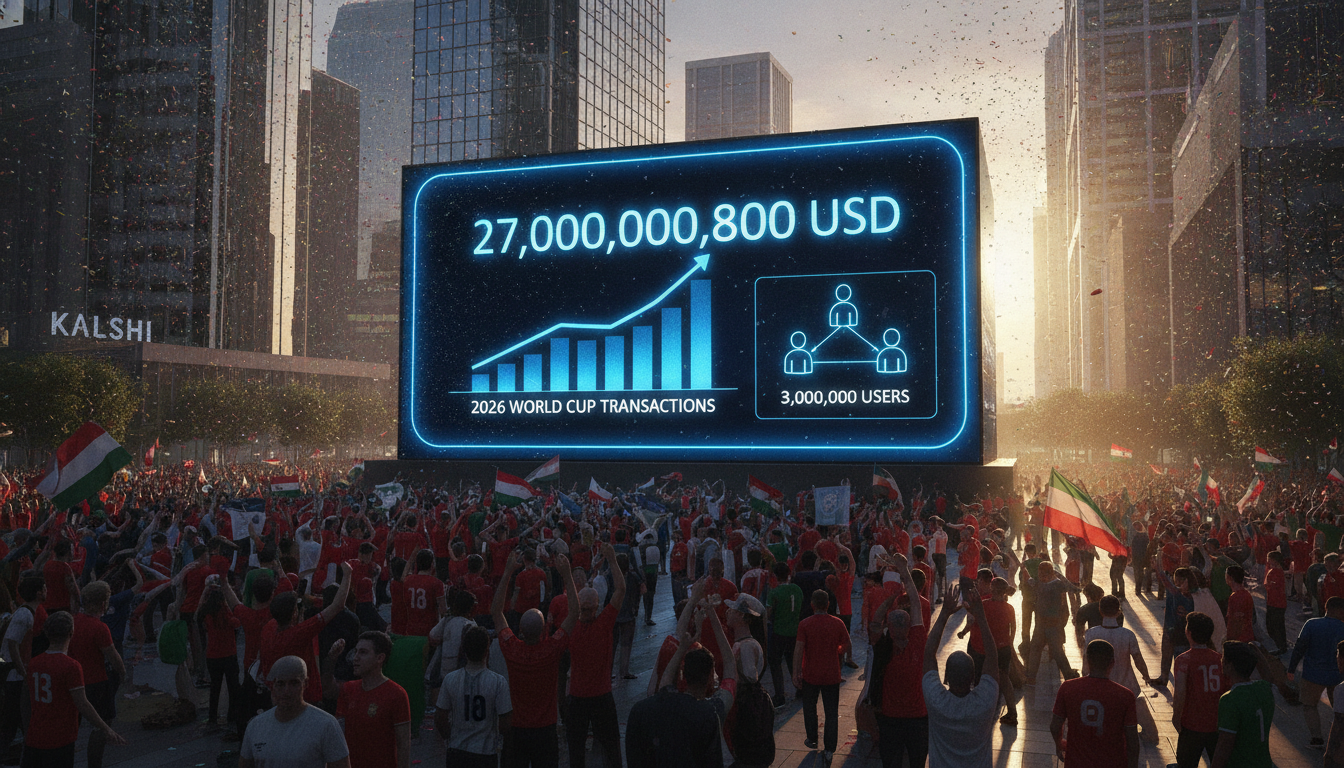
Kalshi’s World Cup trading reached $27 billion with roughly three million users during the 2026 tournament, doubling forecasts and raising regulatory questions.


Kalshi World Cup trading exploded during the 2026 FIFA World Cup, generating roughly $27 billion in volume and attracting about three million users, according to a person familiar with the company’s metrics. The surge far surpassed the start-up’s internal projections of $13 billion in volume and 1.5 million participants, making the tournament a watershed moment for prediction markets. The event, which opened at Mexico’s Estadio Azteca and concluded in New Jersey with Spain defeating Argentina, underscored how live sport can drive mainstream adoption of event-based contracts.
Volume and User Growth
Kalshi recorded about $27 billion in trading volume across the tournament, roughly double its forecast for the event. The platform said it saw approximately three million unique users take positions on match outcomes and related markets during the month-long competition. The numbers represent a sharp acceleration from previous major sporting events and put Kalshi among the most active venues in the prediction market sector during the World Cup.
Trading activity picked up in waves aligned with marquee matches, with spikes recorded around knockout-stage games and the final two fixtures. Users gravitated toward binary event contracts that paid out based on match winners, goal totals and tournament milestones. That pattern of concentrated interest around high-profile fixtures mirrors behavior observed in other wagering markets but on a much larger scale for a prediction-market start-up.
How Fans Turned Insight into Bets
The World Cup presented a natural occasion for fans to convert knowledge and intuition into tradable positions, particularly as social and mainstream media amplified statistical analysis and match narratives. Kalshi’s offerings allowed users to take positions on a range of precise outcomes, enabling both short-term trades tied to single matches and longer-term contracts linked to tournament winners. That mix appealed to casual viewers seeking a stake in outcomes and more sophisticated participants employing strategy and hedging techniques.
Platforms such as Kalshi and competitors like Polymarket bridged casual interest and speculative trading by packaging event outcomes as clear, binary contracts. For many users the activity was part entertainment and part market play, with participants treating predictions as a way to test judgment against crowd signals. The blend of community-driven discussion, real-time odds discovery and the tournament’s global reach accelerated engagement beyond what the firm had planned for.
Commercial and Competitive Implications
The magnitude of volume during the World Cup elevates Kalshi from a niche exchange into a more visible player within a growing genre of event-based contracts. The startup’s performance provides a proof point for the commercial viability of prediction markets when aligned with mass sporting events. Institutional attention and liquidity providers are likely to view the result as evidence that venue-based event contracts can scale to handle major global spectacles.
That said, high-volume events also invite scrutiny from competitors and market observers who will assess execution, fee structures and the quality of markets offered. Increased attention may attract new market entrants, partnerships with sports media outlets and opportunities to build bespoke products for high-profile tournaments. The consequences for market structure and customer acquisition strategies will unfold as firms and investors digest the World Cup results.
Regulatory Scrutiny and Legal Hurdles
Kalshi’s success comes amid ongoing regulatory tensions around state gambling laws and how prediction markets are classified and governed. The exchange has faced challenges in several U.S. jurisdictions where regulators assess whether event contracts constitute unlawful wagering or fall within existing commodities or securities frameworks. The World Cup numbers will likely intensify regulatory conversations as states evaluate consumer protection, advertising standards and state-by-state licensing requirements.
Regulatory scrutiny could lead to tighter controls on product types, disclosure obligations and limits on certain market categories, particularly those perceived to resemble traditional sports betting. Kalshi and similar platforms must navigate a patchwork of rules while defending their operating model to policymakers. How regulators respond will shape where and how prediction markets can operate at scale in the United States.
Expansion Into Healthcare and New Contracts
Earlier this month Kalshi announced plans to begin listing contracts tied to clinical trial outcomes and U.S. Food and Drug Administration reviews, marking a significant broadening of its product set. The move aims to make drug-development odds public, enabling market participants to trade on the binary outcomes of regulatory milestones and trial endpoints. That expansion into healthcare is designed to capture interest from new specialty audiences and to diversify the firm’s revenue sources beyond sports-related markets.
The healthcare angle is likely to draw its own round of debate over appropriateness and oversight, with advocates highlighting improved transparency in drug development and critics cautioning about ethical and market-manipulation risks. Kalshi’s handling of sensitive categories, adherence to scientific confidentiality norms and coordination with regulators will determine whether the firm can scale those markets responsibly. The company’s experience during the World Cup gives it operating data, but the nuances of medical and regulatory markets present novel challenges.
Market Integrity and Consumer Protection Measures
Surging trading volumes place a premium on market integrity, surveillance and robust safeguards against manipulation and technological disruption. Kalshi must ensure order matching, price discovery and settlement processes function under peak loads while maintaining fair access for retail and professional participants. The exchange’s systems, transparency policies and dispute-resolution procedures will be central to maintaining trust as attention and capital flow onto the platform.
Consumer protections will also be critical, including clear disclosures about risks, limits on leverage and tools for users to monitor exposure. Regulators and consumer advocates have shown heightened interest in how new financialized products are marketed and whether vulnerable users receive adequate protections. Effective controls and public reporting on safeguards could reduce friction with authorities and help normalize prediction markets’ role in the broader ecosystem.
Signals for the Industry and Next Steps
Kalshi’s World Cup performance sends a clear signal that prediction markets can attract mainstream volumes when tied to major global events. The demonstrable demand may accelerate product innovation, distribution partnerships and interest from institutional liquidity providers. At the same time, the episode highlights that scaling such markets will require careful legal, compliance and technology planning.
Looking ahead, Kalshi will likely analyze trading data to refine market structures, expand international accessibility where permitted and engage more proactively with regulators. The company’s next strategic moves—whether forming partnerships with sports broadcasters, launching new contract categories or pursuing regulatory approvals—will determine whether the World Cup spike becomes a sustained growth trajectory or a standout event.
The World Cup surge has repositioned Kalshi within a competitive field and placed event-based markets squarely on the regulatory and commercial radar. The company’s ability to balance rapid customer growth with responsible governance will shape not only its own prospects but the evolution of prediction markets as a mainstream financial and entertainment product.