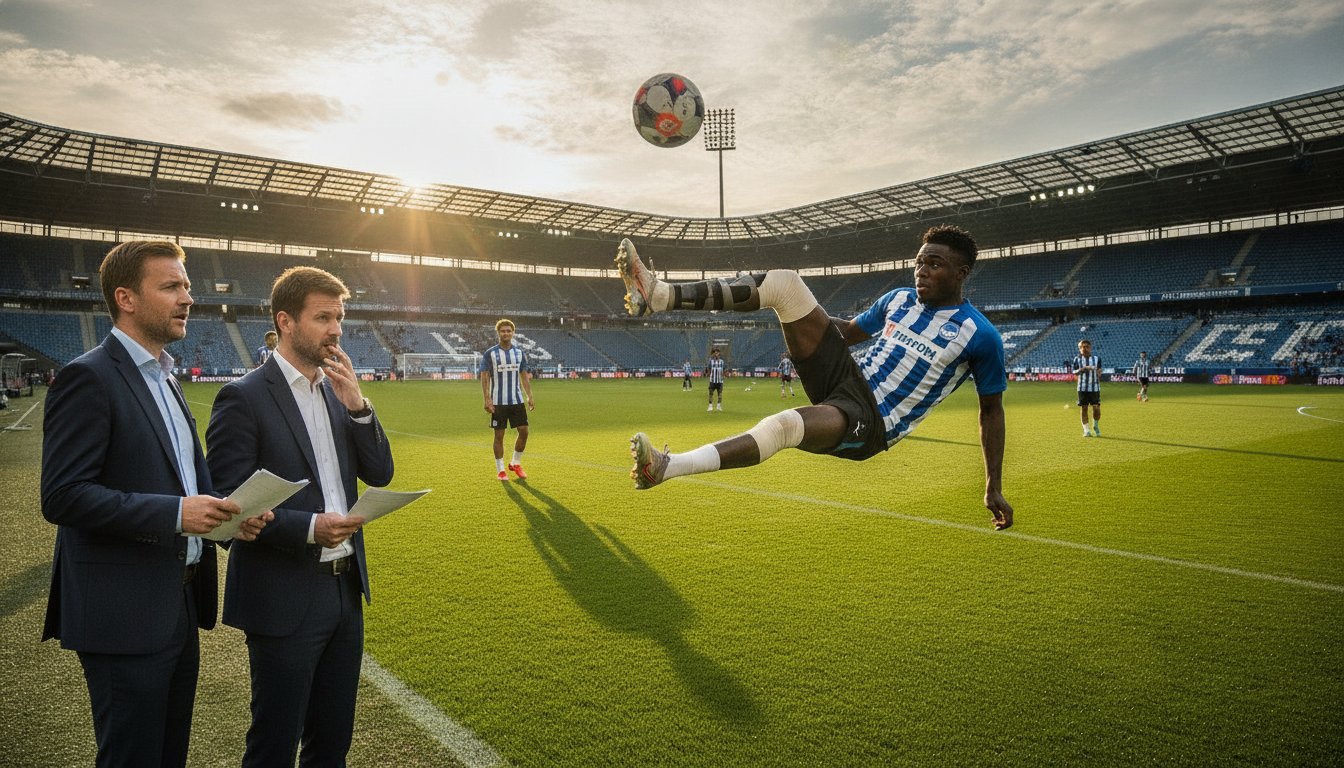
Hamburg open talks to sign Terem Moffi as club assesses medical and financial risks
Hamburg in talks to sign Terem Moffi from Nice amid ACL concerns; club weighing medical risk, contract to 2027 and how the striker would complement Patson Daka.


Terem Moffi has emerged as a transfer target for Hamburger SV as the club seeks to add a powerful centre-forward to its attack. Hamburg have reportedly opened negotiations over the 27-year-old Nigerian, whose contract with OGC Nice runs until 2027, and the potential move is being examined carefully because of recent injury history. The striker’s name has circulated after HSV bolstered their front line with Patson Daka, prompting the club to consider a follow-up addition that could offer different physical presence and goalscoring instincts.
Hamburg open talks for Terem Moffi
Hamburger SV have initiated discussions with Nice over the possibility of signing Terem Moffi, sources close to the negotiations say. The club’s recruitment drive this summer is focused on adding versatility and firepower to a forward unit that already features new signing Patson Daka. Talks at this stage are understood to involve both sporting terms and an assessment of financial structure, with HSV weighing a fee and potential payment terms that reflect Moffi’s recent availability.
Those involved in the dialogue are balancing ambition with prudence, given the player’s injury record. Hamburg’s technical staff have signaled that any agreement would include a thorough medical evaluation and conditional clauses to mitigate risk. Negotiations are ongoing and could hinge on medical findings, salary demands and whether Nice are prepared to accept a reduced transfer fee to move the player on.
Medical red flags after ACL layoff
Moffi’s most significant recent setback came during the 2024/25 campaign when an anterior cruciate ligament injury sidelined him for almost the entire season. The severity of the ACL tear and the length of rehabilitation mean that clubs assessing Moffi must scrutinize his recovery trajectory and workload since returning to action. Medical teams at interested clubs typically request detailed records, scans and a monitored fitness plan before finalizing a signing.
Since his return from injury, Moffi made a limited number of appearances for Nice before securing a winter loan to Porto, raising fresh questions about his consistency and match fitness. Hamburg’s medical department will likely evaluate not only his current physical condition but also his history of minutes, sprinting workload and susceptibility to recurrence. Any lingering concerns could result in performance-based clauses, reduced base salary or an initial loan with an obligation conditioned on appearances.
Recent performances at Nice and Porto
Before his suspension from regular play, Moffi had built a reputation in Ligue 1 with effective finishing and direct play, accumulating a notable goalscoring record across his time in France. Across spells at Lorient and Nice, he recorded 54 goals in 148 Ligue 1 matches, a return that highlighted his threat inside the box and ability to finish chances from both open play and transitions. That body of work remains a key factor in why clubs are interested despite recent injuries.
During his loan at Porto in the winter transfer window he contributed two goals and one assist in 15 appearances, a modest but useful contribution as he worked to regain form. Those outings offered evidence that he can still impact games at a competitive level when managed carefully. Scouts will be weighing a sample of performances since the ACL recovery alongside the longer-term scoring record to determine his expected contribution at HSV.
Contract situation and market valuation
Moffi’s current contract with Nice runs through 2027, which gives Nice leverage in any transfer negotiation and the ability to command a fee for a player still under contract. That contractual length complicates a clearance for a bargain move, and Hamburg will need to find common ground with Nice on valuation and payment structure. Any deal may include loan-to-buy language or staggered payments to reduce immediate financial exposure.
Market valuations have fluctuated since the injury; once estimated at roughly €25 million, Moffi’s market value underwent a sharp decline and was listed closer to €8 million in the May 2026 update from Transfermarkt. That revaluation reflects diminished recent playing time and the medical question mark, but also signals potential opportunity for buyers prepared to accept rehabilitation risk. Clubs often use such market movements to structure deals that limit downside while preserving upside if the player returns to form.
How Moffi would fit with Daka and HSV’s attack
Hamburg’s acquisition of Patson Daka earlier in the window addressed pace and movement in the final third, and Terem Moffi would bring complementary attributes as a more physical, central striker. Daka’s mobility and pressing from wide channels opens space in behind, while Moffi’s size and finishing could provide a direct aerial and hold-up threat in the box. Sport directors and coaching staff are assessing whether that combination would improve goal returns and offer tactical flexibility across competitions.
The coaching team will also consider minutes management to protect Moffi’s long-term fitness. A plan that rotates the two forwards based on opponent profiles could reduce strain and allow Moffi to be introduced gradually into a full-season workload. Tactical drills, tailored conditioning and a phased return to 90-minute matches would likely form part of any integration strategy if Hamburg proceeds with a signing.
Financial prudence and contingency planning
HSV’s recruitment department is understood to be weighing medical findings against transfer cost and potential resale value, with contingency options on the table should the deal not reach acceptable terms. Alternatives could include pursuing younger forwards with lower injury risk or targeting loan deals with purchase options to spread the fiscal burden. The club’s financial controllers will want clauses that protect against extended absences, such as wage reductions during long-term layoffs or bonuses tied to appearances and goals.
Insurance, amortisation schedules and potential sell-on clauses will shape the final proposal presented to Nice and to Moffi’s representatives. Hamburg must ensure that any investment aligns with budgetary limits and competitive objectives, especially given the investments already made in the squad this offseason. Sporting directors commonly prefer deals that balance immediate squad needs with medium-term financial sustainability, and this pursuit of Moffi appears to fit that cautious template.
Signals from player and selling club
While Nice retain contractual control, the player’s desire to secure regular minutes and re-establish himself in a competitive league may influence proceedings. Moffi’s reported willingness to consider a move to a club offering a starting role would make Hamburg an attractive option if medical conditions are met. Conversely, Nice may prefer a permanent sale only if the fee reflects both the player’s pedigree and the uncertainty of his recent fitness.
The winter loan to Porto, where he contributed in a supporting role, offered both the player and potential suitors a limited sample of his post-injury form. Clubs observing that spell will factor in the context of match minutes, role on the pitch and adaptation to different tactical demands. Those elements, combined with direct medical feedback, will determine how quickly negotiations progress toward a final agreement.
Hamburg will continue to evaluate Terem Moffi’s potential acquisition in the coming days, balancing sporting ambition with fiscal and medical caution.
The club’s decision will hinge on the outcome of detailed medical examinations and the structure of any financial offer, and it will mark a significant test of HSV’s recruitment strategy this window.