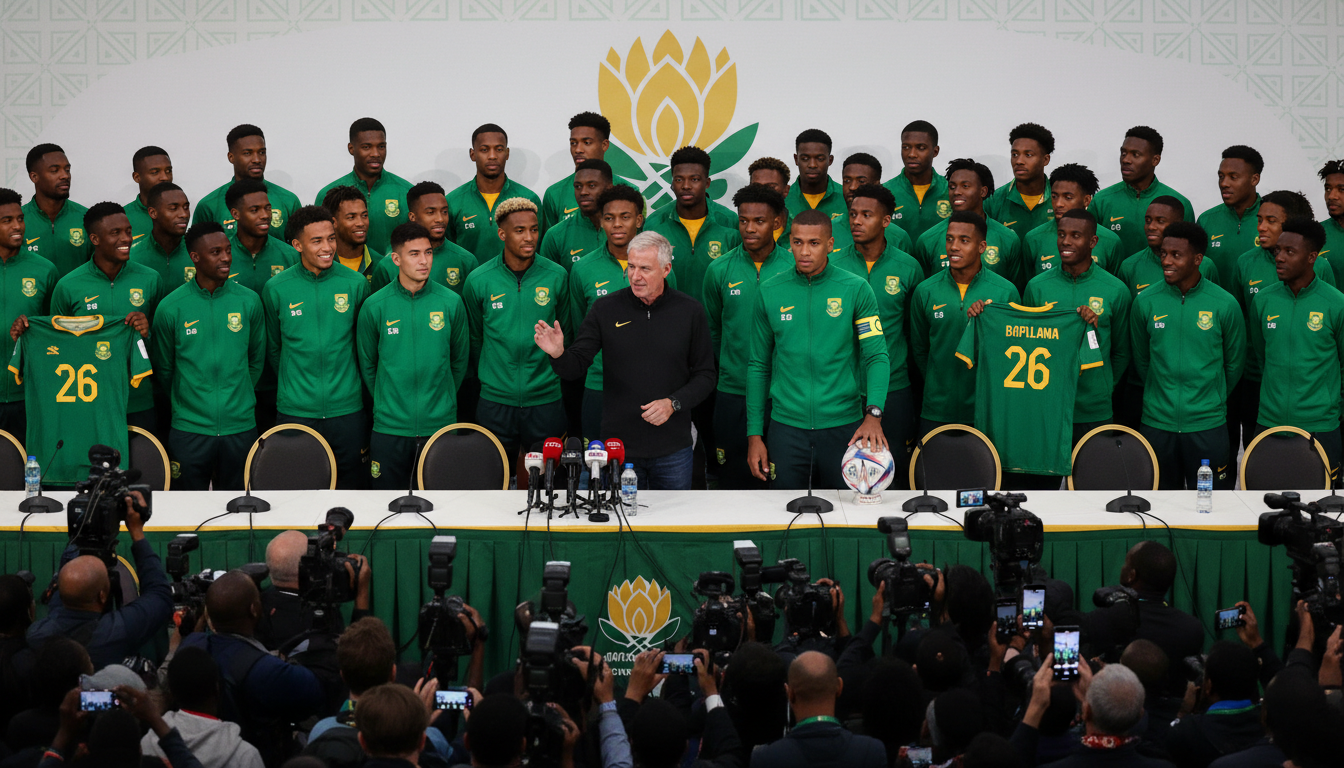
Hugo Broos names Bafana Bafana 2026 World Cup squad with Ronwen Williams retained as captain
Bafana Bafana 2026 World Cup squad announced by coach Hugo Broos, featuring a 26-player mix of seasoned internationals and emerging talent to contest the global finals.

Bafana Bafana will head into the 2026 World Cup with a 26-man squad selected by coach Hugo Broos, who balanced experience with youth in the final roster announcement. The squad selection, designed to provide tactical flexibility and depth, places the spotlight on an experienced core led by goalkeeper and skipper Ronwen Williams. South Africa’s preparations now shift to cohesion-building and targeted friendlies as the team seeks to translate domestic form into World Cup resilience.
Broos names 26-man World Cup squad
Broos made clear that his selections were informed by a long view of tournament football, prioritizing players who have proven themselves in big moments. The final 26 combines players who have threaded seasons of consistent club performance with younger figures who earned places through recent international impact. The list reflects Broos’s stated aim to create a team capable of adapting to varied opponents and match situations at the World Cup.
The coach’s choices show a preference for multifunctional players who can switch systems without losing balance on the field. Several positions include two or three realistic starters and capable backups, a structure that should withstand injuries and suspensions during the condensed tournament schedule. Selection debates that played out in public were settled by Broos with an eye to tournament management rather than single-match form.
Broos also kept an eye on leadership balance across the dressing room, pairing established internationals with emerging leaders who have worn the national shirt at youth levels. That approach aims to sustain on-field authority while encouraging younger players to grow under pressure. The next weeks will be crucial for integrating newcomers and finalizing tactical roles.
Blend of experience and youth across the roster
The squad contains a nucleus of veterans whose international minutes provide tactical steadiness in knockout settings. These players bring a calmness and situational judgment that are often decisive in tournament play. Their presence allows the coach to field experienced combinations in high-stakes matches.
At the same time, Broos rewarded promising talent that has forced its way into consideration through strong club campaigns and impactful substitute appearances for the national side. Those younger players offer dynamism, pace, and a willingness to press, qualities that can unbalance more static opponents. Depth in wide areas and midfield rotation were clear priorities in his selections.
Balancing minutes during pre-tournament friendlies will be essential to deliver both familiarity and match sharpness across the squad. The coaching staff will face the challenge of building on existing cohesion while giving new call-ups sufficient time to learn team patterns. How well the team achieves that balance will influence its ability to navigate the group stage and beyond.
Ronwen Williams to lead as captain and last line
Ronwen Williams, born 21 January 1992 and currently with Mamelodi Sundowns, retains the captain’s armband and the responsibility of organizing the defense from the back. Williams’s presence between the posts is as much about his shot-stopping as it is about his composure and communication under pressure. His leadership will be a central feature of South Africa’s set-piece defence and transition play.
Williams made his senior international debut in a baptism of fire against Brazil in March 2014, a match that tested him against world-class opposition early in his career. While that opening was difficult, it accelerated his development rather than derailed it, and he went on to establish himself as a dependable presence for both club and country. Over the years he has become one of the squad’s most trusted figures.
The goalkeeper’s international resume includes a standout penalty shootout performance at the 2023 Africa Cup of Nations, where he saved four spot-kicks to help his team advance. That episode is often cited as evidence of his mental resilience and his aptitude for decisive moments. Williams’s ability to combine experience with an appetite for big-game intervention will be crucial to South Africa’s World Cup ambitions.
Goalkeeping pedigree and Williams’ personal journey
Williams’s path to captaincy has been shaped by both professional milestones and personal adversity, a combination that informs his presence in the dressing room. He has shouldered responsibility at club level in domestic and continental contests and translated those lessons into senior international leadership. Team-mates and coaches have spoken of his calm demeanour and steadying influence during tense spells.
Personal tragedy touched Williams early in his life when he lost his brother at a formative age, an event he has described as a motivating force in his career. Off the field, that experience has been central to how he frames pressure and loss, often drawing on it to steady himself ahead of key moments. Those private reserves of motivation have played a role in his growth as a goalkeeper who reads the game and speaks decisively to his defence.
At Mamelodi Sundowns, Williams has been a constant through multiple campaigns and a figure around whom defensive plans are often structured. That club stability has allowed him to refine distribution, command of the box, and organization skills that translate to the international stage. The coaching staff will rely on him not only for saves but for the positional intelligence he brings to the back line.
Tactical shape and selection signals
Broos’s squad choices send clear tactical signals about the team’s intended flexibility and balance. With versatile full-backs and midfielders who can operate in compact or expansive shapes, South Africa can shift between possession-oriented and counter-attacking stances. The coach appears to favor a compact defensive block that can release quick transitions through wide channels.
Midfield depth allows for rotation between a double pivot to protect the back four and a single pivot that frees an attacking midfielder to drive into spaces. That tactical duality helps South Africa respond to stronger opponents who dominate possession and to weaker sides that invite pressure. Coaches preparing for the tournament will study how Broos deploys his midfield to judge whether he prefers control or calculated risk.
Forward options suggest a mixture of close-range finishers and wingers who can create by dribbling or crosses, enabling tactical tweaks without wholesale personnel changes. Set-piece planning and defensive organization will also be areas of emphasis, given how tournaments are often decided by marginal moments. The staff’s ability to instill a clear identity before the first match will be decisive.
Preparation timeline and competitive outlook
The immediate focus for the coaching team is assembling the squad for a training camp and a series of warm-up fixtures that will simulate tournament tempo. Those matches provide the only realistic rehearsal under match conditions, so minute management and experimentation will be carefully planned. Staff will calibrate intensity to avoid injuries while ensuring competitive sharpness.
South Africa’s objectives at the World Cup are pragmatic: navigate the group stage, secure maximum points from favorable fixtures, and be prepared to raise intensity in knockout scenarios. External expectations will include both hope for progression and recognition of the tournament’s elite-level demands. The coaching staff has framed success as delivering consistent performances rather than chasing headline results.
Off-field logistics — travel, recovery protocols, and acclimatisation plans — will receive heightened attention as the squad moves from domestic seasons into a high-stakes international environment. Medical staff and performance analysts will work with coaches to optimize fitness windows and tactical briefings. Cohesion on and off the pitch will be a major determinant of how far Bafana Bafana can go.
South Africa enters the tournament with a defined spine and room to surprise opponents who may underestimate the team’s tactical discipline and mental fortitude. The next weeks of training and friendly matches will show whether Broos’s blend of experience and youth can forge a side capable of consistent results on football’s biggest stage.
The squad announcement closes a chapter of selection debate and opens a new one of preparation, where leadership from veterans like Ronwen Williams and the energy of younger players must converge into a cohesive team ready for the pressures of World Cup football.