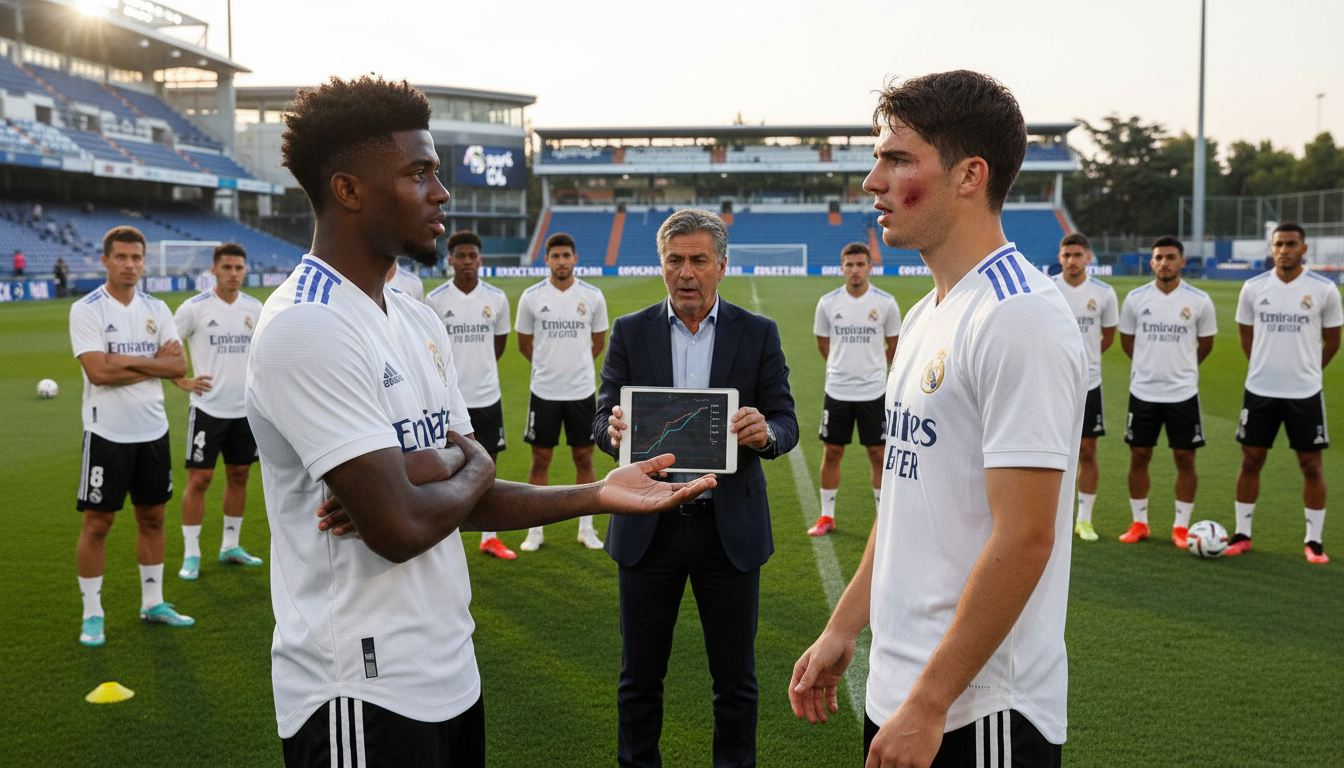
Tchouameni denies punching Valverde after Valdebebas altercation as Real Madrid fines both players €500k
Tchouameni denies punching Fede Valverde after Valdebebas clash; both fined €500,000. Real Madrid reprimands leak while players insist they will move on.

Aurelien Tchouameni has publicly denied punching Fede Valverde following the widely reported Valdebebas altercation, saying media accounts overstated the incident. The Tchouameni Valverde fight has dominated coverage after Valverde required hospital treatment for a head wound and the club imposed heavy fines on both players. Real Madrid’s disciplinary action and internal probe focused as much on the breach of confidentiality as on the conduct itself. Both midfielders say they remain focused on team objectives amid renewed scrutiny.
Tchouameni rejects allegation of a punch
Aurelien Tchouameni told reporters and Spanish outlets that he did not strike Fede Valverde and that descriptions of a violent confrontation were exaggerated. He acknowledged that an incident occurred at the club training ground but rejected claims that he delivered a punch, urging that many details reported in the press were inaccurate. Tchouameni emphasized that internal matters are handled by the club and that he preferred not to expand publicly on dressing-room disputes. He also stressed that he and Valverde share the same professional goal of winning trophies for Real Madrid.
The French international framed the episode as a matter already known to club officials and not representative of a deeper personal rift. He insisted there are “no problems” between him and Valverde and that normal relations have been restored within the squad. Tchouameni also noted that sporting commitments come first and that both players will be motivated to perform for their respective national teams. His comments were aimed at closing the story and shifting attention back to football.
Valverde’s hospital treatment and brief statement
Fede Valverde was seen leaving the training facility and subsequently received medical attention for a cut to his head that required stitches, according to club and media reports. The Uruguayan midfielder later addressed the matter upon joining Uruguay’s national squad, offering limited detail while describing the episode as a learning moment. Valverde did not elaborate on how the injury occurred but denied earlier social-media speculation that suggested more serious malicious intent. He portrayed the episode as something to move past as he prepared for international duty.
On arrival to the national camp, Valverde emphasized personal growth and maturity in response to questions about the incident. He framed the episode as an uncomfortable moment that will serve as experience rather than a source of lasting conflict. The Uruguay coaching staff and federation did not escalate the matter publicly, allowing the player to concentrate on preparations. Medical staff confirmed the stitches and fitness assessments required for his continued availability.
Club penalties and the €500,000 fines
Real Madrid announced substantial fines for both players, levying €500,000 penalties as part of disciplinary measures tied to the Valdebebas incident. The club described the sanctions as a response to indiscipline and a breach of internal rules, with financial penalties intended to underline the seriousness of the episode. Sources inside the organization indicated the punishment reflected not only the physical altercation but also the reputational damage caused by the story’s public dissemination. The fines stand as some of the more severe internal sanctions seen at the club in recent seasons.
The decision to issue identical penalties to both Tchouameni and Valverde signaled the club’s preference to treat the situation as a collective failure rather than single out a sole instigator. Real Madrid has historically imposed strict codes of conduct on senior players and has used fines to reinforce internal standards. The club’s disciplinary committee reviewed witness accounts and internal reports before finalizing the sanction. Both players accepted the club’s rulings and pledged to address matters internally.
Real Madrid leadership condemns the leak
Club officials publicly expressed greater frustration with the fact that details of the incident reached the media than with the players’ conduct itself. Then-manager Alvaro Arbeloa said the most damaging aspect was that someone inside the club leaked the story, a point repeated by other executives. President Florentino Perez took a similarly stern line, indicating that whoever released the information would face termination and stressing that periodic disputes among players are not unprecedented. Leadership framed the leak as an attack on the club’s integrity and vowed to tighten internal controls.
Perez and the board portrayed the episode as symptomatic of wider confidentiality problems rather than an isolated player dispute. Their public comments sought to deter future breaches and to reassure supporters that the club would handle internal matters decisively. The leadership also emphasized continuity, noting Real Madrid’s long history of internal friction that has been resolved without long-term consequences. That message aimed to calm supporters and stabilize the dressing room ahead of the next competitive phase.
Locker-room dynamics and squad management
Incidents of confrontation have periodically surfaced at elite clubs and are often resolved behind closed doors; Real Madrid’s hierarchy reiterated that approach in this case. Team management moved quickly to contain the situation, conducting internal interviews and documenting accounts to avoid recurring media speculation. Coaching staff focused on restoring normal training routines and reinforcing collective responsibilities to prevent distraction ahead of key fixtures. The pace of normal activity at Valdebebas suggested the club prioritized on-field performance over prolonged public debate.
Senior players and staff were reportedly involved in mediating between the two midfielders and reasserting professional expectations. The squad’s experienced leaders played a role in calming tensions and reconciling differences so that working relationships could resume. Practical steps included revisiting codes of conduct, clarifying channels for grievances, and reminding personnel of confidentiality obligations. Those measures were intended to ensure that internal disagreement did not erode team cohesion during a critical period in the season.
Potential impact on international duty and upcoming fixtures
Both players face different immediate international commitments, with Valverde joining Uruguay and Tchouameni linked to France’s setup, raising the possibility of them opposing each other on the global stage. While the club row has introduced an extraneous storyline, national team staffs have emphasized player readiness rather than personal background. Coaches typically assess fitness and form first, leaving internal club disputes as secondary concerns unless they affect availability. The prospect of meeting at a major tournament has added a narrative flourish but is unlikely to alter selections purely for disciplinary reasons.
From a sporting perspective, both midfielders remain valuable assets whose form will influence selection and tactical plans for their countries. National team preparation periods and major competitions will test whether short-term frictions carry any lasting effect on performance. Observers will watch body language and on-field interactions should the two face each other in competitive fixtures. For now, both players have signaled intentions to focus on football and to separate club incidents from international responsibilities.
Aurelien Tchouameni’s denial of a punch, combined with Real Madrid’s heavy fines and stern leadership response, has shifted the conversation toward governance and confidentiality as much as player behavior. The club’s handling of the episode underscores how top clubs balance internal discipline, public reputation, and sporting priorities when managing personnel issues. Both players appear determined to move past the episode and to prioritize upcoming matches with their clubs and national teams.
While the incident prompted intense media coverage, the immediate practical consequences have been limited to monetary penalties and internal scrutiny. Training routines resumed, and both players continue to be available for selection where medically cleared and tactically required. Real Madrid’s leadership has signaled zero tolerance for leaks and a preference for resolving matters internally to protect the squad and the institution.
The Tchouameni-Valverde episode will likely remain a footnote unless further developments emerge, but it has already produced a clear institutional reaction: heavy fines, public admonishments from the club hierarchy, and renewed attention to media security at Valdebebas. Both players have stated their intent to focus on football and to leave the matter behind them as they prepare for the next phase of domestic and international competition.