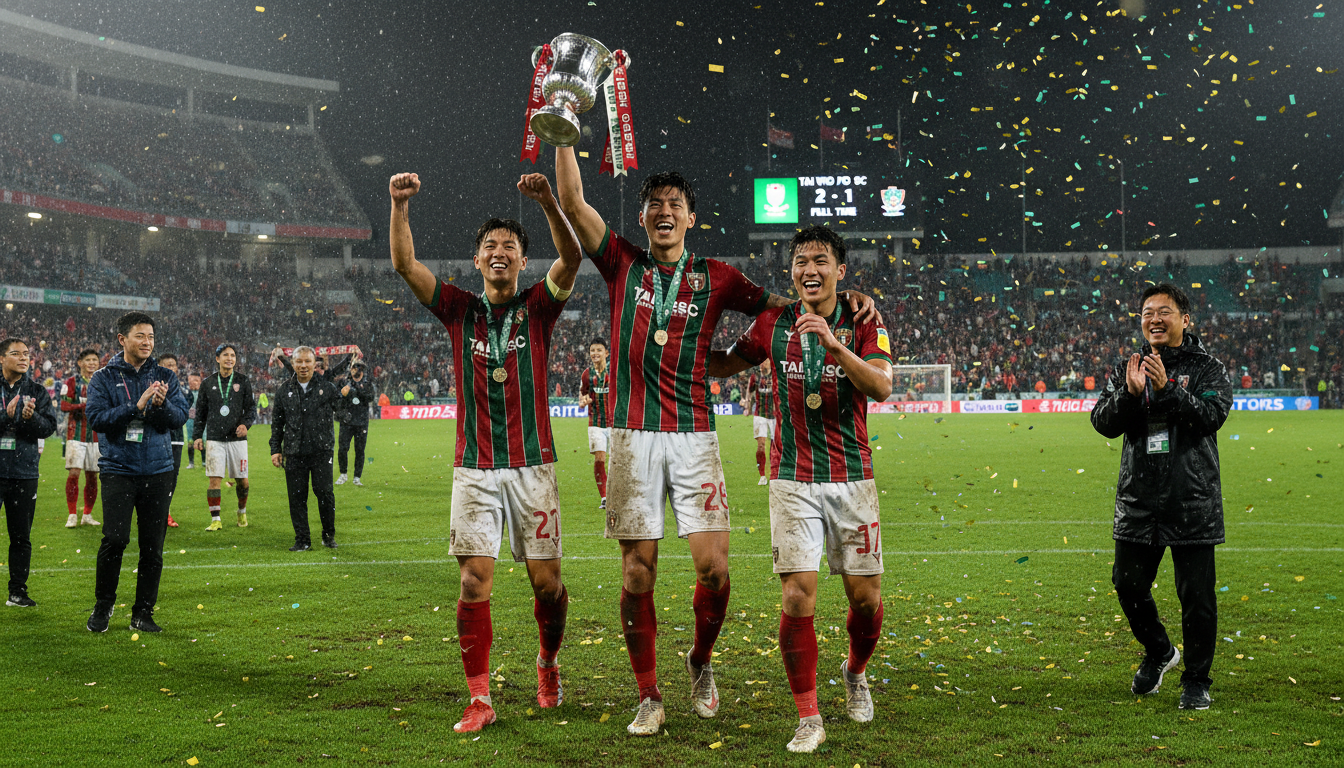
Marco Wong Stars as Tai Po Lift FA Cup After a Season of Doubt and Persistence
Marco Wong’s rise from New York student to Tai Po FA Cup hero showcases resilience after months of doubt and limited playing time in Saturday’s final.


Wong delivers when it mattered
Marco Wong produced one of his most significant performances in Tai Po’s FA Cup final victory over Eastern District, helping the district club secure silverware after a season of uneven personal fortunes. The 23-year-old, a native of Tai Po, had spent much of the campaign on the fringes before stepping into a decisive role in the final. His influence on the pitch — from movement off the ball to timely interventions — provided a clear contrast to a season that began with questions over his place in the team. The performance served both as validation of his talent and a reminder of the value of perseverance in a professional career.
Wong’s impact did not arrive in isolation; it arrived at a moment when Tai Po needed composure and energy. The final required tactical discipline and individual initiative, and Wong supplied both, linking midfield and attack with a calmness that belied his limited minutes earlier in the season. Coaches and teammates noted his adaptability in the match, able to drift inside, press opponents and contribute defensively while still offering an attacking threat. By the final whistle, his contribution was visible in the scoreboard and in the lifted moods of a club that counts him among its own.
The FA Cup trophy will now become a defining milestone in Wong’s early senior career. For a player who returned from studies in the United States and faced a protracted run of limited opportunities, the final offered a stark turnaround. It also amplified expectations: supporters and pundits will watch how Tai Po and Wong manage the momentum into the off-season and next league campaign.
A season that tested his commitment
Wong’s first season back in Hong Kong after completing university in New York was marked by long stretches of inactivity and mounting uncertainty over his role. For the opening eight and a half months he saw little action, a reality that weighed heavily on him and forced a reassessment of his footballing path. At one low point in February, he found himself an overage name listed for an under-22 match for the third time without being introduced, an experience he later described as deeply discouraging. That series of benchings prompted questions about whether professional football remained a viable option for him.
Those difficult months were punctuated by self-doubt and the temptation to step away from the game. Teammates noticed his subdued moments but also observed a determination to remain prepared for opportunities. Coaching staff, according to those close to the club, encouraged Wong to maintain training standards and to channel frustration into development rather than resignation. The eventual rewards in the FA Cup final suggest that the approach worked, but the path there highlighted the fragile nature of playing time and confidence for players returning from extended education commitments.
The pattern is instructive for clubs and players balancing academic ambitions with professional sport. Wong’s experience underscores how reintegration into a competitive squad can take time, particularly when a player arrives after a lengthy absence for studies and overseas development. Tai Po’s management adjusted their selection across the season, and Wong’s late-season inclusion in key matches illustrated that patience and tactical needs can shift quickly.
US education and formative football years
Wong’s recent history includes a significant chapter in the United States, where he combined study and sport for several years. He spent two years at Northwood School in Lake Placid, where he achieved high academic marks while continuing his football development. During that period he also played semi-professionally for Black Rock FC, gaining match experience against older, more seasoned opposition. Those seasons in the US provided him with a blend of technical and mental maturity that has been evident since his return to Hong Kong.
Following Northwood, Wong pursued higher education in upstate New York and earned a mathematics degree from St. Lawrence University in Canton. The academic discipline and analytical skills required for a mathematics course helped shape his approach to training and match preparation, according to coaches familiar with his background. The time in the US exposed him to different coaching methods and playing styles, which he later credited with broadening his tactical understanding and on-field decision-making. Those experiences contributed to the player Tai Po ultimately benefited from in the FA Cup final.
Balancing a rigorous academic schedule with semi-professional competition also tested Wong’s time-management and commitment, qualities that translate well to professional football. His route — through American high school and collegiate structures rather than a continuous domestic academy track — is increasingly familiar among players who prioritize education alongside athletic aspirations. The success in the FA Cup will likely encourage other student-athletes considering a return to professional leagues to believe in the feasibility of that pathway.
February benching and the turning point
The nadir of Wong’s season arrived in February when he was once again an overage player in an under-22 squad but remained unused for the match, repeating a pattern that had already occurred twice. That sequence forced a confrontation with the possibility that his football career might not progress as hoped, prompting candid reflection. Rather than withdraw, Wong chose to redouble his efforts in training and to remain mentally engaged, believing that opportunity might yet arrive. The strategy of persistence produced incremental changes in selection decisions as the season progressed.
Coaching staff have described how consistent training intensity and positive attitude can tip the scales when squad options are tight, and Wong’s case became an example of that dynamic. As injuries and tactical rotations created openings, he was among the players trusted to step into crucial fixtures, culminating in the FA Cup. Sources inside the club stressed that selection is often a balance of form, fitness and tactical fit, and Wong’s renewed focus on those areas helped him meet the moment. The arc from February’s disappointment to June’s triumph demonstrates how episodic careers can be and how quickly fortunes can change in team sport.
The turning point also carried psychological weight. Wong moved from questioning whether to continue in the game to embracing the unpredictability inherent in professional football. His ability to translate frustration into a constructive drive became a model for younger squad members facing similar setbacks. The club’s handling of his reintegration — offering opportunities while maintaining performance standards — will likely be reviewed as a case study in player management.
Implications for Tai Po and Wong’s next steps
Tai Po’s reliance on a player raised in the district reflects both a cultural and strategic dimension for the club. Wong’s success in the FA Cup underlines the value of local talent who understand the club’s identity and are motivated to perform for their home community. For Tai Po the victory provides a tangible return on investing in players who combine local ties with external development experiences. The club’s recruitment and development strategies may lean more heavily on similar profiles as they prepare for the next season.
For Wong personally, the FA Cup offers a platform to secure more regular minutes and to shape his professional trajectory. At 23, he remains at an age where consistent game time could underpin further improvement and potential moves, whether within the Hong Kong Premier League or beyond. The combination of his US-acquired education and footballing credentials also gives him career flexibility outside the pitch, a pragmatic advantage for any athlete. Club officials will face choices about how to integrate him into squad plans so that his talents are maximized while his confidence is preserved.
The broader message concerns player welfare and development pathways. Wong’s case demonstrates that non-linear careers are a reality; success can follow prolonged periods of inactivity when the player and club maintain mutual commitment. Coaches, sporting directors and those overseeing youth-to-senior transitions may extract lessons from Tai Po’s management of Wong’s situation, balancing competition with patience to allow talent to emerge at the right moment.
Final paragraph
Marco Wong’s journey from the classrooms and pitches of upstate New York back to a hometown trophy highlights the interplay of talent, opportunity and resilience in modern football. His FA Cup performance validated a difficult season and offers both player and club a foundation on which to build, while also illustrating the importance of patient development and the potential rewards of combining academic and athletic pathways. If Tai Po and Wong can sustain the momentum, the cup could mark the beginning of a more regular role for the local graduate turned cup hero.