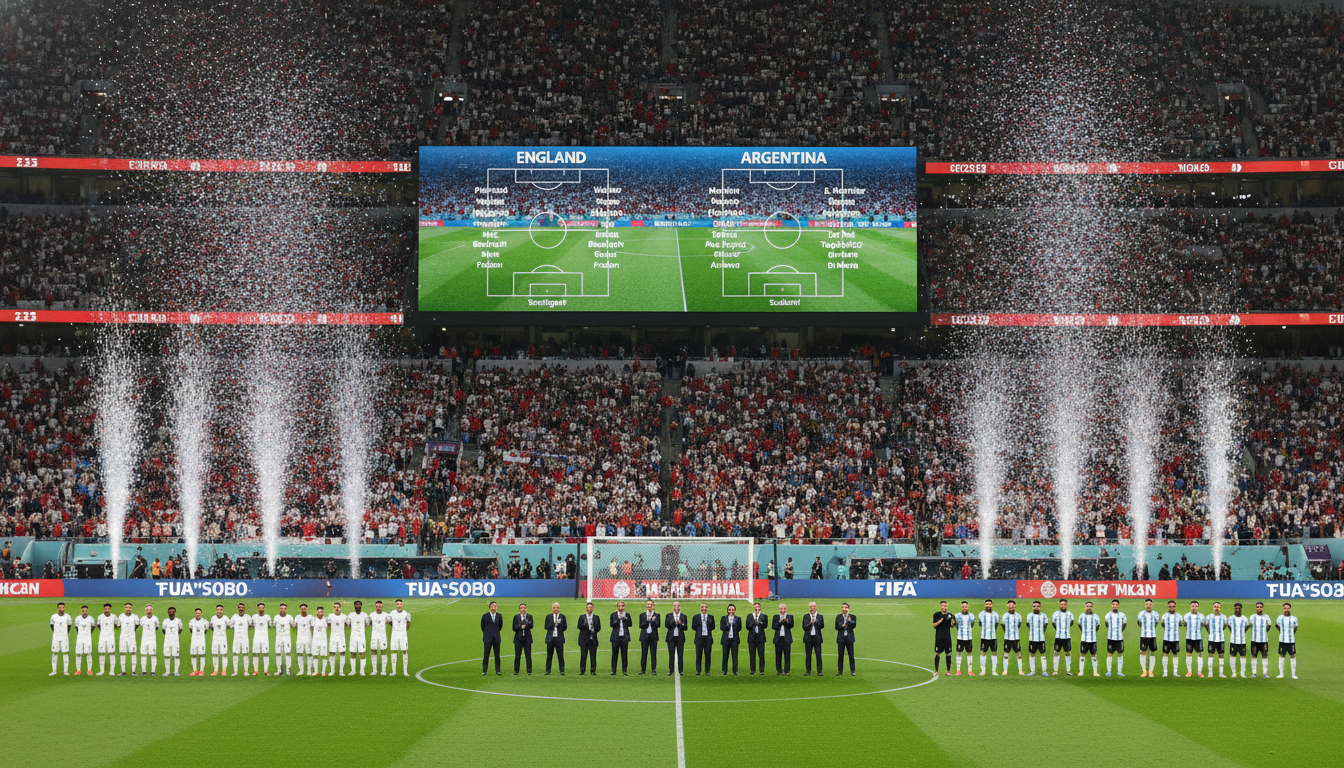
England vs Argentina lineups: Confirmed starting XIs for 2026 World Cup semi-final in Atlanta
England vs Argentina lineups confirmed for the 2026 World Cup semi-final in Atlanta, with both sides naming strong XIs for a winner-takes-all showdown.


Confirmed starting XIs and formations
England will line up in a 4-2-3-1 with Jordan Pickford in goal and a back four of Reece James, John Stones, Marc Guehi and Djed Spence.
Declan Rice and Elliot Anderson are paired in midfield, while Morgan Rogers, Jude Bellingham and Anthony Gordon support Harry Kane up front. (radiosportiva.com)
Argentina will deploy a 4-4-2 with Emiliano Martínez between the posts and a defence of Nahuel Molina, Cristian Romero, Lisandro Martínez and Nicolás Tagliafico.
Enzo Fernández, Leandro Paredes, Alexis Mac Allister and Giuliano Simeone form a midfield quartet ahead of Lionel Messi and Julián Álvarez. (radiosportiva.com)
Both lineups prioritise structural balance: England aiming to combine wing pace with a compact double pivot, and Argentina reverting to a two-striker front to maximise Messi and Álvarez’s interplay. (sportingnews.com)
Kick-off, venue and match context
The semi-final will be played at Atlanta Stadium, with a kick-off scheduled for 21:00 CET on Wednesday evening in the United States.
The fixture pits Thomas Tuchel’s England against Lionel Scaloni’s Argentina, the holders from 2022, with a place in the World Cup final at stake. (fifa.com)
This is the final semi-final of the tournament and a rematch of high-profile modern encounters between the two nations, heightening both tactical intrigue and public interest.
Both squads reach Atlanta after contrasting knockout routes that tested depth, stamina and game management in recent rounds. (sportsmole.co.uk)
Tactical matchups that will decide the tie
England’s selection signals a focus on quick transitions from the flanks, using Reece James and Anthony Gordon to stretch Argentina’s full-backs.
The presence of Marc Guehi and John Stones together suggests Tuchel values defensive composure and aerial control against two forwards. (fdp.fifa.org)
Argentina’s 4-4-2 will push Messi into pockets between the lines while Álvarez operates as both a finisher and secondary creator.
The midfield battle—particularly Breaching space around Rice and Anderson—will determine whether Argentina can play through the middle or must rely on rapid vertical balls to the front two. (fourfourtwo.com)
Set pieces and transitional play are likely to be decisive, with both teams possessing aerially dominant centre-backs and forwards who can capitalise on second balls.
Coaches on both sides must also weigh the risk of substitutions: fresh legs on the wings or an extra midfielder could swing momentum late in the game. (sportingnews.com)
Kane closing in on tournament scoring charts and Messi’s influence
Harry Kane starts the semi-final as one of England’s principal scoring threats and is closing the gap on the tournament’s top scorers.
Kane’s role as a focal point—linking play, holding up the ball and finishing chances—will test Argentina’s central defenders throughout the match. (sportingnews.com)
Lionel Messi remains the fulcrum of Argentina’s attack, not just as a scorer but as the creative engine behind their positional rotations.
Messi’s ability to drop, pick passes and draw defenders out of position will be crucial in creating space for Álvarez and the midfield runners. (fourfourtwo.com)
Both teams carry attacking players capable of moments of brilliance, which means a single individual action could determine which side progresses to the final.
Coaches will be acutely aware that margins are thin at this stage of the competition and that game management across 90 minutes (and beyond) is essential.
Bench decisions, omissions and squad depth
Exequiel Palacios, the Bayer Leverkusen midfielder, is listed among Argentina’s substitutes and does not make the starting XI, reflecting Scaloni’s preference for the chosen midfield quartet. (wtksports.com)
England’s bench contains attacking options and defensive cover, giving Tuchel pathways to introduce pace or solidity depending on how the game unfolds.
The depth of both squads means tactical switches are expected; managers have held back players who can change tempo or style when introduced from the bench. (squawka.com)
Several coaches and analysts highlighted that leaving experienced names on the bench is a deliberate move to preserve tactical flexibility rather than a reflection on form.
Substitution patterns in the knockout rounds show a common thread: managers prefer to keep versatile players available to respond to in-game developments. (sportsmole.co.uk)
Broadcast details and what a place in the final would represent
The match will be widely televised and streamed in multiple markets, with broadcasters and platforms preparing extended pre- and post-match coverage given the fixture’s significance.
A win will send either England or Argentina to the World Cup final, a career-defining achievement for players and coaching staffs alike. (goal.com)
For England, a final appearance would mark the nation’s deepest run since 1966 and would vindicate a squad built around emerging talent and Tuchel’s recent tactical imprint.
For Argentina, defending the title would underscore the longevity of a core group that has remained competitive at the highest level across successive World Cups. (fifa.com)
The global audience will watch not only for the result but for immediate tactical lessons and long-term implications for both national programmes.
Player legacies, coaching reputations and transfer market narratives are all likely to be shaped by the outcome in Atlanta.
England vs Argentina lineups will shape the initial rhythm of this semi-final, but the match’s narrative will be written in momentum swings, substitutions and key individual moments. The confirmed XIs reflect coaches’ strategic priorities and set the stage for a tactical, high-stakes encounter with a place in the World Cup final on the line.