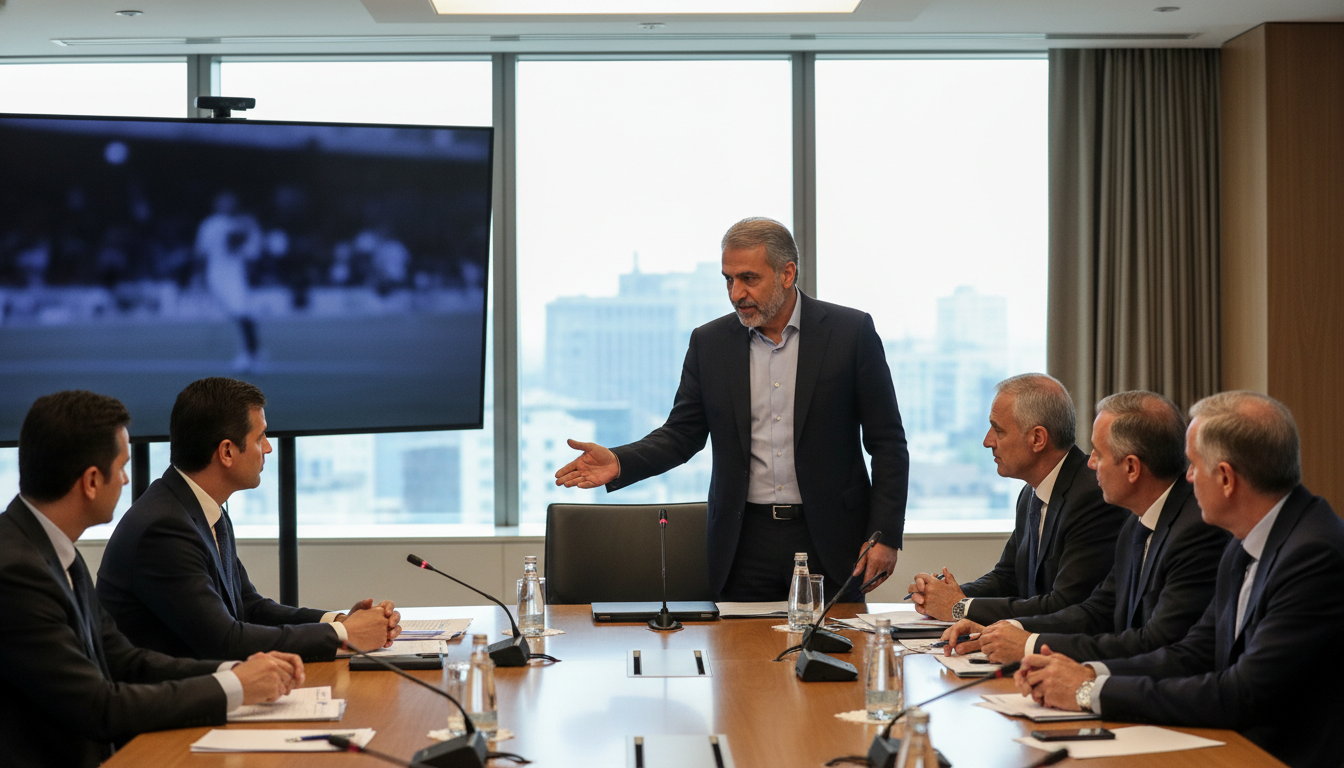
Iran FA chief Mehdi Taj demands FIFA guarantee over IRGC treatment ahead of US World Cup
Iranian Football Federation chief Mehdi Taj has demanded a clear FIFA guarantee over the treatment of the Islamic Revolutionary Guard Corps (IRGC) before Iran’s national team travels to the United States for the World Cup in June. FIFA guarantee is now at the center of a diplomatic and sporting dispute after an FFIRI delegation was turned back at the Canadian border and a visa cancellation was confirmed. Taj has said he will seek formal assurances from FIFA about the conduct of US authorities toward Iranian officials and affiliated personnel.


Taj frames demand as precondition for US travel
Taj told state broadcaster IRIB that FIFA must provide explicit commitments that members of the Iranian delegation or associated personnel will not be insulted or demeaned by US authorities if they attend matches in June. He presented the demand as a necessary step to protect the dignity of Iran’s officials and to remove uncertainty about how security and immigration procedures will be handled. The request frames FIFA not only as a sporting regulator but as an arbiter of the environment in which national teams and officials can safely participate in the tournament.
Taj’s stance has immediate practical implications for Tehran’s planning, since final preparations and logistics for the World Cup require clarity on visas, travel protocols and accreditation. By making the FIFA guarantee a public condition, Taj has put pressure on both the governing body and host-country authorities to address the interplay between sport and state-level security designations.
FFIRI delegation turned back at Canadian border, delegation says
An FFIRI delegation that included Taj returned to Iran last week after encountering what the federation described as disrespectful treatment by Canadian immigration officials while attempting to attend the FIFA Congress in Vancouver. FFIRI officials said they decided to turn back of their own volition after a series of interactions that they characterized as humiliating and inconsistent with normal diplomatic or sporting engagement. The incident has been cited by Tehran as evidence that Iranian officials can face unpredictable treatment while traveling in North America.
FFIRI’s account of the episode highlights the sensitivity of cross-border travel for delegations connected to entities that are subject to foreign security designations. The delegation’s aborted attendance at the FIFA Congress also deprived Iranian officials of an opportunity to press their case in person to governing-body representatives ahead of the tournament.
Canada confirms visa cancellation linked to IRGC ties
Canadian authorities later confirmed to Parliament that Mehdi Taj’s visa had been cancelled while he was in the air, with officials linking the cancellation to his reported connections to the IRGC. Ottawa’s confirmation altered the narrative from one of purely interpersonal mistreatment to a formal administrative action grounded in national security policy. The timing of the cancellation, announced after the delegation had already begun travel, underscored procedural and diplomatic complexities that can arise when visa decisions intersect with international sporting schedules.
The confirmation also casts the episode as a state decision rather than an isolated incident at a border checkpoint, prompting questions in Tehran about the predictability of travel approvals for Iranian sports officials. That unpredictability is central to FFIRI’s demand for a FIFA guarantee that would, in their view, bind the governing body to ensure smoother facilitation of World Cup participation.
IRGC designated a terrorist entity by Canada in 2024, by US earlier
Canada added the Islamic Revolutionary Guard Corps to its list of terrorist entities in 2024, a designation that follows a US listing several years earlier and which has had concrete legal and diplomatic repercussions. The IRGC is an elite branch of Iran’s armed forces established to safeguard the country’s clerical leadership, and its designation by Western states has complicated interactions involving individuals with known or alleged ties to the force. These designations carry implications for visas, financial transactions and cross-border diplomacy, and they form the backdrop to the current dispute between the Iranian federation and host countries.
The presence of such designations in the international security landscape has made it harder for sporting organizers, diplomatic services and immigration authorities to apply a consistent approach to delegation movement. For Iran, the designations elevate routine matters of accreditation into politically charged issues that require careful handling by FIFA if the governing body wishes to preserve the tournament’s inclusive character.
FIFA expresses regret and invites FFIRI to Zurich meeting
FIFA secretary general Mattias Grafström sent a letter to the Iranian federation expressing regret for the “inconvenience and disappointment” experienced by the delegation and inviting FFIRI leadership to Zurich for talks on May 20 to discuss World Cup preparations. The invitation indicates that FIFA is seeking to de-escalate the dispute and to position itself as a facilitator between Iran and host-country authorities. The planned meeting provides a forum for FFIRI to present its demands for guarantees and for FIFA to outline the practical steps it can take within the scope of its mandate.
FIFA will face the task of balancing its obligations to uphold the tournament’s integrity and safety with the sovereign decisions of member states and host countries on immigration and national security. The outcome of the Zurich meeting will test FIFA’s capacity to broker arrangements acceptable to both Tehran and Washington, and it may set a precedent for how similar conflicts are managed in future international events.
Diplomatic and logistical stakes for Iran’s World Cup campaign
The dispute raises tangible concerns about Iran’s ability to prepare fully for the World Cup, with potential knock-on effects on training camps, staff accreditation, and the movement of support personnel and fans. Travel disruptions for officials can complicate scouting, medical arrangements and liaison activities that are essential in the weeks before a major tournament. For Iran’s team staff and players, uncertainty about who will be permitted to travel and under what conditions could become a distraction from sporting preparation.
Beyond logistics, the episode spotlights the intersection of sport and geopolitics, where national security policies can influence the practicalities of international competition. Other federations and FIFA itself will be watching closely for how guarantees are framed and enforced, as the handling of this case could inform the governance of future events hosted in countries with differing diplomatic stances toward participating nations.
Possible paths forward and monitoring ahead of June
A range of outcomes is possible ahead of the tournament in June, from a negotiated compromise that clarifies procedures for Iranian officials to continued contention that forces further diplomatic intervention. FIFA could seek written commitments from the US and Canadian authorities regarding accreditation treatment, or it could broker an arrangement that limits travel of particular individuals while preserving team participation. Iran could also pursue bilateral discussions with host-country governments in parallel with FIFA-led talks in Zurich.
Monitoring the situation will be crucial in the weeks before the World Cup, as timing is tight and logistical decisions must be finalized well in advance of kick-off. The May 20 meeting in Zurich represents a decisive moment for resolving outstanding issues, and the messages that emerge afterward will determine whether Iran’s demand for a FIFA guarantee has been met to Tehran’s satisfaction.
The coming weeks will reveal whether FIFA can secure the assurances sought by Mehdi Taj and whether Iran will accept conditions that allow its national team to compete in the United States without further diplomatic or administrative obstacles.