Champions League handball controversy overshadows PSG’s aggregate win over Bayern
PSG’s 6-5 aggregate progression over Bayern Munich was dominated by a Champions League handball controversy that left managers, pundits and supporters questioning refereeing consistency across the competition.


The return leg ended 1-1 after a dramatic stoppage-time equaliser from Harry Kane, but debate centred on two key handball incidents that influenced the tie and fuelled fresh calls for clarity in how the law is applied.
Refereeing decisions decide a high-stakes tie
The match produced late drama on the pitch and sustained controversy off it as several handball decisions became decisive talking points.
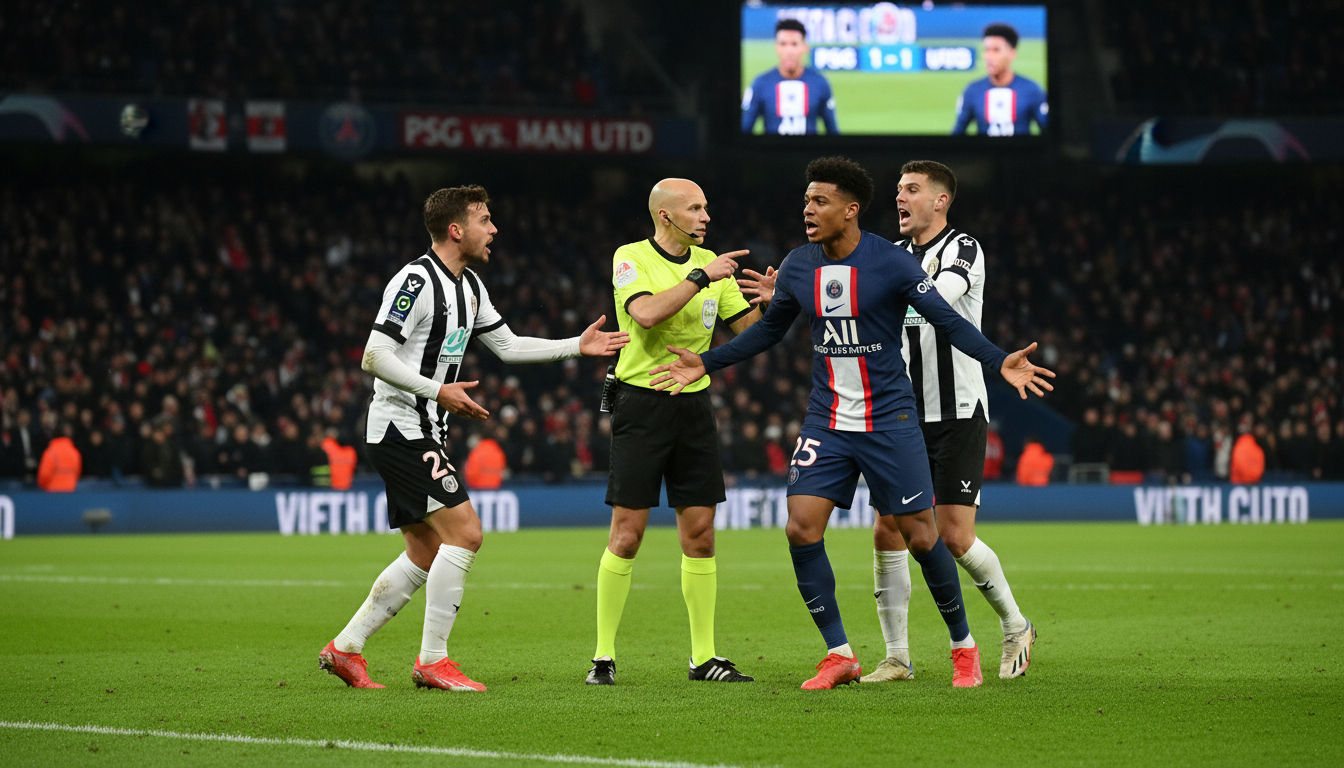
Officials spared PSG left-back Nuno Mendes a second yellow after an early foul left him on a booking, while another handball ruling prompted sharp criticism from former players and Bayern’s manager.
Refereeing decisions influenced the balance of the tie, with PSG eventually advancing despite the 1-1 scoreline in the second leg.
That outcome has intensified scrutiny of how referees and VAR interpret handball incidents in Champions League knockout matches.
Pundits voice confusion over handball interpretations
Former Liverpool defender Stephen Warnock said the ruling left many observers puzzled and indicated that the application of the handball law in this season’s Champions League feels inconsistent.
His comments reflected a broader unease among broadcasters and former professionals who struggled to reconcile the on-field calls with public expectations of a clear, repeatable standard.
Ex-Chelsea striker Chris Sutton was equally forthright, questioning the logic of decisions that, he argued, appeared to permit certain deliberate arm or hand contact with the ball when other forms of handling are penalised.
Those views underline a growing chorus demanding clearer guidance from governing bodies about how the rule should be enforced at elite level.
Kompany criticises handling of Nuno Mendes incident
Bayern manager Vincent Kompany publicly questioned the referee’s management of the match after Nuno Mendes avoided a second yellow card following a handball ruling.
Kompany said he had seen angles suggesting Konrad Laimer did not touch the ball with his hand before Mendes handled it, and claimed the official appeared to hesitate after initially considering dismissal.
The specific sequence came after Mendes was already booked inside the opening eight minutes for a foul on Michael Olise, amplifying Bayern’s frustration when the referee awarded a free kick to PSG instead of a dismissal.
Kompany’s post-match remarks added weight to the argument that consistency in disciplinary decisions is vital, especially in knockout fixtures with far-reaching consequences.
Match events: Dembele opener, Kane late equaliser, PSG progress
Ousmane Dembele’s early strike in the third minute gave PSG a crucial away goal that set the tone for a tense evening and ultimately played a major role in the aggregate outcome.
Harry Kane’s 94th-minute equaliser salvaged parity on the night for Bayern but proved insufficient as PSG advanced 6-5 on aggregate to reach the Champions League final.
The result sets up a final against Arsenal in Budapest on 30 May 2026, a match that now carries an added layer of controversy as the competition’s governing bodies face renewed pressure to clarify interpretation of the handball rule.
For Bayern, the late goal was consolation; for PSG, progression came amid unresolved questions about whether the on-field decisions were applied fairly and consistently.
Impact on refereeing debate and UEFA’s next steps
The incidents in this tie have intensified calls for UEFA to provide sharper, more consistent guidelines on handball to reduce ambiguity for referees, players and coaches.
Experts and former players argue that without clearer directives, similar controversies will continue to mar high-profile matches and undermine confidence in officiating.
UEFA has in the past refined wording and implementation guidance for handball, but the latest controversy suggests existing measures have not removed interpretive gaps.
Any forthcoming clarifications will be closely watched, as they could affect not only tactical behaviour in the final stages of competitions but also perceptions of fairness across European football.
What players and coaches might change tactically
Managers may now reassess how they coach defenders in one-on-one and aerial scenarios given the perceived uncertainties around arm and hand involvement.
Tactical instructions could evolve to encourage minimized arm movement or clearer body positioning to avoid marginal calls that can determine match outcomes.
Attacking players, too, might adapt their approaches to provoke or avoid contentious situations, while clubs are likely to request more explicit examples from refereeing authorities to guide training ground practice.
Such tactical shifts would reflect an attempt to pre-empt inconsistent enforcement rather than rely solely on retroactive decisions by match officials or VAR.
A final whistle in a dramatic tie provided a headline moment for Harry Kane and a path to the final for PSG, but the greater story may now be the lingering uncertainty surrounding how the handball law is being interpreted at the highest level of European football.