Lamine Yamal injury latest: Spain hopeful as teenage winger targets World Cup return
Lamine Yamal injury threatens Spain opener — Barcelona winger recovering from a hamstring and aiming to be available for Spain’s second World Cup group match.

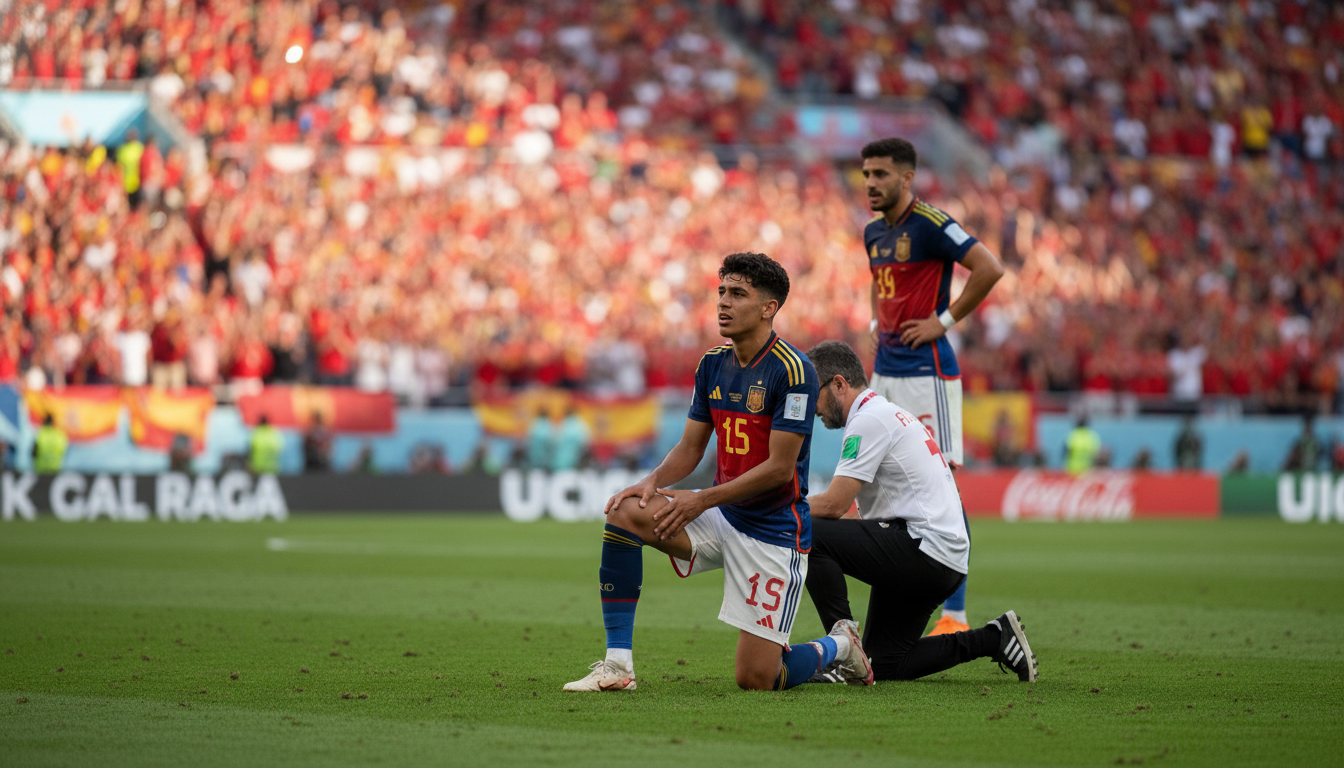
Lamine Yamal’s hamstring problem has cast doubt over his involvement in Spain’s opening World Cup game, but the Barcelona teenager remains optimistic about returning during the group stage. The 18-year-old suffered the injury in April against Espanyol and has been undergoing treatment in the national camp as Spain prepare for matches in the United States, Canada and Mexico. Manager Luis de la Fuente has said those not fit for the first match are expected to be ready by the second, leaving Yamal and the staff to manage a cautious path back to action.
Hamstring injury and how it happened
Yamal’s injury occurred in a La Liga fixture late in the domestic season, prompting immediate concern because it involved a previously untested area of his body. The player later described how, in the moments after going down, he feared the worst — that the issue might end his tournament before it began. Medical scans confirmed a hamstring problem rather than a simple cramp, setting a rehabilitation timetable that rules him out of at least the first fixture.
The uncertainty that followed has been a central focus for Spain’s medical team, who have balanced the risk of a relapse against the desire to have one of their most dangerous attackers available. Yamal’s lack of prior hamstring history has been a positive factor, but it has not eliminated the need for a conservative recovery plan. The immediate priority has been to remove the risk of re-injury ahead of a tournament that will demand peak fitness over three weeks.
Spain coach outlines recovery plan
Luis de la Fuente has been clear in public comments that the squad was selected with player welfare in mind, and that the coaching staff expect those who miss the opener to be ready for the second match. That message has framed Spain’s approach to Yamal’s rehabilitation, with training load and match involvement to be adjusted on a day-by-day basis. The national team has insisted that there will be no rush to reintroduce players who are not fully prepared physically.
Behind the scenes, practical steps include controlled on-field work, gym-based strength sessions and regular assessments by physiotherapists. De la Fuente’s staff are also coordinating with Barcelona’s medical team to ensure continuity in treatment and to share data on progress. The aim is to have a clear, test-based pathway that provides objective criteria for match readiness rather than relying on calendar timelines alone.
Recovery approach and fitness management
A hamstring problem at this stage of the season demands a blend of rest, targeted strengthening and progressive running drills to restore confidence in the muscle. For a player like Yamal, whose game depends on explosive acceleration and change of direction, the rehabilitation programme prioritises high-quality, specific exercises over simply returning to general fitness. Staff are monitoring both the raw physical recovery and the player’s subjective readiness, including pain levels and perceived risk.
There is a potential upside to enforced downtime: having less cumulative fatigue from a long domestic season could leave Yamal fresher if he rejoins the squad later in the group stage. The team’s sports science department has noted that well-managed rest can reduce injury risk and improve performance, provided reintroduction to training is gradual. That calculus will inform whether Yamal is eased into minutes off the bench or considered for a starting role once fit.
Player mentality and role in Spain’s campaign
Yamal has emerged rapidly as one of Spain’s most exciting young attacking talents, and the expectation that he would be a key figure in the tournament has been widely discussed. He has publicly framed the pressure of high-profile fixtures as a motivating force and has spoken about relishing the challenge rather than being overwhelmed by it. Teammates and coaches view his temperament as a strength that can complement his technical and physical gifts.
Despite his youth, Yamal’s experience at elite club level has already included high-stakes matches, which helps explain why the staff are prepared to manage his minutes rather than protect him from all pressure. He remains a central figure in Spain’s attacking plans when available, capable of changing games with direct runs and quick interplay down the flank. The coaching team will factor his psychological readiness into selection decisions as much as the medical report.
Spain’s wider fitness picture
Yamal is not the only member of Spain’s squad carrying recent fitness concerns, which complicates selection and tactical planning for the group stage. Winger Nico Williams has also been managing a fitness issue after a season disrupted by hamstring problems of his own, and midfielder Mikel Merino has returned from a long-term absence and is being monitored going into the tournament. The presence of several players on cautious programmes has forced the staff to consider multiple contingency plans.
Younger squad members and backup options have been given opportunities in training to simulate the roles they might occupy in competitive fixtures. Defensive and midfield rotations are being prepared to absorb potential absences without sacrificing balance or pressing intensity. Team doctors have described the current situation as manageable, but they stress that the early matches will be used to build match fitness progressively rather than to push all players to immediate full capacity.
Tactical implications for the opener against Cape Verde
If Yamal indeed misses the opener, Spain will likely alter its approach on the right wing to compensate for his direct threat and pace. The coaching staff could opt for a more possession-based wide option or deploy a fullback with overlapping tendencies to recreate the verticality Yamal offers. Alternatively, a different forward with similar profiles may be given the nod to maintain vertical transitions and rapid attacks down the flank.
The choice will depend on opponent analysis and the broader aim of controlling the tempo in the opening fixture. Against a team expected to sit back and seek counter opportunities, Spain may prefer patient build-up with selective bursts rather than turn to constant wing sprints without Yamal. The first match thus becomes both a tactical test and an opportunity to manage workload across the squad in the opening stages of the tournament.
Return timetable and signals to watch
The immediate marker for Yamal’s return remains Spain’s second group game, with the coaching staff setting that match as a realistic target if his recovery progresses as hoped. Key indicators that will determine his availability include the ability to perform repeated high-speed runs in training without pain, full range of motion in the affected leg and successful completion of contact drills. The medical team will also consider match-readiness from a neuromuscular control perspective before clearing him for competitive minutes.
Fans and analysts should look for incremental signs in training reports: short bouts of full-speed running, inclusion in tactical sessions and limited minutes in warm-up friendlies will all be meaningful. Ultimately, Spain’s medical and coaching teams have signalled they will follow objective criteria rather than commit to fixed dates, prioritising long-term fitness for a player whose development is still at an early stage.
Spain will enter the World Cup with a mix of youthful exuberance and experienced heads tasked with navigating the group phase. Yamal’s presence, when he returns, is likely to boost the team’s attacking options and provide a spark in decisive moments.
The final decision on Lamine Yamal’s involvement will rest on medical clearance and coaching judgement, but the prevailing message from the camp is one of cautious optimism that he can join Spain’s World Cup campaign while minimising the risk of recurrence.