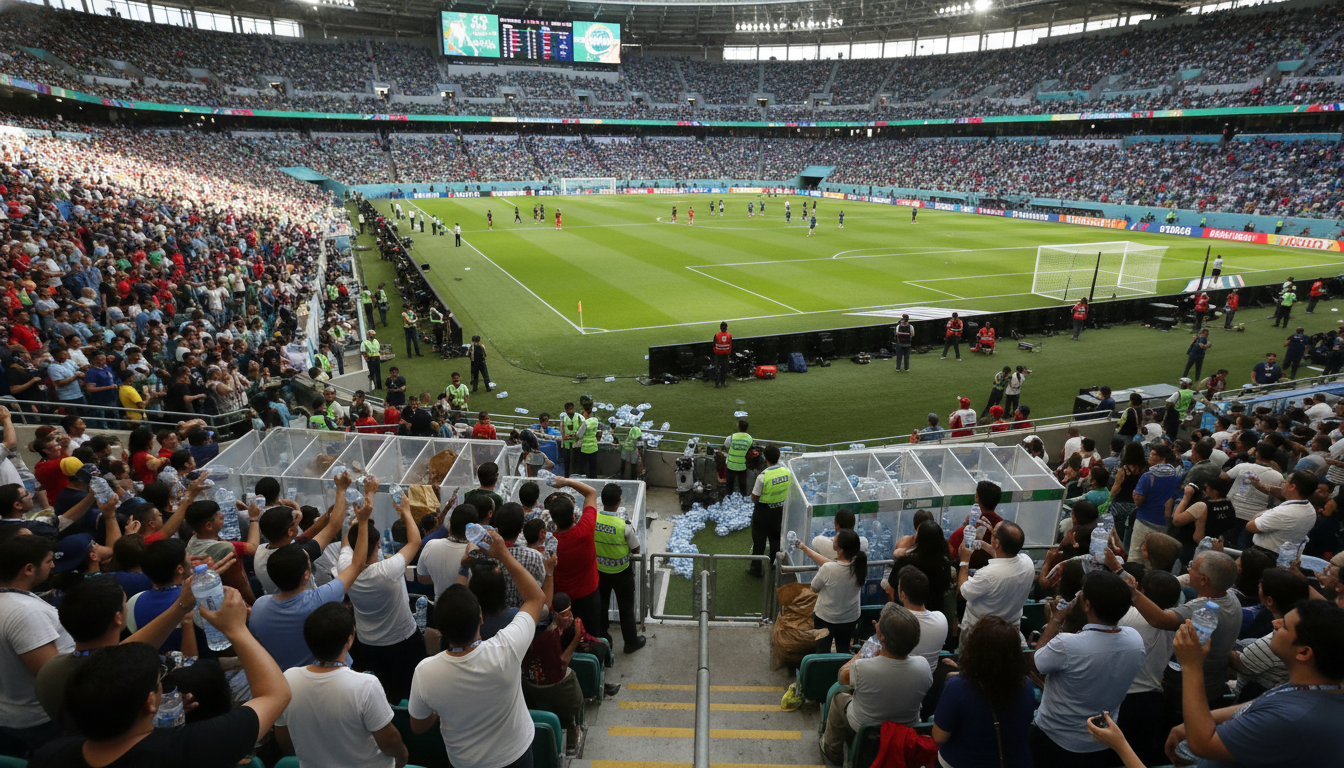
FIFA bans reusable water bottles at 2026 World Cup amid safety concerns
FIFA has banned reusable water bottles at the 2026 World Cup, citing safety and injury prevention in an updated stadium code that disallows outside bottles.


The decision was announced days before the tournament and modifies earlier guidance that had allowed reusable containers. FIFA said the change was made to reduce risk to players and attendees, and the updated stadium code now explicitly states that reusable bottles are not permitted inside match venues. The move affects matches across Canada, Mexico and the United States and has prompted immediate questions about consistency, fan costs and environmental impacts.
FIFA cites safety and injury prevention
FIFA framed the new restriction as a safety measure intended to prevent potential risks to players and spectators. A spokesman told organizers that several host venues already prohibited outside bottles for safety reasons, and FIFA has applied that consideration uniformly across its tournament stadiums.
Officials argued that a clear, unified rule reduces confusion at entry points and supports existing venue security protocols. The governing body said the change was made to "prevent risk and injury," emphasizing the need for a consistent approach at multiple host sites.
Code of conduct change issued days before tournament
The updated language appeared in a revised stadium code of conduct that, according to reporting, now specifically bars reusable water bottles. That change follows earlier guidance that had allowed refillable bottles, making the reversal notable for its timing and practical consequences.
Organizers are implementing the amendment at a late stage, which has left fans and stadium operators scrambling to adjust. Ticket holders who planned to bring reusable containers for environmental or cost reasons were confronted with the new restriction shortly before entering venues.
Venue inconsistency raises operational questions
Not all stadiums have the same baseline policies and some venues had permitted reusable bottles for other events prior to the FIFA update. MetLife Stadium, just outside New York and scheduled to host eight matches including the final, has previously allowed reusable containers at non-World Cup events, highlighting a contrast with FIFA’s new directive.
That patchwork of prior rules has prompted venue operators and local authorities to coordinate on enforcement and messaging. Fans arriving at gates have reported differing signage and staff responses at various entry points, underscoring the challenge of rolling out a last-minute uniform prohibition across multiple jurisdictions.
Financial impact on fans and stadium concessions
The ban effectively pushes fans toward purchasing bottled water and other beverages inside stadiums, a cost many supporters say will add up over a long match day. Concession prices at major sporting arenas are often significantly higher than retail outlets, and the prohibition on reusable bottles increases dependence on on-site sales.
Supporters groups and consumer advocates have warned that the change could disproportionately affect families and lower-income ticket holders who budget tightly for travel and match expenses. Organizers have suggested that concession partners will offer a range of price points, but details on pricing caps, if any, have not been made public.
Player hydration protocols and extreme heat measures
Tournament planners have separately adopted specific player hydration measures to cope with expected high temperatures at some venues. Teams will receive scheduled breaks to allow players to rehydrate on the field, with reports indicating a three-minute stoppage per half for water intake in particularly hot conditions.
Medical staff and competition officials have emphasized that player welfare remains a priority and that in-match hydration pauses are intended to reduce heat-related risks. Those measures are designed to complement stadium cooling systems, shaded seating where available, and medical readiness protocols for heat illness.
Environmental criticism and fan backlash
Environmental organizations and sustainability advocates have criticized the decision for undermining efforts to reduce single-use plastic waste. Many fans had planned to bring reusable bottles to minimize their environmental footprint, and the ban complicates local and tournament-wide sustainability commitments.
Supporter groups have voiced frustration on social media and at fan events, calling on FIFA and venue operators to provide alternatives such as inexpensive reusable cups sold inside stadiums or free water refill stations. Organizers have acknowledged the concerns and said they will review logistics for waste reduction during the tournament, but immediate remedies remain limited.
Questions about enforcement and entry procedures
Security teams at stadium gates face the practical task of enforcing the prohibition while maintaining efficient access for large crowds. Ticketed attendees passing through multiple checkpoints may encounter bag checks and screening procedures that vary in strictness, which can create bottlenecks and confusion.
Clear signage and proactive communication have been recommended by venue managers to avoid confrontations and delays. Organizers have urged fans to consult pre-match guidance from FIFA and local venues, even as advocates call for clearer, earlier messaging to prevent unnecessary confiscations.
Fans have also raised concerns about what happens to confiscated bottles and whether stadiums will offer recycling or reuse programs for surrendered containers. Transparency on disposal practices will be important to address environmental critics and maintain public trust.
Organizers balancing safety, cost and sustainability
FIFA and host venue authorities are navigating a complex set of priorities that include spectator safety, player welfare, revenue generation and environmental responsibility. The reusable bottle ban illustrates the trade-offs that can arise when security considerations intersect with commercial and sustainability goals.
Stakeholders on all sides have acknowledged the difficulty of reconciling competing demands at a major international event spanning multiple countries. For many fans, the practical impact of the rule—added expense and restricted options—has become a focal point of dissatisfaction even as organizers stress safety imperatives.
The prohibition on reusable water bottles has reignited debates over how major sports events should manage spectator needs when public health, security and sustainability objectives collide. Many supporters remain hopeful that clearer guidance and mitigation measures, such as affordable beverage options and improved refill infrastructure inside venues, will reduce the rule’s negative effects.
The revised policy represents a significant operational shift for the 2026 World Cup and will shape fan experience across stadiums in Canada, Mexico and the United States. Organizers and local operators face the immediate task of enforcing the rule fairly while addressing outreach, pricing and environmental concerns as the tournament proceeds.