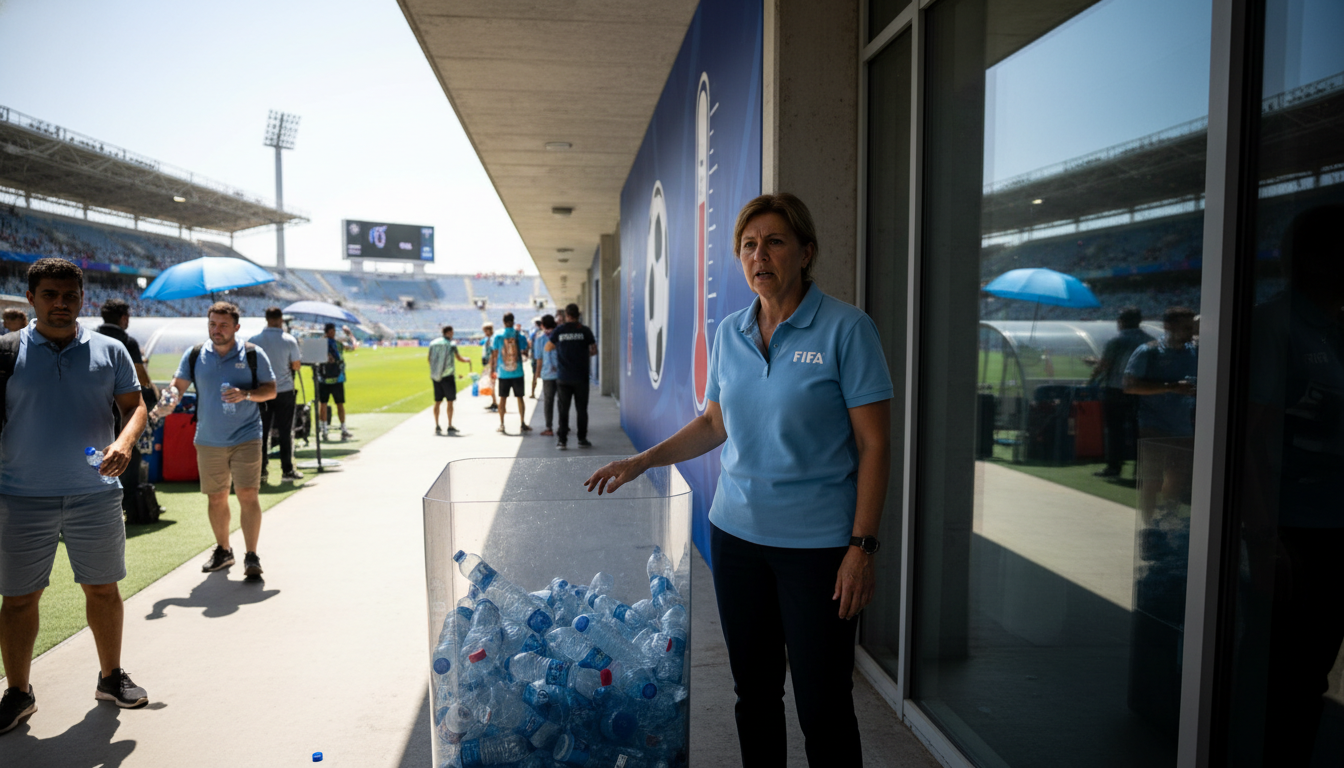
FIFA bans refillable water bottles at World Cup venues, sparking heat and access concerns
FIFA bans refillable water bottles at World Cup stadiums, citing safety; organizers say hydration stations will be available but experts and fans warn heat risks and access issues.


FIFA bans refillable water bottles at World Cup venues in last-minute policy shift that will force supporters to rely on bottled sales and stadium hydration points, the governing body said.
The updated stadium code of conduct removes previous language allowing empty, clear reusable bottles and replaces it with an explicit prohibition on refillable containers, FIFA told news agencies as it framed the move as a safety measure.
The decision applies across tournament stadiums in the United States, Canada and Mexico and comes amid renewed scrutiny of venue policies and fan welfare ahead of the competition.
FIFA cites safety concerns in rule change
FIFA told reporters that the ban on refillable water bottles was adopted to reduce risks inside stadiums and to protect players, staff and spectators.
A spokesperson described the change as aligned with safety practices already enforced at some host venues, and said the organization is standardizing that approach across its tournament sites.
Officials said the stadium code update was motivated by concerns that bottles could become hazardous objects in crowded or high-tempo match situations, though they did not provide detailed incident studies to support the blanket prohibition.
FIFA emphasized its commitment to health and safety while noting that the revised guidance is part of venue management protocols for the tournament.
Stadium services to include hydration and cooling options
FIFA and venue operators say multiple hydration solutions will be available inside the stadium footprint to reduce the impact of the ban on refillable bottles.
Organizers plan to deploy misting stations, hydration stands, cooling tents and staffed water points that officials say will allow fans to rehydrate without bringing their own containers.
FIFA also said bottled water will be sold within stadiums at prices it described as consistent with those charged at other events at the same venues.
Event operators have described these provisions as standard event services, but they acknowledged that access and queueing logistics will be managed on a venue-by-venue basis.
Heat and health experts warn of elevated risks
Public-health researchers and meteorologists have previously warned that several World Cup matches are likely to be played in conditions posing heat stress risks to spectators.
A recent analysis by a climate research group estimated that a significant number of tournament fixtures could experience elevated wet-bulb globe temperature measurements, which combine heat, humidity and solar radiation to assess human heat stress.
Heat stress can elevate the need for frequent, accessible drinking water and cooling, particularly at open-air stadiums and for vulnerable attendees such as older adults and young children.
Experts caution that removing the option to carry personal refillable bottles increases reliance on stadium infrastructure and vendors, which could be problematic if lines, limited supply or entry delays occur on match days.
Policy change follows precedent at U.S. events
Organizers noted that the ban mirrors existing restrictions at several host venues, including stadia that already prohibit outside bottles for security or operational reasons.
Event operators and security teams often impose varied entry rules that can range from allowing empty clear bottles to prohibiting any outside containers, depending on local risk assessments.
At previous high-profile soccer events in the United States, fans reported strict enforcement of bottle policies and, in some cases, heat-related discomfort when stadium conditions were particularly warm.
FIFA has moved to codify a uniform approach across its World Cup sites, arguing that consistency will aid enforcement and reduce confusion for attendees traveling between different host cities.
Pricing and access questions emerge ahead of tournament
The ban raises practical questions about access to water inside stadiums and the cost burden on fans who will need to purchase bottled drinks.
While FIFA said bottled water prices will align with other events at each stadium, fans and consumer advocates note that event concessions commonly mark up beverage prices, which can be a significant expense for families and groups attending multiple matches.
There are also concerns that the logistics of distributing free water via hydration stations could vary widely by venue, potentially leading to congestion at entry points and around concession stands during peak arrival times.
Some disability and elder-care advocates have urged organizers to ensure clear exemptions or accessible provisions for those who medically require personal hydration containers, though FIFA did not outline specific exemption rules in its initial statement.
Supporters and advocacy groups call for clearer guidance
Fan groups and advocacy organizations have expressed frustration at the timing and communication of the policy change, arguing that last-minute adjustments make planning for match attendance more difficult.
Supporters said they were surprised to see the explicit prohibition given earlier wording that allowed empty transparent reusable bottles of up to one liter capacity in stadiums.
Groups representing fans have called on FIFA and venue operators to publish precise maps of hydration point locations, opening hours and service capacity so that visitors can plan accordingly.
Some advocates also urged ticketing agencies and event organizers to consider discounted or complimentary bottled water for early-arriving spectators, seniors, families, and fans with medical needs.
The lack of a detailed operational plan, they say, risks leaving fans to navigate variable stadium practices and potential shortages during high-heat matches.
FIFA described the policy as a targeted safety measure rather than an environmental choice, though critics noted the environmental trade-offs of increased single-use plastic consumption.
Environmental groups emphasized that replacing reusable bottles with single-use plastic could undermine sustainability goals unless operators provide robust recycling and refill programs inside the venues.
FIFA responded by highlighting hydration infrastructure but did not specify how waste management or recycling would be scaled to handle increased bottled sales.
Operational clarity around recycling bins, staff to manage waste streams and the presence of compostable or returnable packaging were among items stakeholders asked organizers to confirm before the tournament begins.
Fans planning travel across the United States, Canada and Mexico will also face venue-specific enforcement at different stadiums, which supporters say underscores the need for a central, detailed guidance document from organizers.
Organizers were urged to roll out precise, searchable information on permitted items, hydration point locations, concession pricing and accessible provisions well before first matches to reduce confusion and protect spectator health.
Balancing safety protocols with environmental considerations and equitable access is emerging as a central operational challenge for tournament organizers in the run-up to the competition.
The final weeks before kickoff present an opportunity for FIFA and host venues to provide comprehensive, practical guidance that addresses fan safety, heat mitigation, pricing transparency and the needs of vulnerable spectators.
Fans and public-interest groups have requested that organizers publish an updated, easily navigable stadium guide and communicate any exemptions or special provisions clearly to ticket holders.
Such steps could ease concerns about hydration access, limit potential health risks in high heat conditions, and reduce friction at stadium entrances throughout the tournament.
As the World Cup approaches, the debate over refillable bottles underscores the competing priorities of safety, environmental responsibility and spectator comfort that major sporting events must reconcile.
Organizers have signaled they will maintain the ban while rolling out stadium services intended to substitute for personal bottles, and they face pressure to ensure those services are reliable, affordable and accessible to all attendees.
Fan groups, health experts and venue operators will be watching how these measures are implemented and whether they effectively protect spectators without imposing undue burdens or unintended consequences.
The coming weeks should clarify operational details and reveal whether the new policy achieves FIFA’s stated safety goals without compromising fan welfare.