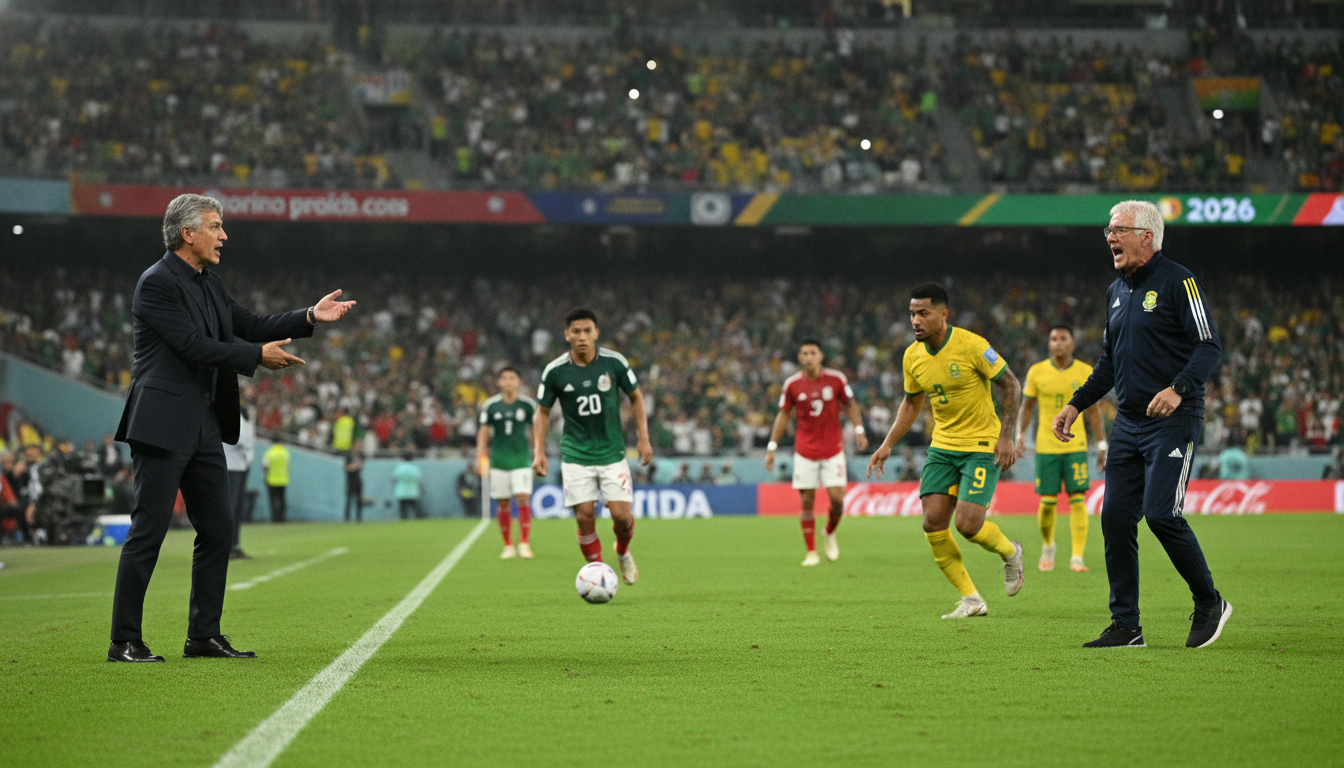
Mexico vs South Africa: Aguirre and Broos Renew 40-Year Rivalry in World Cup Opener
Mexico vs South Africa: Aguirre v Broos renew a 40-year rivalry in the 2026 World Cup opener at the Azteca amid travel concerns in the 48-team tournament


Mexico vs South Africa will kick off one of the most expanded and logistically complex World Cups on Friday, June 12, 2026 at 03:00 HKT, as hosts Mexico, led by Javier Aguirre, meet Hugo Broos’s South Africa in a match threaded with history and modern challenges. The tie revives echoes of the 1986 opening game at the Azteca, and the matchup is now set against the backdrop of a 48-team tournament spread across three countries. Both coaches, the venue and the tournament’s scale have shaped pre-match attention, with travel, scheduling and media access emerging as defining storylines ahead of kickoff.
Aguirre and Broos: A 40-year arc from Mexico 1986
Four decades ago Javier Aguirre was involved in the opening match of the 1986 World Cup at the Estadio Azteca when Mexico beat Belgium 2-1 in front of roughly 110,000 spectators. That result and the spectacle of the Azteca have become part of the match’s lore, making Friday’s reunion between Aguirre and Hugo Broos feel like a full-circle moment. Both coaches arrive now with very different challenges and rosters, but the historical link adds an emotional edge to what is otherwise a group-stage fixture.
The 1986 fixture took place in an era of a 24-team World Cup contained inside one country, a contrast that underscores how much the competition has changed. Aguirre returns as the host nation’s manager with the weight of expectation that accompanies hosting duties, while Broos leads a South African side intent on making a mark in a wider, more crowded field. The coach-to-coach narrative provides a neat throughline, but the contemporary focus is as much on logistics and tournament format as on nostalgia.
Tactical outlook for Mexico vs South Africa
Mexico will be expected to control possession and build attacks through a blend of experienced campaigners and younger, creative midfielders who can unlock compact defensive blocks. Aguirre’s teams have typically emphasized organization and transitional strikes, and Mexico will likely aim to assert tempo early to both satisfy the home crowd and set a platform for the group. Given the Azteca’s size and intensity, Mexico can use home advantage to push the pace and test South Africa’s defensive concentration.
South Africa under Hugo Broos have arrived with an approach shaped by pragmatism and set-piece preparedness, aiming to be compact without the ball and dangerous on counter-attacks. Broos has spoken about adapting to difficult travel and venue shifts across the tournament, and his tactical planning appears to factor in squad rotation and measured exertion. The contest may hinge on midfield control and which side better manages transitions and second-ball situations inside the box.
Logistics and travel: The 48-team format’s growing pains
The 2026 World Cup’s expansion to 48 teams and staging across three countries has generated fresh logistical challenges for squads, officials and the media. Broos warned that the tournament’s scale can make it “more exhausting” than previous editions, pointing to the prospect of long-distance travel to venues such as Atlanta or Los Angeles for knockout matches. Teams now face the prospect of lengthy transits and compressed turnaround windows that demand careful planning of training, recovery and squad rotation.
For national associations and tournament organizers, balancing fairness with feasibility has become a constant operational puzzle. Travel implications are not merely about miles covered; they affect acclimatization, sleep patterns and scouting preparations. Coaches who can manage rotation and preserve energy across sequences of fixtures will have an advantage as the group stage hands out chances to progress in the widened field.
Azteca atmosphere and host expectations
The Estadio Azteca remains a symbolic centerpiece of Mexican football, its cavernous bowl and vocal support capable of molding match rhythms. Hosting the opening match in a stadium long associated with World Cup drama places added pressure on the home team to perform, and Mexico will need to harness the crowd to create an early tournament momentum. For visiting teams, coping with crowd noise and the scale of the arena is an early test in tournament temperament.
Organizers have sought to accommodate press and supporters around the venue, but the size of the event has also exposed operational strains. Even as the Azteca offers capacity and history, ensuring a consistent fan and media experience across multiple host cities has proved a significant undertaking. How well local organizers and the national federation manage the immediate matchday environment will be noticed by teams and the wider tournament audience.
Media accreditation and press access issues
Journalists covering the match faced notable delays during accreditation on Wednesday, with queues stretching for several hours under hot sun and limited shelter. Several reporters described waiting around three hours to gain entry to a large marquee where briefings and interviews were to be held, and small frictions such as requests to lower UV umbrellas were raised to manage crowding. The situation highlighted the pressure on local organizers to scale media facilities in line with the tournament’s expanded footprint.
Access and working conditions for journalists are integral to how the World Cup is presented globally, and any bottlenecks have knock-on effects for coverage quality and deadlines. Media contingencies such as hydration points, shade and rapid processing are now part of the logistical checklist for major events, and the early accreditation issues will likely prompt adjustments before later fixtures. Both federations and local organizers will be under scrutiny to streamline operations as the tournament progresses.
Implications for group standings and knockout routes
A victory for Mexico in the opener would provide immediate breathing room in their group and satisfy the expectations of local supporters, while a positive result for South Africa would bolster their prospects in a larger and more congested qualifying landscape. In a 48-team format where multiple third-place pathways and tiebreakers affect progression, early points can be decisive both for confidence and for tactical leeway in later matches. Coaches will weigh short-term selection choices against long-term tournament planning.
Beyond immediate results, the way teams navigate travel, recovery and media obligations will influence their trajectory in the knockout phase. Broos repeatedly signaled concern about long-distance fixtures and the cumulative fatigue that can arise in a transnational tournament. Teams that manage physical load, squad depth and psychological readiness will better position themselves for the intensified demands of knockout football.
The Mexico vs South Africa opener stages a story that blends nostalgia with modern complications, pairing a historical rivalry with the realities of a vastly expanded World Cup. As Aguirre’s hosts and Broos’s visitors take the field at the Azteca on June 12, the match will be judged not only for its scoreline but for how each side copes with the broader pressures of travel, logistics and expectation in a tournament reshaped by scale.