Erling Haaland Double Sends Norway Past Senegal 3-2 to Reach World Cup Last 32
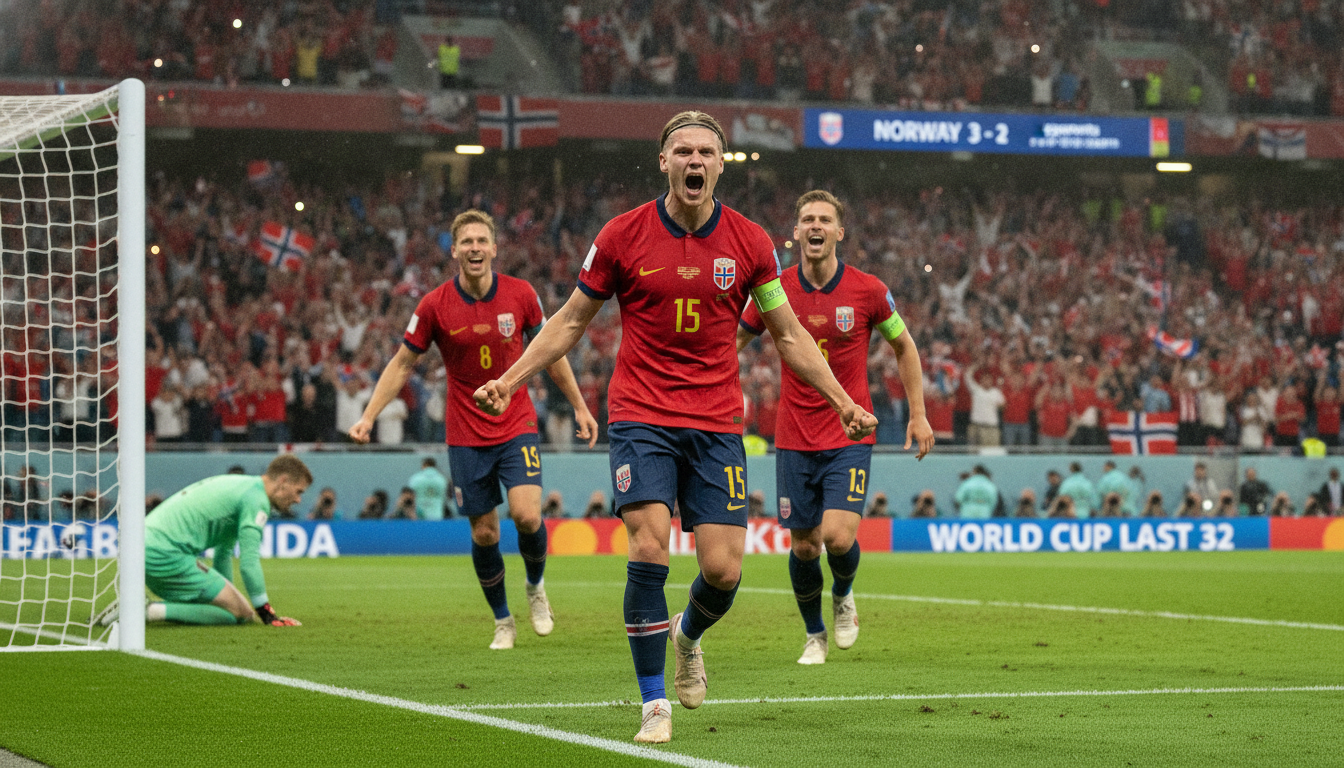
Erling Haaland’s double powered Norway to a 3-2 victory over Senegal at MetLife Stadium, securing the Scandinavian side a place in the World Cup last 32 and reshaping Group I’s dynamics.

Haaland’s brace seals Norway’s progression
Erling Haaland opened the scoring and added a second to give Norway a decisive edge in a pulsating encounter in New Jersey. His movement and clinical finishing ensured the visitors took control early and repeatedly punished gaps in Senegal’s defence. Haaland’s two goals moved him to four for the tournament after just two matches, a blistering start that has already drawn historical comparisons.
Marcus Holmgren Pedersen also found the net to extend Norway’s lead, supplying a valuable third goal that stretched Senegal’s resolve. Norway managed the game’s tempo thereafter, alternating between possession-heavy phases and quick, direct transitions to keep Senegal unsettled. The win mathematically secured Norway a place among the last 32, lifting pressure on the Scandinavians ahead of the final group fixtures.
Confidence within the Norwegian camp was visible after full-time as players and staff celebrated the qualification milestone. The result also sends a message about Norway’s attacking identity at this tournament, with Haaland leading an attack that is both efficient and adaptable. For a nation long chasing consistent World Cup impact, the victory represents a clear step forward.
Dramatic finish as Sarr ignites Senegal comeback
Senegal responded with urgency late in the match, Ismaila Sarr producing a second-half brace to turn the closing stages into a grandstand finish. Sarr’s pace and directness troubled Norway’s backline, and his second goal in particular set up a nerve‑shredding finale for the crowd at MetLife Stadium. The Lions of Teranga showed belief until the final whistle, but ultimately fell short by a single goal.
The comeback attempt underlined Senegal’s attacking potential and highlighted moments of vulnerability for Norway, especially in transition. While the result was disappointing for the West African side, the performance confirmed they remain a threat in the group. Sarr’s display will be taken as a positive sign by his coaches as Senegal prepare for their last group game.
Senegal’s path to the knockout phase now hinges on a big win in their final fixture and favourable results elsewhere. If the Lions can amass a high-scoring victory in their next match they could still qualify as one of the tournament’s best third-placed teams. That realistic but narrow avenue ensures Senegal will not only compete for points but also for goal difference and goals scored.
Group I permutations and standings after New Jersey
The result left Norway level on points with France at the top of Group I, tightening the contest for first place as the group approaches its decisive round. France dominated their match against Iraq, with Kylian Mbappe contributing a brace in a comprehensive 3-0 victory that kept Les Bleus in contention. Meanwhile Lionel Messi’s brace in Argentina’s separate fixture underlined the quality on display across the tournament and provided wider context to Norway’s qualification.
With two matchdays played, every goal and every tactical nuance now carries extra weight in the calculation of which teams advance automatically and which must rely on third-place slots. Norway’s qualification does not automatically eliminate Senegal from the equation; a high-scoring final group day could still swing the balance. Teams in Group I will head into the last round of fixtures acutely aware that fine margins will determine who advances and who does not.
Coaches and analysts will spend the coming days parsing the permutations and preparing game plans that account for both points and goal metrics. For Norway, maintaining momentum while managing expectations will be the immediate priority. For Senegal and France, the upcoming matches present both opportunity and pressure, with qualification scenarios dependent on both performance on the pitch and results elsewhere.
Tactical shifts and key moments that decided the match
Norway’s approach combined patient possession with rapid forward bursts, allowing Haaland to exploit spaces between Senegal’s defensive lines. The visitors created openings through smart off-the-ball runs and quick passes into the penalty area, forcing Senegal to make difficult choices in marking and pressing. Pedersen’s contribution came from following up play in the box, illustrating Norway’s emphasis on collective attacking responsibility.
Senegal adjusted by introducing greater directness late in the game, looking to use Sarr’s speed to stretch Norway and create isolation opportunities. That tactical tweak paid dividends, producing both of Sarr’s goals and bringing Senegal within striking distance. However, gaps remained at the back for the West African side, and Norway capitalised on one decisive sequence to regain control.
Set-piece moments and transitional play were also pivotal as the game swung one way and then the other. Norway’s ability to defend discrete periods of pressure and then switch quickly to attack made the difference in the closing stages. Coaches on both benches will take lessons from the match on the importance of managing transitions and responding to opponent adjustments in real time.
Haaland’s tournament form and historical context
Erling Haaland’s four goals in two World Cup matches mark one of the most explosive starts by a striker at a major finals in recent memory. His scoring run places him among a small group of players who have managed multiple-goal hauls across their first two games at the tournament. The comparison to other prolific starts underlines the striker’s potential to dominate the scoring charts if he maintains this level of form.
Beyond raw numbers, Haaland’s contributions have been significant in controlling matches and giving Norway a psychological edge. His presence forces opponents to commit extra defenders, opening space for teammates and altering opposing formations. Such an influence is as valuable as the goals themselves, and it helps explain why Norway’s attack has looked coherent and threatening.
As the tournament progresses, opponents will plan specifically to counter Haaland’s strengths, testing Norway’s ability to diversify their attacking options. For Haaland, maintaining sharpness and staying fit will be crucial to sustaining his scoring pace. The coming fixtures will reveal whether this is the start of a historic tournament or an early peak that others will aim to curb.
Implications for the remainder of the group stage
Norway now carry momentum but must navigate the final group match with focus to secure a favorable draw for the knockout rounds. The Scandinavian side’s coaches will likely weigh the benefits of consolidating their defensive structure against the need to preserve attacking fluidity. How Norway manage rotation and tactics in the next fixture will determine whether they head into the last 32 fully prepared.
Senegal face a make-or-break scenario in their final match, needing a large margin victory and supportive results from other groups to keep qualification hopes alive. The Lions’ ability to replicate the attacking urgency shown late at MetLife Stadium will be critical. Players like Ismaila Sarr will be expected to lead the offensive charge while teammates shore up vulnerabilities at the back.
For France, Ireland, and other contenders watching Group I unfold, the results in New Jersey add another layer of complexity to tournament planning. Coaches across the World Cup will monitor the group closely, mindful that shifting standings can affect preparation, scouting, and strategic choices in subsequent rounds. The final group day promises to be decisive and likely dramatic.
Norway’s qualification, fueled by Erling Haaland’s brace and a collective team effort, has reshaped expectations in Group I. The result keeps multiple teams in contention and sets up a tense finish to the group stage with qualification scenarios hinging on both results and goal metrics. As tournament attention turns to the final round of matches, teams and fans alike will be watching how those permutations fall into place.