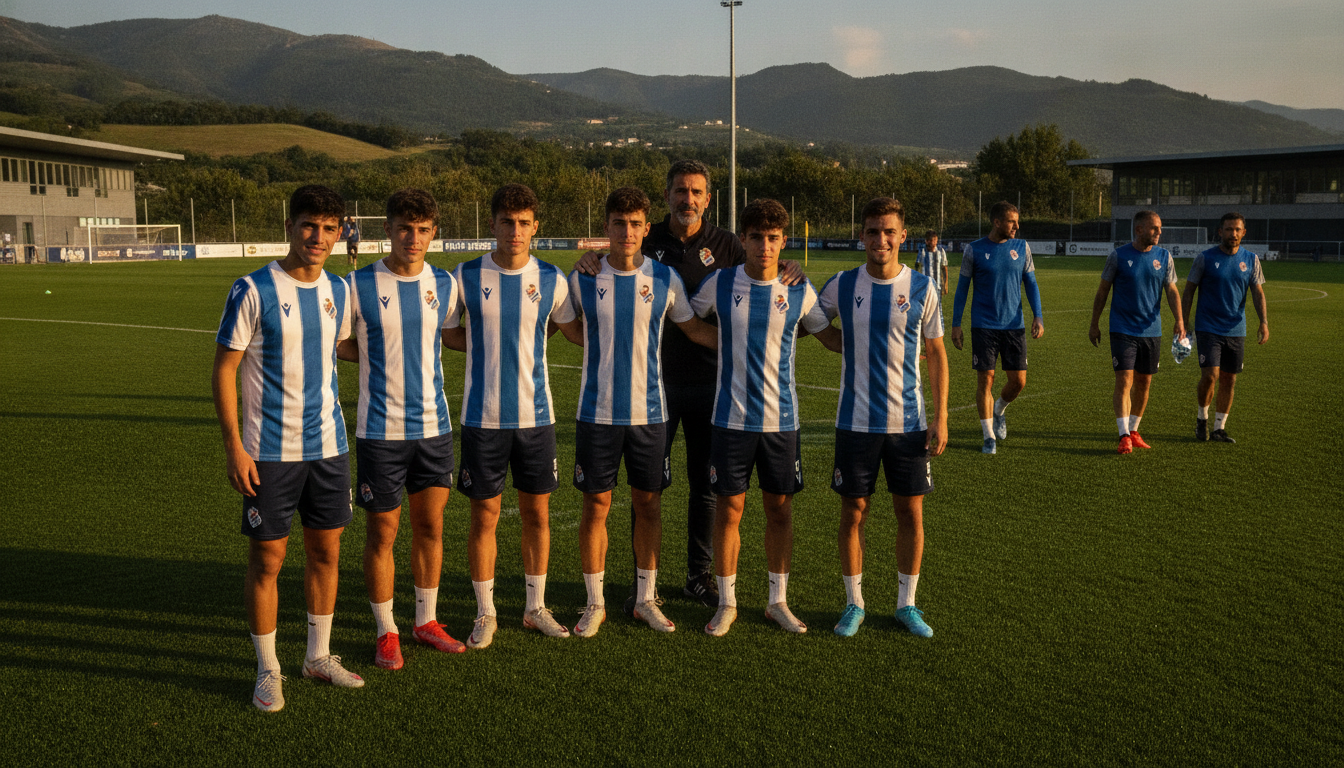
Real Sociedad one-club players: only seven academy graduates can still finish their careers at the club
Seven homegrown players remain capable of completing careers at Real Sociedad after the 2010 promotion; we examine who can stay, who left, the academy’s future.


Real Sociedad’s academy faces a stark reality: of 35 academy players who earned a first-team number since the club’s 2010 promotion, just seven currently retain the plausibility of becoming true Real Sociedad one-club players. The names—Mikel Oyarzabal, Igor Zubeldia, Aihen Muñoz, Ander Barrenetxea, Beñat Turrientes, Pablo Marín and Unai Marrero—stand out as the only homegrown prospects still positioned to make their entire professional careers in the same blue-and-white shirt. This article examines the circumstances that produced so few one-club outcomes, highlights near-misses and departures, and considers what the trend means for the club’s academy and long-term identity.
Seven homegrown players still in position to complete Real Sociedad careers
Mikel Oyarzabal and Igor Zubeldia are the clearest examples of homegrown success within the current squad, occupying leadership roles and long-term first-team places. Both players have matured into established internationals and club figures, and their continued presence gives them the best shot at becoming full one-club players. They are joined by Ander Barrenetxea and Aihen Muñoz, who remain in the mix despite differing levels of playing time and contractual security.
Beñat Turrientes, Pablo Marín and Unai Marrero represent the younger tier of those who still have realistic hopes of finishing their careers at Real Sociedad. Each has navigated reserve football and intermittent first-team exposure, and all three retain the developmental runway to establish sustained top-level roles. Together, these seven account for the limited pool of homegrown talent that can plausibly become lifelong club men in San Sebastián.
How the 2010 promotion reshaped the pathway from Zubieta
The promotion achieved in 2010 created a fertile environment for Zubieta graduates to reach the first team, but the subsequent decade-and-a-half has produced mixed career arcs. Early beneficiaries included players who debuted in the post-promotion era and gained first-team numbers, yet not all remained long enough to rack up a full career at the club. The club’s return to the top flight coincided with a renewed emphasis on youth, but external demand and changing market dynamics have repeatedly disrupted retention.
Some graduates became emblematic figures for the club after 2010, while others left at the first major transfer opportunity. That pattern reflects both the quality of Real Sociedad’s production line and the commercial pressures that turn promising academy graduates into transfer assets. The 2010 cohort and subsequent classes underline the dual reality of development: successful integration into the first team is necessary but not sufficient to secure a one-club career.
Notable departures and near-misses that illustrate the difficulty
Several players who seemed destined for one-club status left San Sebastián earlier than fans hoped, underscoring how fragile the one-club trajectory can be. Asier Illarramendi is among the most prominent examples; he emerged from Zubieta and impressed sufficiently that Real Madrid activated his clause, taking him away after only a short spell as a senior regular. Similarly, Iñigo Martínez moved on under circumstances that combined sporting ambition and market opportunity.
Other graduates who came close include Joseba Zaldua and Aritz Elustondo, both of whom spent significant time at the club but ultimately did not complete their careers solely at Real Sociedad. Loan spells, transfers abroad and tactical reshuffles converted hopeful continuities into fragmented careers. These cases highlight how player valuation, timing and club strategy often outweigh sentimental continuity when decisions are made.
Recent generations: who stayed, who left and who still has a chance
The academy continued to produce high-level prospects in the years after 2010, and many have remained linked to the first team in various roles. Mikel Oyarzabal and Igor Zubeldia have become pillars, and their development into starters has been the most visible proof that Zubieta can deliver top talent. Players such as Aritz Elustondo, Álvaro Odriozola and others showed promise but moved on when transfers or competitive dynamics made departures likely.
Among younger graduates, several names have been cut from the possibility of a full one-club run by early exits, loans or lack of a sustained squad number. Players like Robin Le Normand, Luca Sangalli and Martín Merquelanz did not complete lifelong Real careers, while others have been released or transferred well before that point. The remaining hopefuls—Beñat Turrientes, Pablo Marín and Unai Marrero—still possess the potential to entrench themselves, but their routes to certainty depend on playing time, contract decisions and the club’s broader transfer policy.
Structural and market reasons why one-club careers are rarer now
Several structural factors explain why becoming a Real Sociedad one-club player is increasingly uncommon. The modern transfer market places a premium on young talent, creating continuous purchase interest from domestically and internationally wealthy clubs. When a homegrown player shows form, a well-timed offer can be irresistible to both club and player, particularly if it provides financial security or a perceived sporting step up.
Internally, competition for places has intensified as Real Sociedad alternates between relying on academy assets and supplementing the squad with external signings. Tactical evolution and coaching changes also influence which academy graduates fit the team’s needs long-term. Contracts and squad management—such as the assignment of first-team numbers and the decision to loan players—further complicate the pathway to lifelong tenure, making the one-club outcome the exception rather than the rule.
What the pattern means for Real Sociedad’s identity and academy strategy
The shrinking list of potential one-club players forces a strategic reassessment of how the club balances identity with financial realities. Real Sociedad’s academy remains a core pillar: it supplies talent, embodies the club’s Basque identity and helps sustain competitive performance. Yet the club must reconcile the cultural value of keeping local players with pragmatic choices about sales, loans and reinforcements that preserve sporting momentum.
Strategically, the club can prioritize offering clearer integration plans, longer-term contracts for standout graduates and tailored development pathways that reduce premature exits. Simultaneously, maintaining a healthy transfer policy enables the academy to be financially sustainable and attractive to prospective talents. The challenge will be to sustain a pipeline that produces both competitive players and, when possible, a steady trickle of true one-club professionals.
Real Sociedad’s academy achievements are notable, but the reality is that only a handful of graduates now have a genuine chance to spend their whole careers at the club. That scarcity elevates the status of those who remain and frames each retention decision as consequential for the club’s identity and supporters.