Paraguay stuns Germany on penalties as Japan fall to Brazil at World Cup
Paraguay stuns Germany on penalties in Boston, while Japan crash out after a late Gabriel Martinelli strike handed Brazil a 2-1 win in Houston. AFC teams have managed just three victories from a combined 27 World Cup matches, and all eyes now turn to Australia’s tie with Egypt this weekend.

Paraguay shocks Germany in penalty shootout
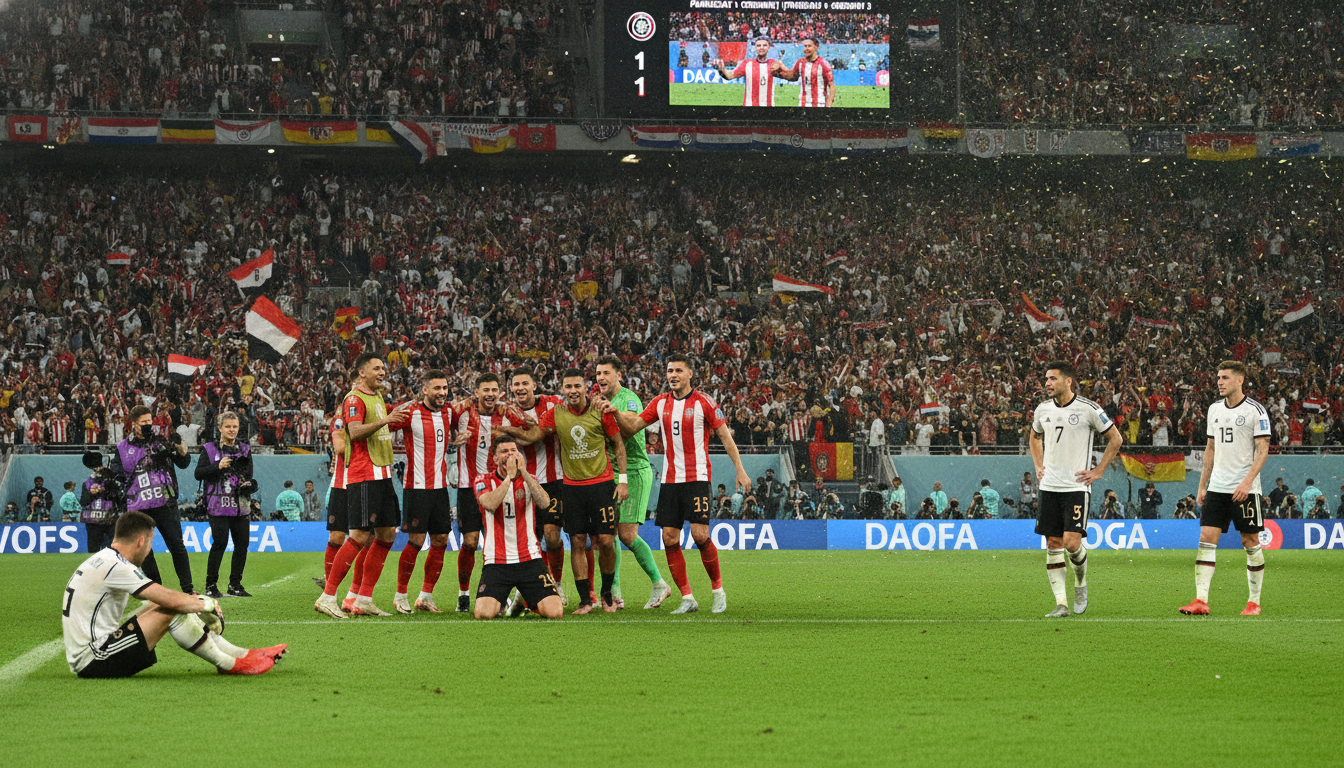
Paraguay produced one of the day’s biggest surprises by eliminating Germany in a penalty shootout in Boston. The tie was decided from the spot, with Paraguay’s Jose Canale converting the decisive kick to send his nation through. The result marked a dramatic end to a tight contest and a sudden halt to Germany’s hopes.
Both teams traded stages of control during the 90 minutes and extra time, but neither could find a decisive breakthrough. The shootout exposed nerves and pressure, with Paraguay remaining composed when it mattered most. The victory will be celebrated as a statement win for South American football.
Martinelli’s stoppage-time blow ends Japan’s run
In Houston, Brazil edged Japan 2-1 thanks to a Gabriel Martinelli goal deep into stoppage time that settled a pulsating match. Japan had shown signs of resilience and were one of the few Asian sides with hopes of progressing, but Brazil’s persistence paid off late. The strike extinguished Japan’s campaign and sent an experienced Brazil side into the next round.
Carlo Ancelotti’s team, described by many as below Brazil’s usual standards entering the tournament, nevertheless found a way to advance. The late winner underlined the relentlessness of knockout football, where single moments can define entire campaigns. For Japan, the defeat closes another World Cup chapter that began with cautious optimism.
AFC’s World Cup record now under scrutiny
The latest results deepen concerns over the performance of Asian Football Confederation nations at the tournament, with the region now recording only three wins from 27 matches. That return has prompted fresh debate about development pathways, domestic leagues and international competitiveness across Asia. Pundits and federations will be under pressure to assess why progress at regional levels has not translated to World Cup success.
Japan’s exit leaves Australia as the continent’s remaining hope, a responsibility that carries weight for fans and officials alike. The statistic of three wins from 27 matches will be hard to ignore as federations prepare post-tournament reviews. The scale of the shortfall suggests structural questions that will require sustained attention.
Germany’s early exit triggers squad and tactical questions
Germany’s defeat raises immediate questions about squad selection, tactical approach and tournament planning. Expectations were high for the European powerhouse, but the knockout exit exposes vulnerabilities that opponents exploited. The nature of the loss — decided on penalties — may soften some criticism, yet the failure to control the decisive moments will demand answers.
Tournament exits often lead to introspection at the federation level, and this result will likely prompt a review of coaching, player development and transition strategies. Analysts will probe whether this squad reflected a coherent long-term vision or a stopgap selection. For a nation accustomed to deep World Cup runs, the early departure is a notable setback.
Australia’s match against Egypt now carries continental significance
With Japan eliminated, Australia’s upcoming match against Egypt has taken on added significance for the AFC’s hopes in the competition. A win would keep at least one Asian representative alive and offer a route for the region to secure a stronger showing. The match is now framed as more than a single tie; it represents a chance to restore some pride and momentum.
Australia will prepare with the knowledge that the continent is watching, and Egypt will be keen to deny them that platform. The dynamics of the tie — experience against tactical discipline — make it a compelling fixture on paper. Both sides will need to manage nerves and the heavy expectations that come with knockout football.
Knockout drama underlines unpredictability of World Cup
The day’s results reinforced how quickly narratives can shift in the knockout rounds, where penalties and late goals rewrite expectations. Paraguay’s composed shootout performance and Martinelli’s stoppage-time strike are reminders that matches are decided by narrow margins. The intensity of single-elimination football often elevates the stakes and rewards resilience and precision.
For tournament organizers and spectators, the mixture of upsets and late finishes adds to the World Cup’s dramatic appeal. For the eliminated teams, it is a moment for reflection and planning; for the winners, a fragile platform from which to build. The grind of knockout fixtures tests depth, adaptability and mental fortitude.
Implications for coaching and player development across confederations
The outcomes will feed into broader conversations about coaching philosophies and youth development across confederations, particularly within Asia. Federations may look to tweak domestic calendar alignment, invest in coaching education, and broaden pathways into elite environments. The gap between regional success and World Cup performance suggests that short-term fixes will not suffice.
Youth academies and domestic leagues will face renewed scrutiny as stakeholders seek to convert talent into results on the biggest stage. Talent identification, international exposure and competitive match minutes are likely to come under the microscope. Any substantive response will require coordinated action and patience from federations, clubs and governments.
The day also offers lessons for established powers that stumbled, demonstrating that talent alone does not guarantee progression. Tactical clarity, cohesion and adaptability often decide knockout ties as much as individual quality. Teams advancing will need to translate narrow escapes into consistent performances.
Paraguay’s victory and Brazil’s late win have reshaped the tournament bracket and shifted momentum for the teams remaining. The shock result in Boston will be dissected and celebrated in equal measure, while Japan’s exit will prompt urgent evaluation. As the competition moves forward, the next round promises further high-stakes drama and decisive moments for players, coaches and nations alike.