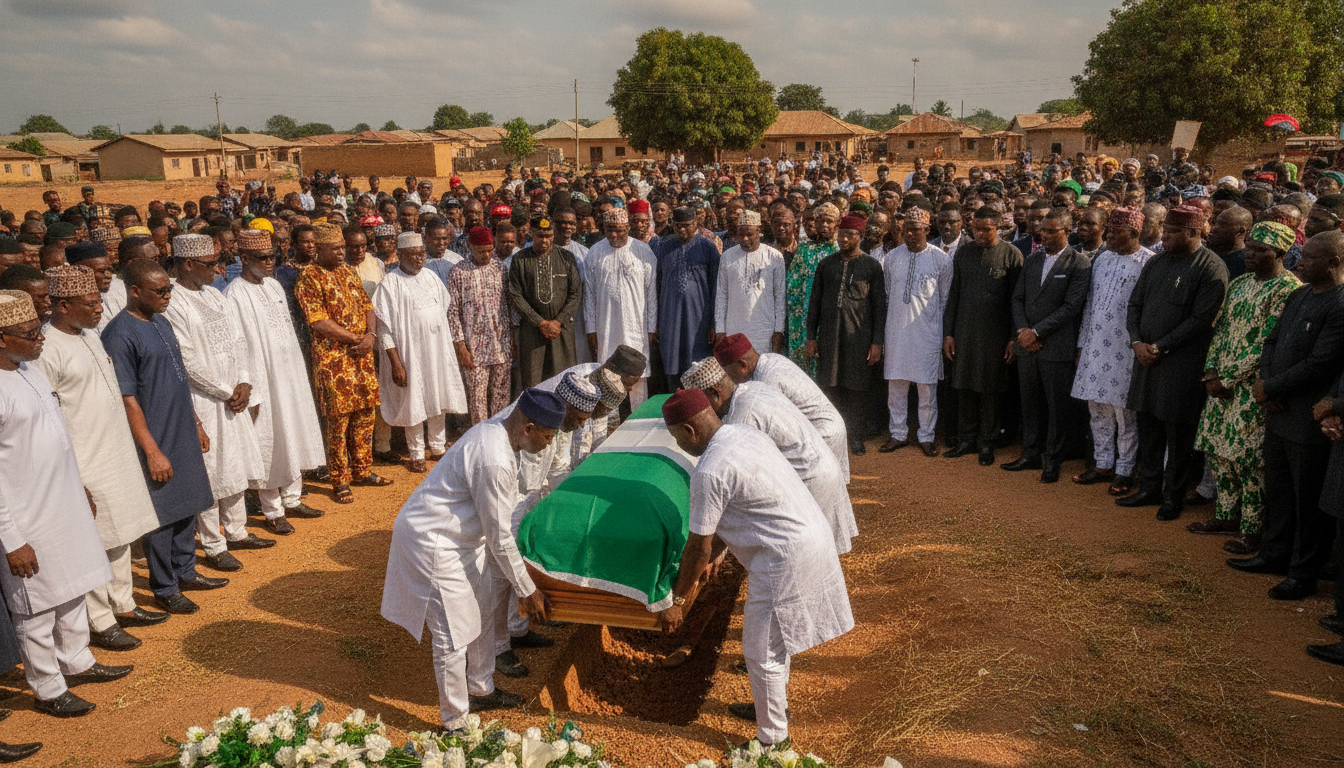
Adegboye Onigbinde funeral sees Super Eagles icon buried in Modakeke amid national tributes
Adegboye Onigbinde funeral in Modakeke drew Nigerian football leaders to honour the coach who led the Super Eagles to the AFCON final and the 2002 World Cup.


Adegboye Onigbinde funeral brought a cross section of Nigerian football, government and traditional authorities together on Friday as the veteran coach was laid to rest in Modakeke, Osun State. The service at Saint Stephen’s Cathedral drew former internationals, federation officials and community leaders who paid public tribute to a coach widely regarded as a pioneer of indigenous Nigerian coaching.
The Nigeria Football Federation confirmed it assisted the family with financial support as part of the burial arrangements. Attendees included current NFF technical officials, past players and representatives of state government and local traditional institutions who emphasized Onigbinde’s long influence on the game at home and abroad.
Onigbinde laid to rest in Modakeke
The burial ceremony took place in Modakeke where the coach’s family and a broad contingent from Nigerian football gathered to mark his passing. The liturgical service at Saint Stephen’s Cathedral was followed by community commemorations that reflected both local respect and national reverence for his career.
Guests included former NFF General Secretary Fanny Amun, NFF Director of Communications Ademola Olajire and a number of ex-internationals such as Mutiu Adepoju and Felix Owolabi. Representatives of the Osun State Government and a number of traditional rulers were also present, underscoring the event’s significance beyond the sporting community.
Prominent federation tributes and support for the family
Augustine Eguavoen, the NFF Technical Director and former Super Eagles captain, represented the federation at the funeral and spoke about Onigbinde’s lasting contribution to Nigerian football. He recalled the coach’s discipline and work ethic, and highlighted the role Onigbinde played in mentoring younger coaches through federation programmes.
The NFF publicly announced it had provided financial assistance to the family to help with funeral arrangements, a move that federation officials described as both practical support and symbolic recognition. Several past and present NFF figures who attended used the occasion to reiterate the federation’s commitment to preserving the legacies of those who shaped the national game.
Career milestones that reshaped Nigerian coaching
Adegboye Onigbinde’s career spanned several decades and helped redefine what indigenous coaching could achieve in Nigeria. He became the first Nigerian coach to take a homegrown squad to the Africa Cup of Nations final in 1984, a milestone that demonstrated the depth of local coaching talent at continental level.
Eighteen years later, Onigbinde again made history by becoming the first Nigerian coach to lead the Super Eagles at a FIFA World Cup when he managed the squad at the 2002 tournament. Although the team did not advance from the group stage, the appointment itself marked an important symbolic and practical breakthrough for Nigerian coaching representation on football’s biggest stage.
Club success and international technical work
Onigbinde enjoyed substantial success at club level, particularly with Shooting Stars Sports Club of Ibadan, where he earned a reputation for tactical acumen and strong player development. His time at Shooting Stars remains a highlight of his domestic coaching career and continues to be cited by former players and colleagues as formative for Nigerian club football.
Beyond Nigeria, his expertise was sought internationally, including a role as technical adviser to the Trinidad and Tobago Football Association and later work as a FIFA technical instructor. Those assignments allowed him to export coaching philosophies developed in Nigeria while bringing broader technical perspectives back to domestic programmes.
Voices from the football community at the funeral
Former teammates, coaching colleagues and ex-players used the ceremony to recall Onigbinde’s mentorship and insistence on coaching education. Several attendees spoke of how he insisted on discipline, preparation and continuous learning, traits they said became hallmarks of modern coaching in Nigeria.
The funeral also brought together multiple generations of Nigerian football figures, from veterans of the 1980s to players and administrators who worked with him in later decades. The breadth of representation at the service was cited by organisers as evidence of the coach’s cross-generational impact and the esteem in which he was held.
Legacy in coaching education and domestic development
Throughout his later years, Onigbinde remained active in coaching education and technical discussions organised by the federation, frequently appearing as a resource person at coaching courses. His advocacy for structured training and certification for coaches was a consistent theme in his public work.
Many who spoke at the burial urged that his focus on education and opportunity for indigenous coaches be carried forward as a living legacy. Officials and former players recommended stronger investment in coach development pathways and the formal recognition of veteran practitioners as mentors for the next generation.
Onigbinde’s passing in March at the age of 88 has prompted reflections across Nigerian football on the progress made and the work that remains. As tributes continue, his career is likely to be cited in future debates about coaching, domestic league development and the role of local expertise in national success.