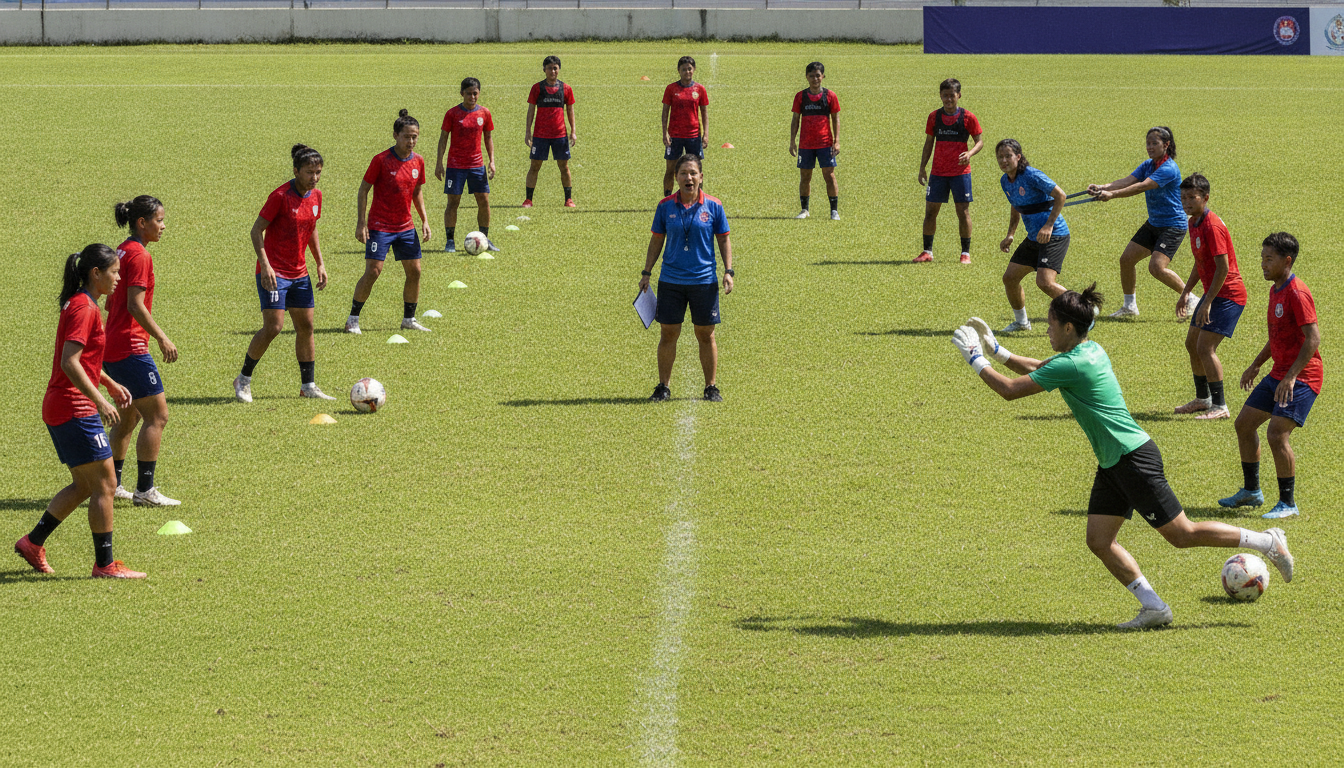
Cambodia women’s national team intensifies training ahead of AFF Women’s Cup 2026
Cambodia women’s national team intensifies training ahead of AFF Women’s Cup 2026 in Kuala Lumpur, sharpening fitness and tactics for opening match on July 10.


Cambodia Steps Up Preparation in Phnom Penh
With less than two weeks until their opening match, the Cambodia women’s national team have ramped up training in Phnom Penh to finalise preparations for the AFF Women’s Cup 2026. The camp is focused on elevating physical conditioning and refining tactical patterns ahead of the Group B fixtures. Team officials say the aim is to bring match-ready fitness and cohesion to Kuala Lumpur.
Coaching staff have organised high-intensity sessions that mix technical work with game-like scenarios to simulate tournament conditions. Players have been rotated through drills emphasizing ball retention, pressing triggers, and quick transitions. The visible increase in tempo underlines the federation’s intent to be competitive on regional soil.
Group B Draw Pits Cambodia with Timor-Leste and Indonesia
Cambodia has been drawn into Group B alongside Timor-Leste and Indonesia for the second edition of the AFF Women’s Cup. Cambodia’s first game is scheduled against Timor-Leste, with the group stage to be played in Kuala Lumpur from July 10–22, 2026. Group A will feature host Malaysia, Laos and Singapore, setting up a compact, six-team tournament at the Kuala Lumpur Football Stadium.
The draw presents contrasting challenges: Indonesia offers a technically polished and experienced opponent, while Timor-Leste represents an opportunity to secure points and sharpen competitive rhythm. Tournament scheduling leaves little margin for error, meaning results in the opening fixtures will be pivotal to advancement hopes.
Squad Selection and Conditioning Priorities
Selection discussions have centred on balancing experience with youthful energy as Cambodia looks to sustain intensity across several matches. The coaching staff are prioritising players who demonstrate endurance and adaptability, optics that are crucial in a compressed tournament format. Medical and support teams have placed an emphasis on recovery protocols to keep the squad fresh between games.
Training sessions have included targeted strength work, aerobic conditioning, and individualized plans to address lingering niggles. The federation has also emphasised mental preparation, with staff running briefings on match scenarios, opponent tendencies and penalty awareness. These preparatory steps are designed to reduce the likelihood of injuries and maintain consistent performance across the group stage.
Tactical Emphasis: Organisation, Set Pieces and Transition
On the tactical front, coaches are focusing on defensive organisation and sharper execution from set plays, areas seen as decisive in short tournaments. Practice routines have concentrated on compact defending, zonal responsibilities and quick recovery after turnovers to limit opposition counter-attacks. Coaches are also drilling patterns for attacking transitions to exploit spaces left by higher-possession sides.
Set-piece routines—both attacking and defensive—have occupied a significant portion of training time, with staff believing that marginal gains from corners and free kicks can determine tight matches. Tactical meetings have paired video analysis with on-pitch implementation, ensuring players understand roles and triggers in various match situations. The intention is to field a compact, disciplined side that can absorb pressure and strike efficiently.
Logistics, Acclimatisation and Match-Day Planning
Cambodia’s delegation will travel to Kuala Lumpur with a schedule that includes acclimatisation sessions and pitch familiarisation ahead of the tournament kick-off. Officials plan to arrive with sufficient time to adapt to local conditions, finalise set-piece routines on the competition surface, and run through match-day procedures. Attention to travel, nutrition and sleep is being treated as a component of competitive preparation.
The AFF Women’s Cup will take place at the Kuala Lumpur Football Stadium, where match conditions, humidity and a tight fixture list require careful load management. Team staff have coordinated with tournament organisers to secure training windows and medical support. Detailed logistical planning aims to minimise disruption and ensure the players’ routines remain stable throughout the competition.
Regional Context and Opportunity for Growth
The AFF Women’s Cup 2026 represents an important platform for Cambodia’s women’s national team to measure progress against regional rivals and accelerate development pathways. For a programme that has invested in grassroots growth and coaching education, this tournament provides exposure for players and a test of recent improvements. Positive results would reinforce momentum for the national programme and help attract attention to women’s football domestically.
Beyond immediate results, the competition offers younger squad members invaluable tournament experience and the chance to stake a claim for future selection. Success in Kuala Lumpur could translate into broader support and funding, while a disciplined performance would signal Cambodia’s intent to become more competitive in Southeast Asia. The event also highlights the broader regional commitment to strengthening the women’s game through frequent competitive opportunities.
The Cambodia women’s national team enter the AFF Women’s Cup 2026 determined to translate their intensified training into tangible results on the pitch. With the tournament beginning on July 10 at the Kuala Lumpur Football Stadium, the squad and technical staff are focused on fitness, tactical clarity and match-day execution for their opening fixture against Timor-Leste. Final preparations in Phnom Penh will wrap up in the coming days before the team departs for Malaysia to begin their campaign.