

Germany World Cup exit: Paraguay stun Germany in penalty drama after extra-time goal ruled out
Germany World Cup exit: Paraguay beat Germany on penalties after an extra-time goal was ruled out; analysis of Nagelsmann’s choices and attacking issues today.


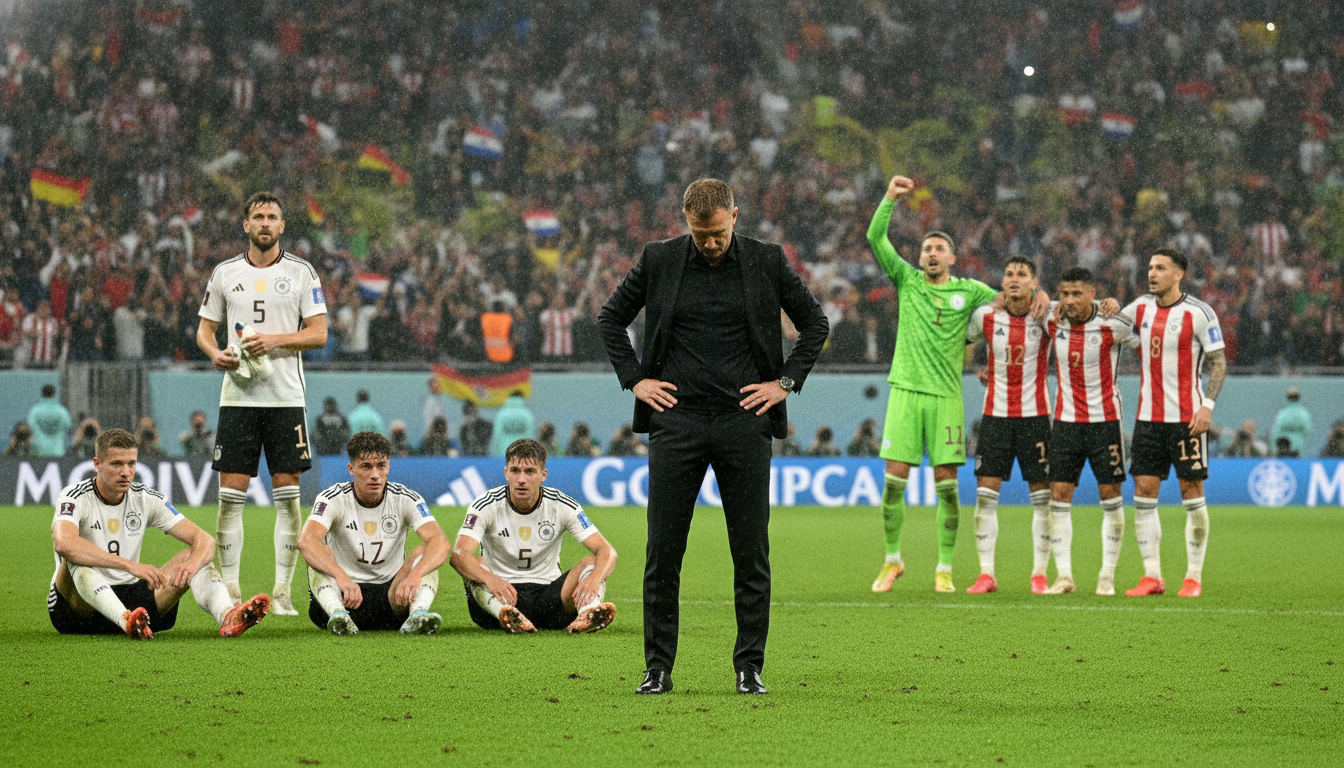
Germany’s World Cup exit came in dramatic fashion as Julian Nagelsmann’s side were eliminated by Paraguay in a penalty shootout after an extra-time goal was disallowed. The match ended with Germany dominant in possession but unable to convert chances, and Jonathan Tah’s would-be winner was rightly overturned following a foul in the build-up. The result underlined persistent attacking inefficiency and raised fresh questions about selection and leadership within the squad. This defeat brings an abrupt end to a tournament that many had expected Germany to contend in more seriously.
Nagelsmann’s selection choices under scrutiny
Nagelsmann entered the knockout stage with a largely consistent starting lineup that had shown signs of strain earlier in the competition. Observers noted a recurring pattern in which substitutes provided greater urgency and impact than the opening XI, yet the coach made only marginal changes for the decisive match against Paraguay. Retaining Leroy Sané in a starting role despite intermittent form became a focal point for criticism, as his influence failed to match that of other attacking options during the tournament.
Those decisions amplified scrutiny on Nagelsmann’s willingness to adapt mid-tournament. Coaches who have succeeded at major tournaments often make bold, corrective moves when early warning signs appear, but Germany’s adjustments felt incremental rather than decisive. The lack of strategic rotation or a clearer offensive contingency plan left the team exposed when Paraguay tightened their defence and forced the game into a tense, low-scoring conclusion.
Missed chances and attacking inefficiency
Germany dominated large stretches of possession but regularly lacked the final pass or composure to turn control into meaningful opportunities. The starting forwards created openings intermittently, yet the team’s attacking sequences too often dissolved before a shot on target was produced. When Germany did threaten, the finishing was inconsistent and their buildup play occasionally became predictable under pressure.
The bench provided glimpses of urgency that the starters could not sustain, with substitute combinations offering sharper transitions and more direct runs behind Paraguay’s defence. That trend highlighted an imbalance between selection and impact, as the match demonstrated how marginal changes in personnel could have altered the rhythm and potency of Germany’s attack. Ultimately, inefficiency in the final third proved decisive when the match needed a match-winner.
Penalty shootout and decisive moments
The match’s pivotal moment arrived in extra time when Jonathan Tah’s header was initially celebrated before being chalked off following a review. Video evidence showed a foul by Waldemar Anton on Paraguay’s goalkeeper Roberto Fernández in the lead-up, and the correct application of the laws erased what would have been a dramatic winner. The reversal shifted momentum and left Germany to find a resolution from the penalty spot, where nerves and precision determine outcomes.
In the shootout itself, Germany’s execution was uneven and appeared to be affected by a visible lack of conviction among certain players. Paraguay displayed a composed collective demeanour, with their takers and goalkeeper showing conviction under pressure. That composure contrasted with Germany’s hesitancy at key moments, and the penalty sequence ultimately favored the side that had managed to better harness the tension inherent in a knockout shootout.
Leadership deficit and squad mentality
Beyond technical shortcomings, the game exposed a leadership shortfall at moments of highest intensity. Reports after the match suggested hesitation among some players when it came to stepping forward for decisive responsibilities, and the team’s body language during the closing stages conveyed a sense of uncertainty. The absence of multiple senior figures taking charge in pressure situations left the burden on a smaller group of individuals to provide direction and resolve.
Germany has historically leaned on collective resilience and a mentality that prioritised determination in knockout football, traits that have sometimes compensated for tactical or technical gaps. This edition’s squad exhibited high-quality technical attributes but lacked the same visible cohesion and self-assuredness when the match tilted towards a nerve-testing finish. Joshua Kimmich’s consistent attempts to shoulder responsibility were noticeable, but one player’s leadership could not fully substitute for a broader culture of in-game accountability.
Tactical drift and questions about national identity
The national team’s recent evolution toward a possession-oriented, positional style has produced periods of tactically refined football, yet it has coincided with the erosion of several traditional strengths. Physical assertiveness, aggressive pressing and direct attacking intent—elements that once defined Germany’s international identity—were less evident during this tournament’s later stages. That drift has prompted debate about whether tactical modernisation has been pursued at the expense of balance and competitive edge.
Adapting to contemporary football is essential, but the transition requires careful preservation of defining characteristics that deliver results in high-stakes tournaments. Over the past cycles, Germany’s approach has fluctuated between innovation and a loss of clarity in how best to win tight matches. The current elimination suggests those tensions remain unresolved and that a clearer synthesis of evolving tactics and ingrained national traits is required.
Path forward for the DFB and coaching staff
The Deutscher Fußball-Bund now faces difficult but necessary decisions about structure, player development and leadership frameworks across the national setup. Short-term responses will likely centre on personnel and tactical recalibration, while longer-term work must address the cultivation of mental resilience and decisive leadership in emerging players. A review that spans coaching methods, captaincy strategy and talent pathways could help produce a team better equipped for knockout unpredictability.
There are practical steps the coaching staff can take immediately: reassessing selection criteria to prioritise current form and mental readiness, rehearsing high-pressure scenarios such as penalty sequences more rigorously, and encouraging more assertive on-field leadership. At the administrative level, the federation may need to revisit development programmes to ensure players are nurtured not only for technical excellence but also for psychological robustness required at the highest international level.
Germany’s World Cup exit will prompt intense internal analysis over the coming weeks, but it also offers an opportunity to confront uncomfortable truths about identity, preparation and tactical clarity. The result against Paraguay should not be viewed simply as a single-match upset but as a catalyst for strategic reflection and institutional improvement. The steps taken now will determine whether the national team can restore the blend of skill, mentality and adaptability that has historically underpinned its success.
For supporters and stakeholders alike, the immediate task is to understand what changed and why, then to apply those lessons constructively so that future tournaments yield outcomes more in line with Germany’s proud footballing heritage. The federation’s response, selection policies and the development of on-field leaders will be watched closely as the team seeks to move beyond this disappointing exit.