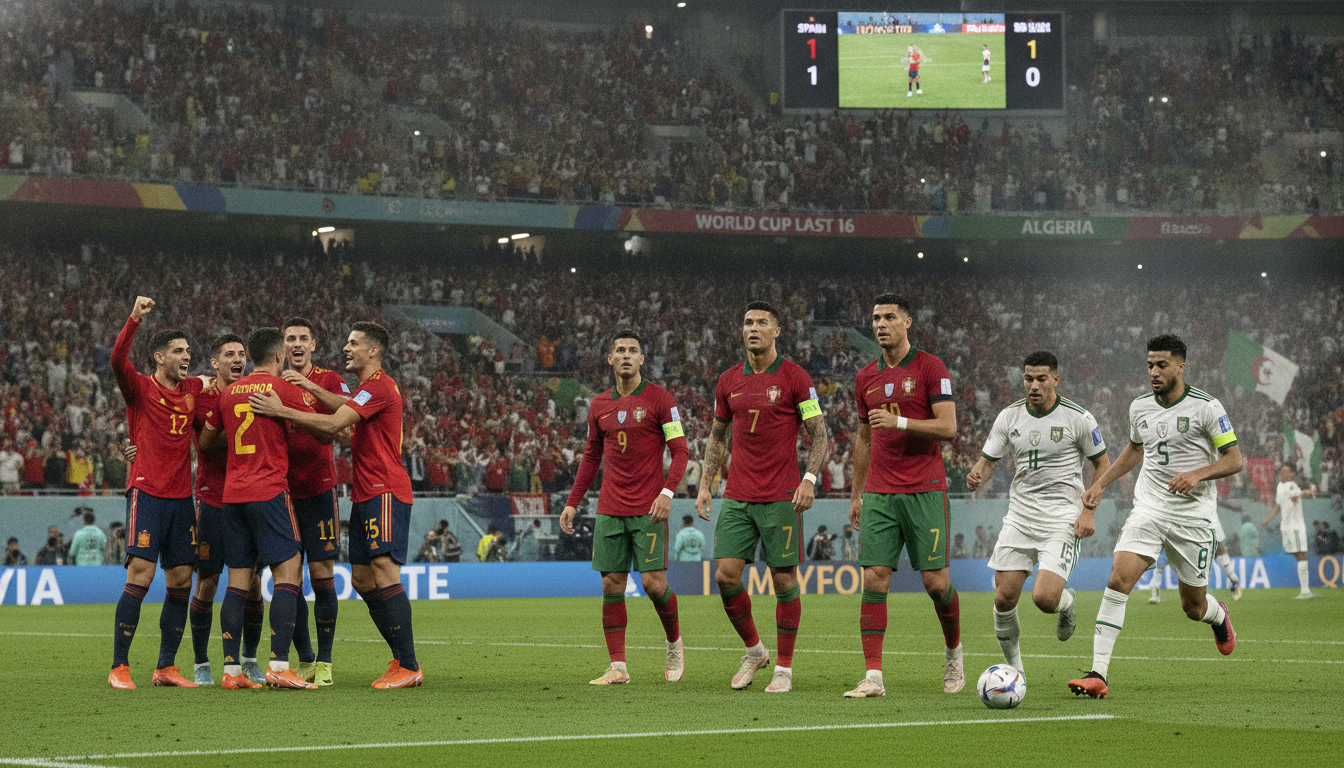
Spain, Portugal and Algeria Chase World Cup Last-16 Places in Decisive Knockout Ties
Spain, Portugal and Algeria chase World Cup last-16 berths on Thursday as Spain face Austria, Portugal meet Croatia and Algeria take on Switzerland in Vancouver

European champions Spain, Cristiano Ronaldo’s Portugal and an Algeria side seeking to revive African fortunes head into a decisive World Cup last-32 matchday that will determine who advances to the tournament’s last 16. Spain play Austria in Los Angeles, Portugal meet Croatia in Toronto and Algeria face Switzerland in Vancouver, with all three fixtures carrying knockout pressure and wider implications for their nations. The outcomes could shape the bracket for the remainder of the World Cup and influence the futures of senior stars on either side.
Spain face Austria in Los Angeles with qualification on the line
Spain arrive in Los Angeles having carried possession and pressure through the group stage but without the clinical edge that often decides knockout games. A win will secure Spain’s place in the World Cup last 16 and keep alive the possibility of meeting Portugal in the next round, should results elsewhere align. Austria, by contrast, will target a resilient defensive showing and look to exploit transitions where Spain can be vulnerable, particularly on set pieces.
Tactical nuance will matter as Spain manager looks to blend midfield control with timely forward runs to break Austria’s block. Austria’s compact structure means Spain must be patient and precise, while Austria will bank on efficient counterattacks and aerial presence in the box. Game management and substitutions are likely to shape the closing stages in a match where one result could tilt a wide-open bracket.
Portugal meet Croatia in Toronto with potential farewells for Ronaldo or Modric
Portugal’s clash with Croatia in Toronto carries not just qualification stakes but the added narrative of two veteran icons possibly playing their final World Cup fixtures. Cristiano Ronaldo remains Portugal’s talisman, and his side will aim to secure a last-16 berth through a balanced display that marries attacking invention with defensive stability. Croatia, led by Luka Modric’s midfield orchestration, will lean on experience and tactical discipline to unlock Portugal’s defensive setups.
The contest pits Portugal’s direct attacking threats against Croatia’s ability to control tempo and recycle possession under pressure. Coaches on both sides will weigh squad rotation against the need to field their strongest XI in a knockout setting, mindful that an upset here would reverberate through the remainder of the World Cup. The match also represents a potential generational handover, with younger players in both camps eager to step forward on a global stage.
Algeria aim to restore African pride against Switzerland in Vancouver
Algeria enter the fixture in Vancouver having advanced from the group stage with a dramatic 3-3 draw against Austria, edging into the last 32 by narrow margins. Their encounter with Switzerland presents an opportunity to reinvigorate African representation in the latter phases of the World Cup after several early knockout exits by other continental sides. Algeria will need a coherent defensive plan paired with quick, incisive attacks to unsettle a disciplined Swiss unit.
Switzerland are likely to present an organized, pragmatic approach that prioritizes compactness and set-piece efficiency. For Algeria, the match is as much about restoring momentum for the squad as it is about national pride, with coaches and players aware that a win would halt a recent pattern of early African exits. The fixture in Vancouver carries symbolic weight for the continent and practical implications for tournament narratives.
Recent knockout struggles frame Algeria’s challenge and continental context
African teams have faced a difficult run in this World Cup’s knockout window, with South Africa, Ivory Coast, Senegal and the Democratic Republic of Congo all eliminated at the first hurdle after progressing from the group stage. That sequence places added pressure on Algeria to arrest a trend that has drawn attention across the continent and beyond. Success for Algeria would not only advance their campaign but also serve as a morale boost for African football in a tournament context.
The broader pattern underlines how marginal differences—game management, late goals, individual moments—often decide knockout encounters. National teams from Africa have shown tactical quality and hunger, but results have gone against several sides at critical moments. Algeria’s manager will therefore emphasize concentration across all 90 minutes and readiness for extra-time or penalty possibilities, understanding that such battles determine advancement in the World Cup.
Tactical matchups, key players and set-piece considerations
Set pieces and transitional moments are expected to be decisive across the three fixtures, with Spain’s probing play, Portugal’s forward variety and Algeria’s quick breaks each presenting distinct threats. Spain’s midfielders will be tasked with maintaining possession under pressure and creating overloads on the flanks to break down Austria’s compact shape. Portugal will look to get creative in the final third through combinations and occasional long switches to stretch Croatia’s defensive line.
Algeria’s plan will likely focus on speed in wide areas and a willingness to commit numbers forward when opportunities arise, while Switzerland’s physicality could challenge airborne duels in both boxes. Coaches will also monitor fitness levels closely given the tournament schedule, and substitutes with specific tactical roles—late runners, set-piece specialists or pressing forwards—may decide tight matches in the World Cup last-32 phase.
Possible permutations and consequences for the tournament bracket
A Spanish win over Austria would set up clearer paths in the bracket and keep open a high-profile potential meeting with Portugal in the next round, which would capture global attention. If Portugal prevail against Croatia, the Portuguese side would advance with momentum and likely favor among bettors and analysts given their blend of experience and individual quality. Conversely, any upset—Austria over Spain, Croatia over Portugal or Switzerland over Algeria—would reshuffle expected matchups and create fresh narratives for the World Cup’s knockout rounds.
Beyond immediate advancement, results will affect squad morale, managerial evaluations and longer-term planning for each federation. Older players contemplating retirement from international football will find their decisions colored by performance in these decisive ties. For supporters and neutrals, the Thursday slate of matches offers both high stakes and the kind of drama that defines the World Cup knockout stages.
The three matches across Los Angeles, Toronto and Vancouver will test depth, discipline and decision-making under pressure, and they are likely to produce moments that linger beyond the final whistle. Managers will need to balance tactical clarity with flexibility in-game, and players will be called on to deliver in fronts where margins are often razor-thin. As the tournament progresses, the outcomes of these fixtures will influence not only which teams feature in the last 16 but also the storylines that shape the remainder of the World Cup.