Philippines women’s national football team to tour four continents in build‑up to 2027 FIFA Women’s World Cup
Philippines women’s national football team will embark on a four‑continent preparation campaign through June 2027, featuring the Asian Games, global friendlies, the Pinatar Cup and Olympic qualifiers to sharpen World Cup readiness.

The Philippines women’s national football team will begin a sustained, globe‑spanning preparation aimed at improving its 2023 World Cup performance and reaching the knockout phase in 2027. Head coach Mark Torcaso has mapped a calendar that moves the squad across Asia, South America, Europe and Oceania between September 2026 and June 2027. The plan combines multi‑regional friendlies, tournament exposure and competitive Olympic qualifying ties to build match fitness, tactical variety and squad depth. The campaign reflects a targeted bid by the Philippine Football Federation to give the Filipinas regular high‑quality opposition and to fine‑tune strategy well before the World Cup.
Torcaso unveils four‑continent buildup through June 2027
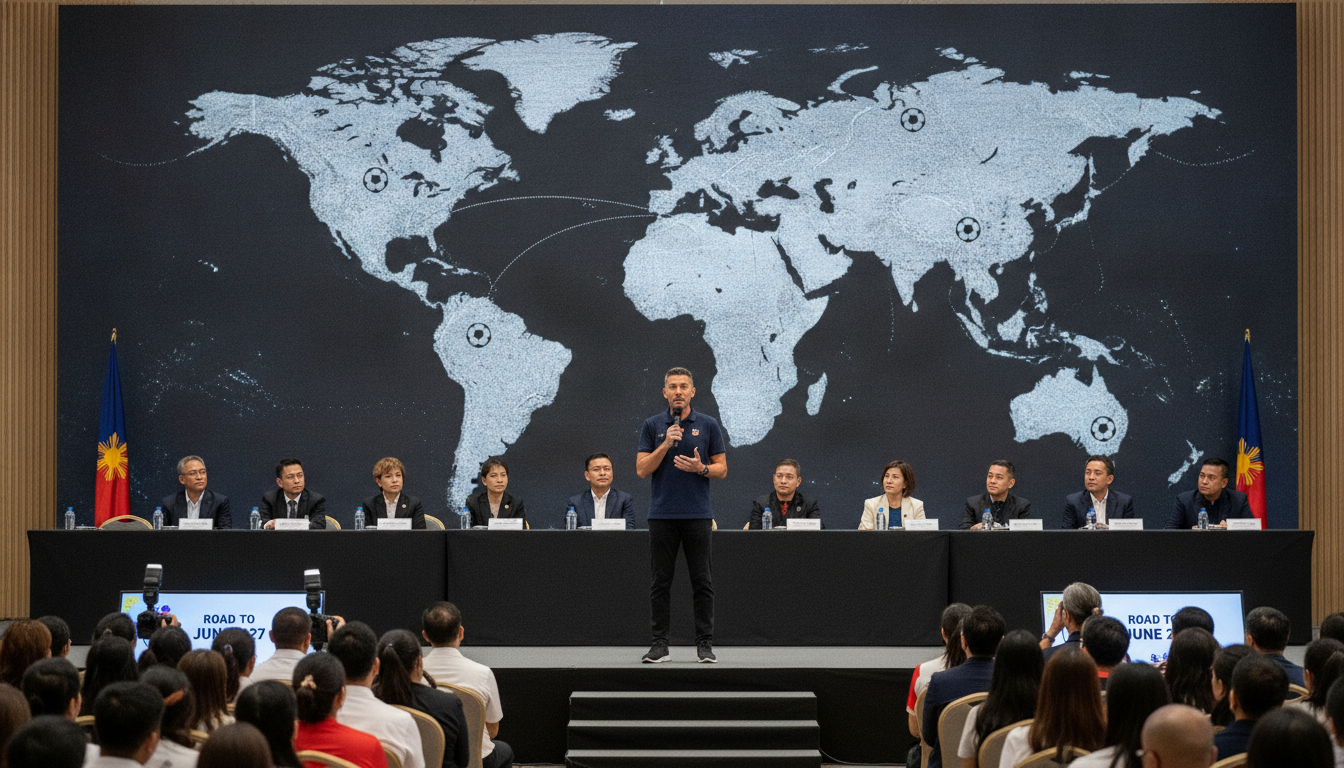
Coach Mark Torcaso’s roadmap begins with the Asian Games in Japan in September 2026 and stretches to an early World Cup camp in South America in June 2027. Between those bookends the team will stage friendlies in South America in October, hold matches across Asia and Oceania from November to December, contest the Pinatar Cup in Spain in February, and play home and away ties in April for 2028 Olympic qualification. Torcaso has framed the schedule as a phased progression designed to expose the squad to differing styles of play and environmental conditions. The sequence is deliberate: competitive tournaments followed by finely chosen friendlies and formal qualifiers to measure progress.
The multi‑continental approach is structured to gradually increase intensity while preserving recovery windows and tactical assimilation. Early tournament play will test the squad’s resilience and cohesion, while later fixtures in Europe and South America aim to simulate World Cup conditions. The inclusion of the Pinatar Cup offers matches against European sides that can challenge defensive organization and transitional play. The schedule also preserves flexibility for additional friendlies and adjustments based on player availability and performance.
Aiming to improve on the 2023 World Cup showing
The Filipinas enter the program with the stated objective of improving on their 2023 World Cup showing and advancing out of the group stage in 2027. That aim drives selection priorities, training emphases and the timing of high‑intensity matches. Torcaso’s plan prioritizes tactical variability so the team can adapt to opponents who employ differing formations and pressing schemes. Coaches and analysts will use the intervening months to refine set‑piece routines, defensive shape and attacking combinations.
Improvement will also hinge on developing a deeper pool of players capable of rotating without diluting quality. The campaign’s friendlies and tournaments provide opportunities to evaluate fringe and emerging players under pressure. Performance tracking across the schedule will inform final World Cup roster choices and positional contingencies. The PFF’s investment in a sustained build‑up signals institutional backing for long‑term competitiveness on the world stage.
Competitive warm‑ups: Asian Games, Pinatar Cup and global friendlies
The Asian Games in Japan will serve as an early, high‑stakes test against regional rivals and strong continental opposition. Matches there will allow the coaching staff to assess the team’s tactical baseline and physical readiness after pre‑camp training. October friendlies in South America are intended to introduce the players to the pace and technical style typical of CONMEBOL opposition. Those fixtures should help the Filipinas adjust to different rhythms of play and sharpen ball‑retention under pressure.
The Pinatar Cup in Spain in February 2027 provides a concentrated block of European opposition and scouting opportunities. European teams in that environment often present disciplined defensive systems and rapid transitional attacks, which will test defensive cohesion and counter‑attacking threat management. Matches across Asia and Oceania in November and December will offer logistical advantages for player recovery while still providing varied tactical challenges. Together, these competitive warm‑ups form a deliberately balanced slate of opponents to build experience across contexts.
Olympic qualifiers as a benchmarking moment
April 2027’s home and away fixtures for the 2028 Olympic qualifiers are positioned as a key measuring stick for the Filipinas ahead of the World Cup. Those competitive ties will reveal whether the squad’s tactical adjustments and personnel choices have translated into consistent results under qualifying pressure. The home‑and‑away format also tests preparation for travel, recovery and strategic adaptability between legs. Positive outcomes in April can validate the preparatory model and increase confidence heading into the final World Cup camp.
Conversely, the qualifiers will highlight areas needing urgent attention, whether in finishing, defensive transitions, or squad rotation. The coaching staff can then target those weaknesses in the subsequent weeks and during the Pinatar Cup and late friendlies. The PFF will likely use data from the qualifiers to finalize logistics and opposition for the June South American camp. In that sense, the Olympic ties are both a goal in their own right and a diagnostic tool for World Cup readiness.
Logistics, travel and match‑readiness considerations
A four‑continent itinerary presents logistical challenges that the PFF and coaching staff must manage carefully to protect player welfare and performance. Travel fatigue, time‑zone changes, and acclimatization to different climates are practical issues that require planning for recovery, rotation, and sports science support. The campaign’s sequencing—regional tournament, continental friendlies, European competition—appears designed to stagger travel demands and allow for tactical consolidation between legs. Proper load management and a clear rotation plan will be essential to avoid injuries and ensure peak availability at critical moments.
Sports science will play an outsized role in the campaign’s success, with recovery protocols, nutrition and individualized training programs becoming central to sustained performance. The team’s medical and conditioning staff will need to coordinate closely with coaching to align return‑to‑play timelines and training intensity. Logistics also extend to scouting and opponent analysis, with dedicated resources required to prepare detailed dossiers on the diverse range of opponents. Effective execution off the field can produce tangible advantages on it.
Implications for Philippine football and regional standing
Beyond immediate World Cup ambitions, the schedule underscores the growth trajectory of Philippine women’s football and the PFF’s commitment to international competitiveness. Sustained exposure to varied football cultures and tactical systems can accelerate player development and raise domestic standards. Successful implementation could also boost the sport’s profile at home, attracting support, sponsorship and a deeper talent pipeline. Regional rivals will note the Filipinas’ intensified preparations, which may alter competitive dynamics across Southeast Asia.
The campaign offers a template for other national programs aiming to build sustainably toward major tournaments. If the Filipinas convert preparation into results, the program could catalyze broader investment in youth development and coaching education within the federation. For players, coaches and administrators, the next 12 months will be a concentrated period in which structural and performance objectives must align. The outcome will influence not just a single World Cup cycle but the longer arc of the sport in the Philippines.
The Philippines’ four‑continent program is a clear, ambitious response to the demands of elite international competition, and it gives the Filipinas a defined pathway to sharpen tactical identity, expand squad depth and test resilience before the 2027 FIFA Women’s World Cup.