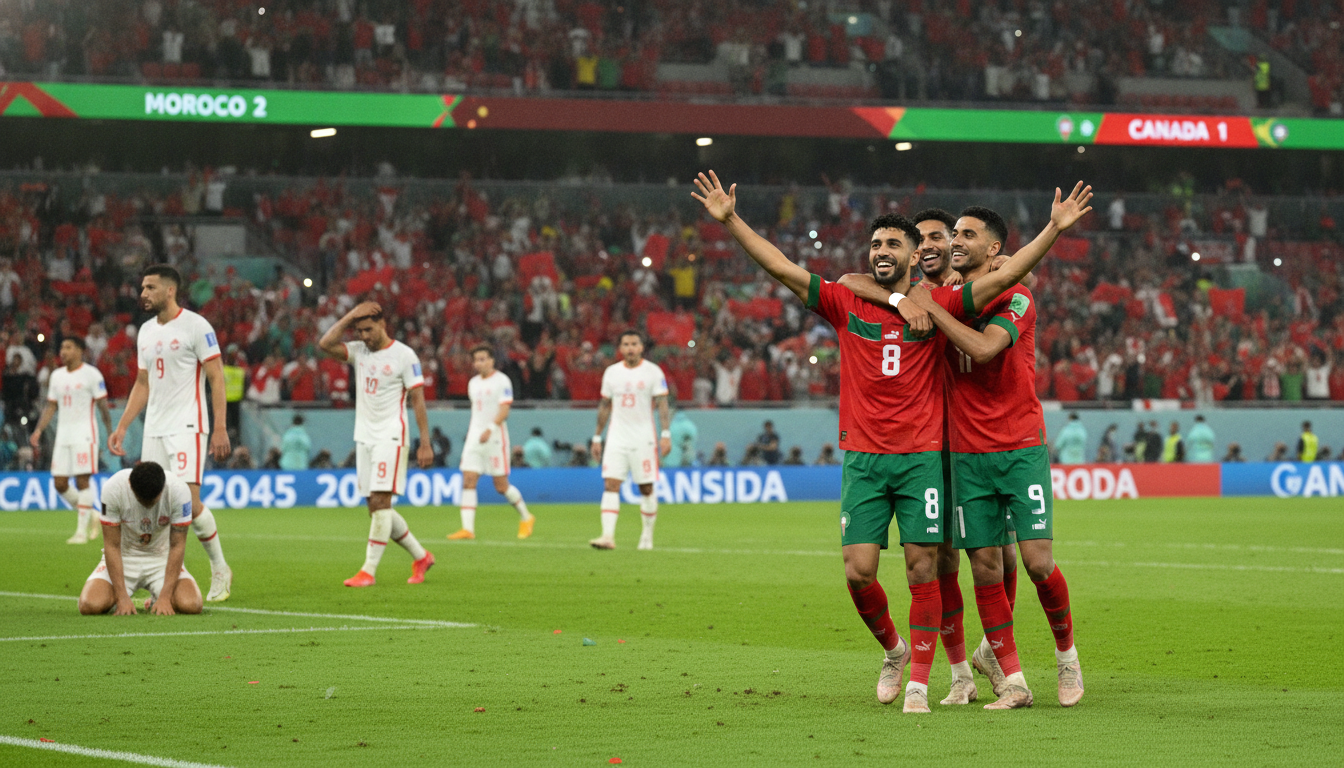
Morocco beat Canada 3-0 in Houston as Ounahi brace sends Atlas Lions into World Cup quarter-finals
Morocco beat Canada 3-0 in Houston as Azzedine Ounahi’s second-half brace and a late Soufiane Rahimi goal propelled the Atlas Lions into the World Cup quarter-finals, setting up a Boston tie on July 9.


Ounahi double sends Morocco into last eight
Azzedine Ounahi scored twice after the interval to break a stubborn deadlock and put Morocco into the quarter-finals for the second consecutive World Cup. His first goal came from a rehearsed set-piece move and his second arrived on the counter as Morocco capitalised on space left by a tiring Canadian side.
Ounahi’s brace marked his first goals at a World Cup and continued an impressive trend: Morocco have rarely lost momentum when he finds the net. The midfielder’s two finishes — a composed strike from the edge of the box and a precise effort into the roof of the net — effectively decided the match in Houston.
Canada started brightly but could not sustain intensity
Canada, one of the tournament’s co-hosts, dominated the opening half through energy and sustained pressure, forcing a series of corners and the game’s first clear chance. Tani Oluwaseyi was played through after Ali Ahmed intercepted a loose Moroccan pass, but his low effort was smartly saved by Yassine Bounou, Morocco’s Canada-born goalkeeper.
The hosts deserved credit for an aggressive opening period, but they were unable to convert early momentum into a lead and visibly faded after the restart. As Morocco grew into the contest, Canada’s offensive threat diminished and the visitors took control of the key moments.
Key moments: injury, set-piece and the decisive counter
The complexion of the game changed when Morocco’s Ismael Saibari, their top tournament scorer, departed with a muscle problem after 22 minutes, replaced by Soufiane Rahimi. Saibari’s exit disrupted Morocco’s rhythm in the first half but allowed others to step forward when it mattered most.
The breakthrough sprang from a planned dead-ball routine, with Achraf Hakimi delivering from the right and Ounahi sweeping home from the D to break the stalemate. Minutes later Morocco punished Canada on the transition, Brahim Diaz’s lay-off finding Ounahi to finish high and emphatically, while Rahimi sealed the result in added time after heading against the bar earlier.
Historical significance for Morocco and African football
With this victory Morocco became the first African nation to reach back-to-back World Cup quarter-finals, extending the nation’s remarkable run following their 2022 semi-final finish in Qatar. The result cements Morocco’s place as one of the tournament’s most consistent performers and furthers the nation’s standing on football’s biggest stage.
Ounahi’s brace also carried continental weight: his two goals were the first time an African player scored a brace in World Cup knockout stages since Henri Camara for Senegal in 2002. That statistical landmark underlines the significance of Morocco’s progression both for the team and for African football more broadly.
Tactical shifts and individual performances that mattered
Morocco adjusted effectively at half-time, shifting the focus to quicker transitions and more aggressive second-ball play, which unsettled Canada’s midfield. Achraf Hakimi’s delivery and Brahim Diaz’s composure to set up the second goal were pivotal elements of the visitor’s improved approach.
On the Canadian side, goalkeeper Maxime Crepeau made important saves but could not keep the scoresheet level in the second half. Canada midfielder Stephen Eustáquio spoke afterward about pride in his team’s tournament and the pain of defeat, noting that Canada had produced a standout first-half performance but were punished by set-piece and transition moments.
Voices from the dressing room and broadcast reactions
Morocco coach Mohamed Ouahbi praised his players’ resilience, highlighting the team’s clean reactions in duels and second-ball situations after the interval. He acknowledged Canada’s quality and said the margin for error in knockout football is slim, with set-pieces and counter-attacks often proving decisive.
Ounahi, speaking to beIN Sports, described his relief and happiness at scoring in such an important fixture and stressed the difficulty of every match in the competition. From Canada, Stephen Eustáquio reflected on the team’s achievement in reaching the last 16 and emphasised national pride despite the knockout exit.
What’s next: Boston quarter-final and potential opponents
Morocco now turn their attention to a quarter-final in Boston on July 9, where they will face the winner of the France versus Paraguay tie. The prospect of drawing France presents a high-profile challenge, while Paraguay would offer a different tactical puzzle; either way, Morocco will prepare for a high-stakes encounter against a nation proud of its own World Cup credentials.
For Canada, the tournament will be remembered as a landmark campaign in which the national team recorded its first-ever World Cup win and advanced to the knockout phase on home soil. The experience should provide a foundation for development ahead of future international tournaments and domestic growth of the game.
Match statistics and standout contributions
The game featured a clear shift in possession and chance creation from the first to the second half, with Canada generating several early opportunities but failing to convert any. Morocco’s efficiency after half-time, combined with their clinical finishing, turned a finely poised contest into a decisive victory.
Individual contributions included Hakimi’s assist for the opener, Brahim Diaz’s involvement in the second, and Rahimi’s late finish to make the scoreline comprehensive. Bounou’s steady goalkeeping and Ounahi’s match-winning influence were the standout elements for Morocco.
Morocco’s win in Houston reinforced the team’s tournament identity: disciplined defending, dangerous counters, and clinical use of set-piece situations. Canada leave the competition having shown progress and competitive spirit, and both teams provided memorable moments that will be analysed in the weeks ahead.
Morocco will travel to Boston with confidence and momentum, while Canada will regroup and reflect on a campaign that has already reshaped expectations for soccer in their country.