United States World Cup exit after Belgium rout puts Pochettino’s future in doubt
United States World Cup exit after 4-1 loss to Belgium raises doubts over Mauricio Pochettino’s future and controversy around Folarin Balogun’s reprieve.

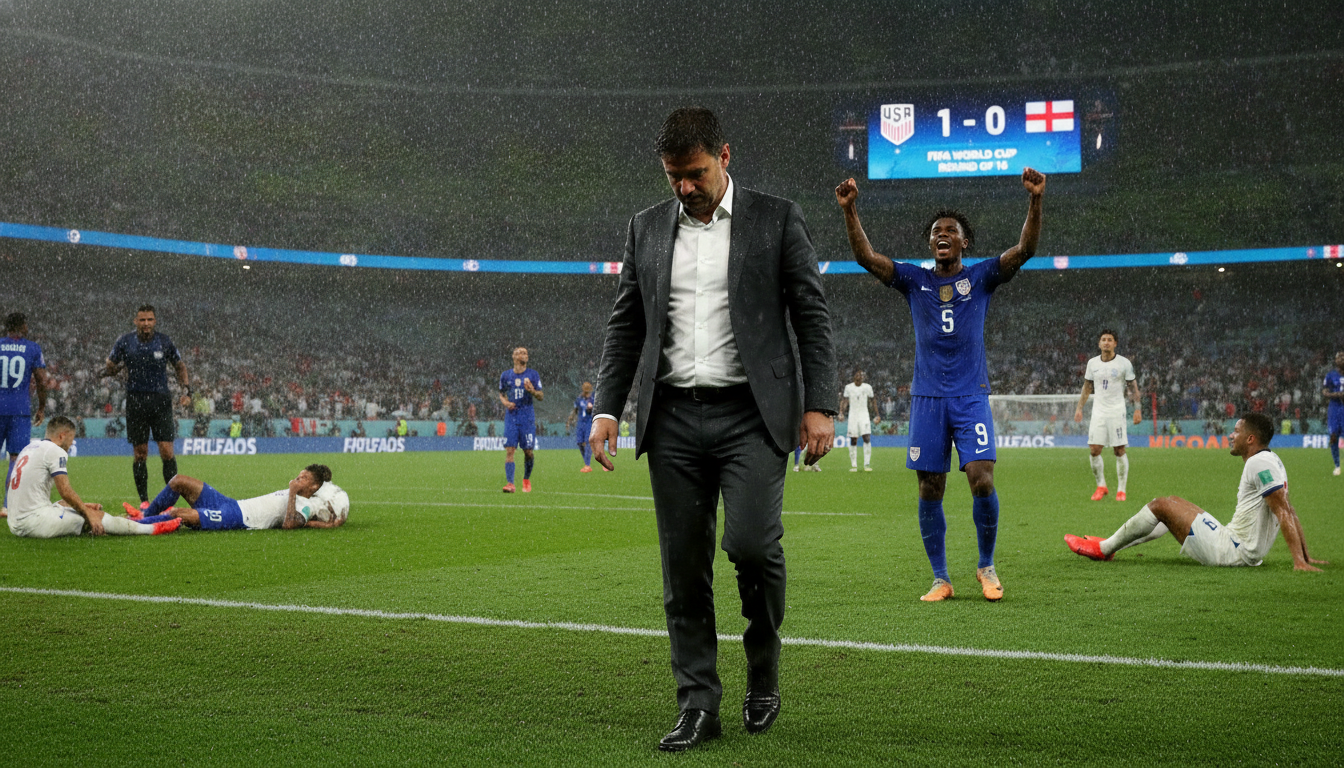
The United States World Cup exit was confirmed after a 4-1 defeat to Belgium in the last 16, a loss that abruptly ended a tournament that had begun with high hopes for the U.S. team. Coach Mauricio Pochettino, whose contract is due to expire in July 2026, said he would “rest a bit and think” before deciding on his future. The defeat and the circumstances that preceded it — including the suspension of a one-match ban for striker Folarin Balogun after intervention from U.S. political figures — have shifted the spotlight from on-field progress to political and administrative controversy.
Defeat in Seattle Ends U.S. Run
The match in Seattle was decisive: Belgium imposed a tactical discipline that the U.S. side could not match for large stretches, turning the game into a clear loss on the scoreboard. The 4-1 result reflects both a clinical finishing from Belgium and moments of defensive disorganization on the American side.
For a team that had impressed in the group stage with wins over Paraguay and Australia and a comfortable last-32 victory over Bosnia-Herzegovina, the exit is a sudden reversal. The manner of the defeat has generated questions about the team’s consistency and its readiness to challenge elite European sides.
Pochettino Signals Doubt Over Contract Renewal
Appointed in September 2024 with a mandate to elevate the United States on the global soccer stage, Pochettino now faces a crossroads as his short-term deal reaches its end in July 2026. His post-match comment that he would “rest a bit and think” was measured, but it carried weight given the club and country-level expectations that accompanied his hiring.
Pochettino’s tenure combined early attacking promise with tactical experiments that yielded mixed returns at the knockout stage. Federation officials will now have to weigh immediate public and political pressures against the longer-term trajectory Pochettino had been building since his appointment.
Balogun’s Suspended Ban Sparks Political Row
The selection and availability of striker Folarin Balogun dominated discussion before kick-off after FIFA suspended his one-match ban for 12 months, permitting him to play against Belgium. That decision followed public intervention by U.S. President Donald Trump, a sequence that many observers said left the federation and the sport’s governing body facing reputational risks.
Balogun’s presence on the pitch did not reverse the result and added a layer of controversy to the elimination. Critics argued the episode blurred lines between sport and politics, while supporters pointed to the player’s form and importance to the team as justification for seeking his availability.
Match Turning Points and Tactical Failures
Tactically, the U.S. started with ambition but ceded control after Belgium capitalized on set-piece and transitional moments. Defensive lapses at critical moments allowed Belgium to convert chances that swung momentum beyond recovery for the hosts.
Offensively, the Americans created openings but lacked the composure to convert them consistently against a compact Belgian backline. Mistimed pressing and lapses in midfield control allowed Belgium to hit gaps and exploit mismatches on the break.
Reaction from Players and Officials
Players acknowledged the disappointment of elimination while defending the effort shown across the tournament. Several squad members stressed that the group had been united and that the result did not erase the progress the team had made over the past year.
U.S. Soccer Federation officials face immediate questions about how to manage the fallout from both the loss and the off-field disputes. The federation will need to address public concern about governance and the influence of external actors on team selection and disciplinary outcomes.
Media and Public Backlash
The U.S. public reaction combined anger at the result with broader criticism of how decisions were made in the lead-up to the match. Social media and editorial pages traced a line from the political intervention to FIFA’s suspension decision and then to the match-day performance itself, creating a charged national conversation.
Broadcasters and analysts highlighted the contrast between the team’s early vibrancy in the tournament and the control that Belgium exerted in the knockout phase. Many pundits suggested the defeat exposed areas where the squad still lacks depth and experience against top-tier opposition.
Implications for U.S. Soccer’s International Standing
The elimination raises questions about whether the United States has moved into a new phase of consistent competitiveness or whether the progress was situational and tied to specific tactical approaches. The team’s dynamic group-stage performances suggested a rising profile, but the knockout defeat has tempered expectations for how quickly the U.S. can close the gap on traditional powers.
Federation strategists will need to consider long-term development pathways, talent pipelines, and coaching stability in determining whether this cycle’s lessons can be converted into sustainable growth. Decisions on the coaching staff, player development focus, and international scheduling are likely to be prioritized in upcoming meetings.
Next Steps for Coaching and Selection
If Pochettino steps away or the federation decides not to extend his contract, an immediate recruitment process will be required ahead of friendlies and the next qualifying cycle. Any search will be influenced by the federation’s appetite for continuity versus a fresh start after the World Cup disappointment.
Player selection discussions are expected to emphasize balance between experienced internationals and emerging talents who can handle the demands of knockout football. The Balogun episode has underscored how disciplinary issues and off-field dynamics can complicate squad planning.
Public trust and transparency will be central themes in the weeks ahead as U.S. Soccer attempts to rebuild momentum and clarify the chain of decision-making that led to the suspension reversal and subsequent elimination.
The United States World Cup exit will be dissected in detail for months, but it also offers a moment for recalibration across coaching, administration, and player development. The federation must now confront tough choices about leadership and governance while preserving the positive elements that surfaced during the group stage.
This tournament provided clear evidence that the American team can produce high-energy football and genuine attacking threats, yet it also exposed vulnerabilities in pressure moments and in handling off-field controversies. The immediate tasks are clear: determine the coaching future, restore confidence among supporters, and establish processes that prevent political interference from overshadowing sporting decisions.
Long-term success will depend on aligning the federation’s administrative decisions with a coherent sporting strategy that rewards merit and protects the integrity of disciplinary processes. The road from this exit to genuine contention among world football’s elite will require candid assessment, unwavering focus on development, and disciplined execution across every level of the national program.