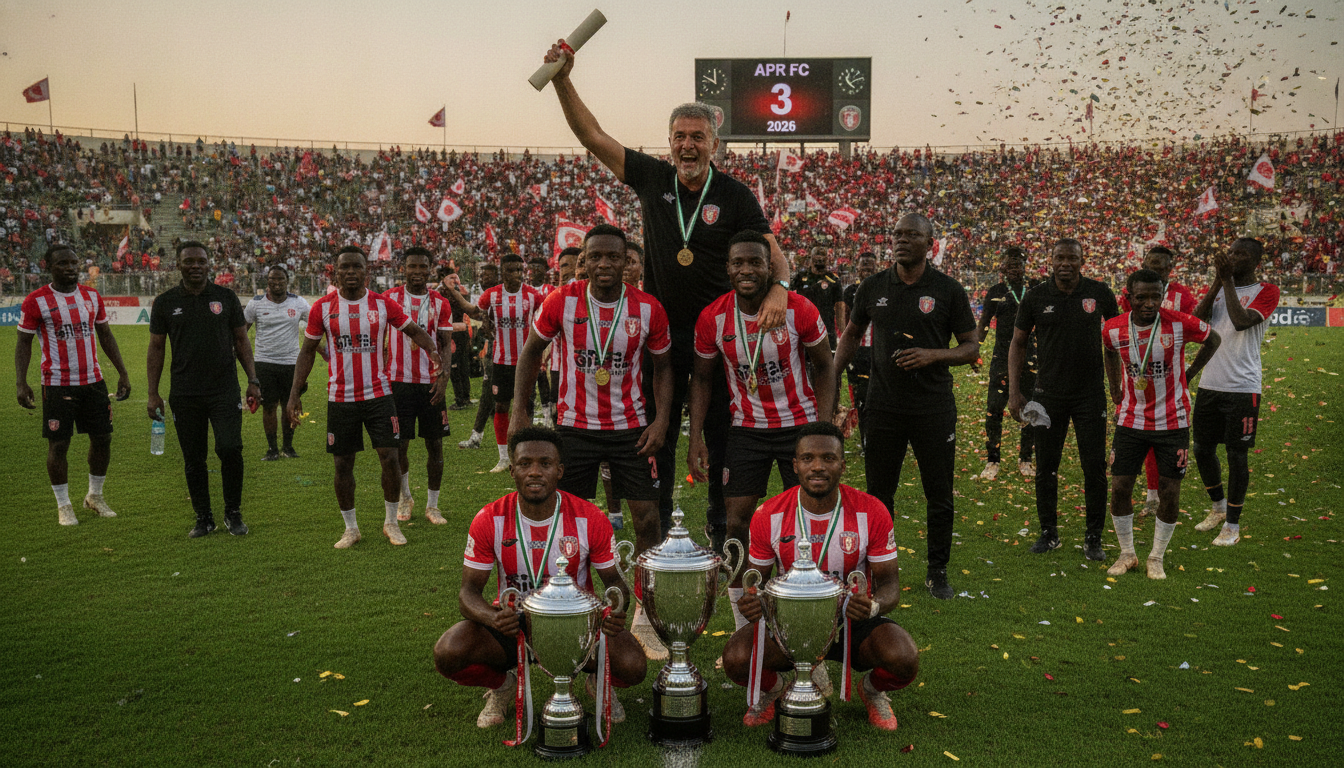
APR FC extend Abderrahim Taleb’s contract after domestic treble
APR FC extend Abderrahim Taleb’s contract after treble; he is charged with winning the CECAFA Kagame Cup and qualifying for the CAF Champions League group stage.


Abderrahim Taleb has signed a one-year contract extension with APR FC after leading the club to a clean sweep of domestic honours in the 2025/26 season. The Moroccan coach secured the BK Pro League title, the Peace Cup and the Super Cup, prompting the club to retain his services as they prepare for the 2026/27 campaign. Club officials say the renewal reflects confidence in Taleb’s tactical approach and his ability to transition APR from domestic dominance to regional and continental competitiveness.
Contract Extension and Treble Success
APR’s board confirmed the 12-month extension following a season that delivered a domestic treble, a rare achievement that reinforced the club’s status at the top of Rwandan football. Club leadership highlighted Taleb’s role in stabilising performance and in extracting consistent results across all competitions. The decision to extend his contract is positioned as continuity ahead of a congested calendar that includes regional tournaments and the CAF Champions League qualifying rounds.
The treble was underpinned by an organized defence and a pragmatic attacking model that yielded results in both knockout and league settings. Players and staff credited Taleb’s detailed planning and man-management for the campaign’s consistency. The extension formalises the coach’s position while setting clearer objectives for the season ahead, shifting expectations from domestic dominance to regional conquest.
Taleb’s Coaching Credentials and New Mandate
Taleb brings both CAF Pro and UEFA Pro licences to APR, credentials that the club says were central to their decision to extend him. Those qualifications underpin a coaching philosophy built on discipline, positional structure, and an emphasis on set-piece efficiency. The club has given him explicit targets for the year ahead, reflecting a higher bar for success than in previous seasons.
Under the renewed terms Taleb has been tasked chiefly with winning the CECAFA Kagame Cup and securing qualification for the CAF Champions League group stage. These goals represent a step up: regional silverware would enhance APR’s standing in East and Central Africa, while a place in the Champions League group phase would bring greater revenue and exposure. The mandate also implicitly requires squad rotation, tactical flexibility and an ability to negotiate the demands of travel and fixture congestion.
Pre-season Timeline and Training Return
APR resumed pre-season training on Thursday, July 2, opening preparations for the 2026/27 season with fitness assessments and tactical work. Taleb returned from a short holiday on Monday, July 6, and immediately rejoined the staff, overseeing a full training session at the Shyorongi Training Ground on Tuesday, July 7. The early sessions combined conditioning drills with possession-based exercises designed to imprint Taleb’s preferred patterns.
Club sources say the initial weeks will focus on fitness and integration rather than complex tactical shifts, allowing fitness staff to rebuild match sharpness after the off-season. The timetable leaves space for a small number of targeted friendlies and regional preparations ahead of the CECAFA Kagame Cup. Taleb’s presence from the first week back aims to signal continuity and to accelerate the process of embedding new arrivals and tactical adjustments.
Squad Availability and Player Reintegration
Pre-season began without three players who are expected to join the squad in the coming days and weeks, affecting availability for early training drills. New signing Madou Zon was given additional leave after completing his previous league campaign, while Seidu Yussif Dauda and Cheikh Djibril Ouattara are absent owing to family matters. Club staff confirmed that Dauda is anticipated to return to Rwanda shortly and that Ouattara is likely to join next week.
The staggered arrivals mean Taleb will have to manage early sessions with a partially assembled group, accelerating individual work for late arrivals and tailoring load to each player’s condition. That phased reintegration could influence early tactical rehearsals and friendly match line-ups. APR will also use friendly fixtures to finalise roles and to give players returning late an environment to regain match rhythm.
Transfer Activity Across the League and Implications
While APR’s immediate business has centred on preparing the squad around Taleb, the wider Rwandan league has seen notable movement that could alter competitive dynamics. Striker Yves Habimana signed a two-year contract with AS Kigali, leaving APR and bolstering a direct domestic rival in the attacking department. Mukura VS completed the signing of goalkeeper Leandre Ndagijimana from Gasogi United on a three-year deal, a move expected to displace Nicolas Sebwato at that club.
Amagaju strengthened with the acquisition of 21-year-old playmaker Fiston Poty Masimango from Muhazi United, adding youthful creativity to their midfield options. Rayon Sports moved to bolster their central engine by bringing in Burundian international Akbar Muderi from Gasogi United; Muderi is due in Rwanda later this week to complete formalities. These transfers reshape the competitive landscape and will be part of Taleb’s strategic calculus when preparing APR to meet both domestic challengers and regional opponents.
Regional Competition and Continental Ambitions
APR’s season objectives will hinge heavily on performance in the CECAFA Kagame Cup, a regional tournament that this year features heavyweights such as Tanzania’s Simba SC, Kenya’s Gor Mahia and Sudanese giants Al Hilal and Al Merrikh. The presence of these established clubs raises the standard of competition and presents APR with early, high-quality tests. Success in CECAFA would not only deliver silverware but also serve as a barometer for the squad’s readiness to compete on a continental stage.
Qualification for the CAF Champions League group stage remains a priority because of its financial and reputational benefits. Group-stage participation secures guaranteed fixtures against top African clubs, increases broadcast exposure and can attract higher-calibre recruits. To achieve that, APR will need to navigate qualifying rounds that demand tactical adaptability and squad depth, particularly in light of travel and the compressed schedule that comes with overlapping domestic and continental campaigns.
The coaching staff will likely emphasise compact defensive shape and efficient transition play in the early continental matches, where margins are often small. Taleb’s prior experience and licences suggest he can prepare the team tactically, but execution will depend on fitness, discipline and the integration of new signings.
APR’s supporters and the club executive have signalled openness to measured reinforcement if needed, prioritising players who can contribute immediately and handle the demands of multi-competition seasons. Recruitment decisions over the coming transfer windows will be pivotal to maintaining momentum from the treble and to meeting the higher goals set for the coach.
Abderrahim Taleb’s extension formalises APR’s ambition to convert domestic dominance into regional and continental success, setting a clear task list for the 2026/27 season that begins with the CECAFA Kagame Cup and a push for the CAF Champions League group stage. The early return to training and the club’s near-term transfer activity will shape APR’s readiness, while the competitive tests that await are set to provide a definitive measure of Taleb’s project.