Argentina vs Switzerland: Alvarez stuns Switzerland in extra time as Argentina reach World Cup semi-final
Julian Alvarez’s extra-time strike settled Argentina vs Switzerland 3-1 in Kansas City, sending Lionel Scaloni’s side into a mouthwatering semi-final with England.

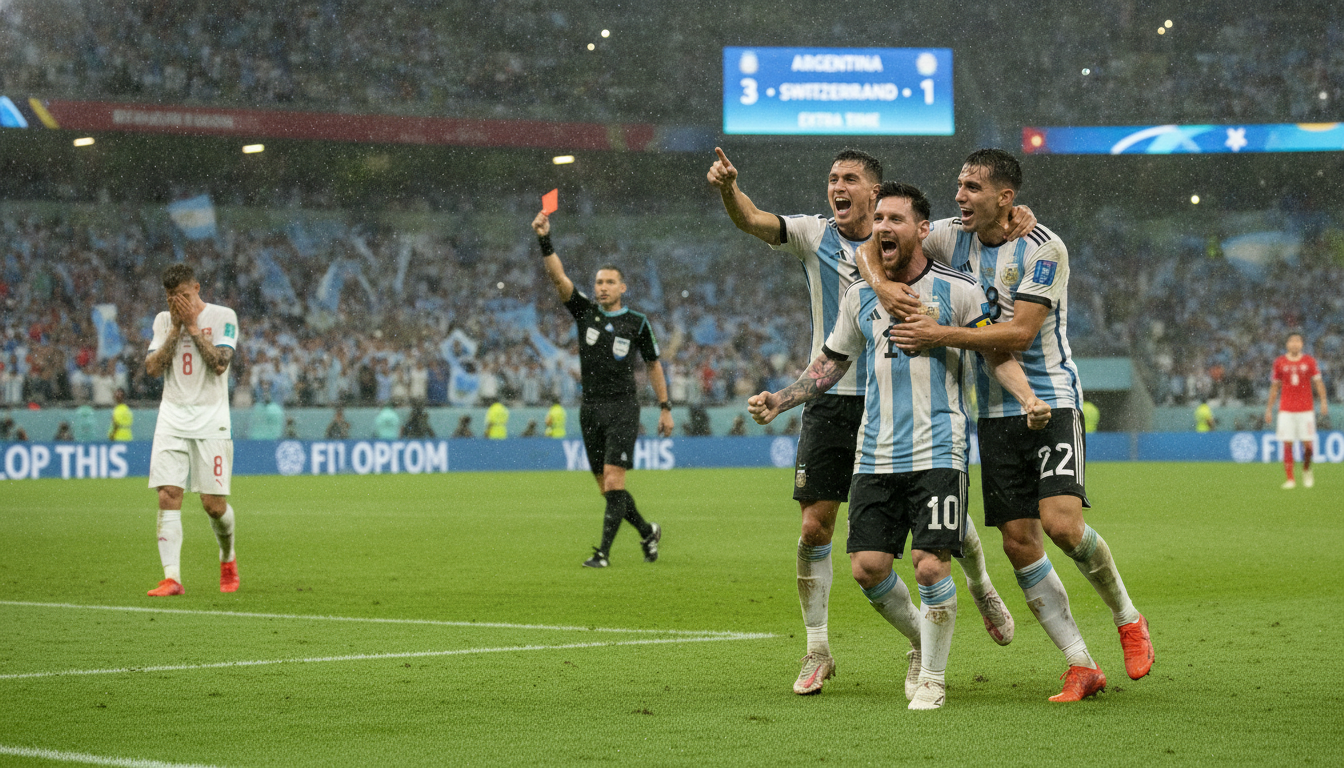
Argentina dominated early and took the lead in the 10th minute after Lionel Messi set up Alexis Mac Allister, but Switzerland fought back through Dan Ndoye midway through the second half to level the match. A second yellow for Breel Embolo swung momentum in Argentina’s favor, and Alvarez’s curling finish in the 112th minute proved decisive before Lautaro Martinez added a late third. The win at Arrowhead Stadium means the top four teams in the Fifa rankings will contest the semi-finals, with France facing Spain in Dallas on Wednesday.
Alvarez’s extra-time winner
Julian Alvarez produced the defining moment of the match when, in the 112th minute, he curled a low, perfectly weighted shot into the top corner to break the deadlock. The strike capped a period of sustained pressure from Argentina that had worn down the Swiss defense and reignited a partisan crowd in Kansas City. Alvarez’s finish combined composure and technique, leaving Switzerland keeper and defenders with little chance as Argentina edged ahead in a match that had teetered between control and chaos.
That goal not only settled the tie but underscored Argentina’s depth of attacking options beyond the well-documented influence of Lionel Messi. Alvarez, whose movement and timing had posed consistent problems all afternoon, demonstrated the sort of incisive finishing that has become vital for teams seeking knockout-stage success. His intervention shifted the psychological balance and allowed Argentina to manage the remaining minutes with greater authority.
Messi assist and Mac Allister opener
The game’s first breakthrough arrived early when Lionel Messi threaded a precise pass that set up Alexis Mac Allister for a clinical finish in the 10th minute. The move exemplified Argentina’s intention to attack with quick combinations and creative link-up play through its star man and midfield runners. Fans of the South American team, dominant in the stands at Arrowhead Stadium, erupted in celebration as Argentina established an early edge and forced Switzerland onto the back foot.
That opening goal gave Scaloni’s side the confidence to press for more but also invited Switzerland to reorganize and look for counterplay. Argentina’s ability to convert a high-quality chance early set the tone for a match that would alternate between sustained Argentine possession and resilient Swiss resistance.
Swiss response and Ndoye equaliser
Switzerland, showing the defensive discipline that has characterized their tournament, absorbed pressure and gradually grew into the game before Dan Ndoye produced the leveller. Ndoye’s finish midway through the second half rewarded Swiss persistence and shifted momentum, delivering a crucial reminder that the tie was far from settled. The equaliser rejuvenated Switzerland’s tactical focus and presented a new set of problems for Argentina to solve as the match moved toward a tense closing period.
Despite finding the net, the Swiss could not fully capitalize on the momentum due to subsequent disciplinary setbacks and the relentless quality of Argentina’s attacking rotation. Switzerland’s ability to create and convert a chance against a high-caliber opponent spoke to their tactical organization, even if it ultimately proved insufficient to secure progression.
Embolo red card and momentum swing
The match’s turning point arrived shortly after Switzerland’s equaliser when Breel Embolo received a second yellow card for simulation, reducing the Swiss to 10 men and altering the contest’s complexion. The dismissal forced Switzerland to adjust to a more conservative shape and to rely on compact defending to see out regular time and any potential extra minutes. Playing a man down in such a tight knockout fixture increased the physical and tactical demands on the Swiss squad and opened spaces for Argentina to exploit.
With the numerical advantage, Argentina intensified their forward thrusts and stretched the remaining Swiss defensive resources, using wide outlets and quick interchanges to probe for openings. The sending-off had the effect of tilting both the tempo and strategic options, allowing Scaloni’s team to press more freely and eventually fashion the chance that led to Alvarez’s decisive strike.
Tactical patterns and Scaloni’s management
Lionel Scaloni’s side blended veteran leadership with youthful dynamism, producing a balanced performance that combined patient build-up play with sudden bursts of directness. Argentina’s use of Messi as both a facilitator and creator allowed midfield runners like Mac Allister to arrive in advanced positions and reward incisive service. Scaloni’s decisions in substitutions and game management — prioritizing fresh legs and attacking options late in the contest — contributed to sustaining pressure over extended spells.
Defensively, Argentina navigated periods of concentrated Swiss counterattack by maintaining compact lines and relying on disciplined tracking back from their forwards. The coaching staff’s emphasis on structure and rotational movement in attack paid dividends in extra time, when fatigue and numerical disadvantage began to affect the Swiss side.
Implications for the World Cup semis and wider tournament
Argentina’s victory sets up a high-profile semi-final against England, renewing one of the sport’s most intense rivalries on the World Cup stage. The win also ensures that the tournament’s semi-final line-up will feature the top four nations in the Fifa rankings, adding a layer of narrative about ranking and form as the competition reaches its climax. Meanwhile, France and Spain will contest the other semi-final in Dallas on Wednesday, meaning the final two matchups promise to present contrasting styles and high stakes.
For Argentina, progression reinforces their status as title contenders but also brings a stern test against England’s athleticism and tactical cohesion. Switzerland, though eliminated, earned plaudits for resilience and for producing a performance that kept the tie alive until the late twists of extra time.
Key performers and match turning points
Beyond Alvarez’s decisive finish and Messi’s creative spark, several contributors shaped the outcome through timely interventions and discipline. Mac Allister’s early goal provided the platform for Argentina’s dominance, while Swiss players showed collective effort that ultimately faltered under pressure. The red card to Embolo, coming at a sensitive juncture, was an inflection point that recalibrated the match’s risk-reward calculations for both sides.
Goalkeepers and defenders on both teams performed crucial saves and last-ditch challenges that kept the scoreline tight for long stretches. Those individual moments, combined with sustained team shapes and set-piece organization, underscored how marginal differences in decision-making and discipline can decide knockout ties at this stage of a major tournament.
Argentina’s fans created an intense atmosphere inside Arrowhead Stadium, with vocal support that provided a backdrop to key plays and emotive passages of the game. The partisan crowd helped amplify the significance of each momentum shift and celebrated Alvarez’s decisive strike as the match reached its conclusion.
Argentina’s passage to the semi-finals marks another chapter in their World Cup campaign, one that balances expectation with the tangible demands of facing top-quality opposition. The result confirms Argentina’s capacity to win tight, high-pressure fixtures, and it sets the stage for a compelling encounter with England that will test both strategic planning and individual brilliance.
The match ended 3-1 after extra time, with Argentina advancing to the next round while Switzerland’s spirited effort concluded at Arrowhead Stadium.