


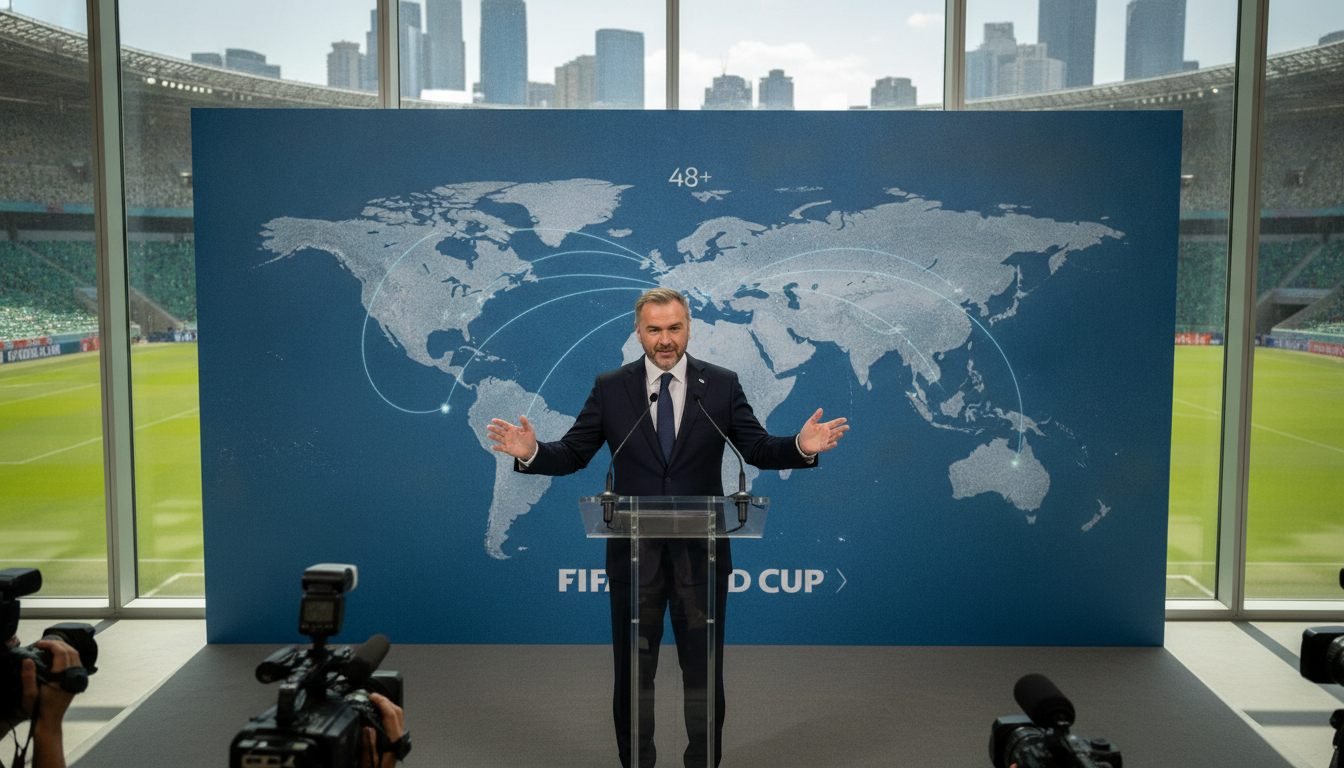
FIFA to review World Cup expansion after 2026 as Infantino raises 64-team possibility
FIFA president Gianni Infantino said further World Cup expansion, including talk of a 64-team finals, will be debated after the 2026 tournament, signalling fresh discussions on World Cup expansion.


FIFA president Gianni Infantino told Swiss broadcaster Blue Sport that any move beyond the new 48-team format will be considered after this year’s edition, without providing a timetable or specific proposals.
The comments followed the first 48-team World Cup, hosted across Canada, Mexico and the United States, and came alongside Infantino’s assessment of the tournament’s commercial haul.
Infantino reiterated his long-standing stance that the World Cup should be truly global and that expanding access gives smaller nations an incentive to invest in their football programmes.
Infantino signals post-World Cup review on expansion
Infantino described the question of further increasing the number of teams as “issues that we will be examining after the World Cup,” underlining that no immediate change will be rushed into during the tournament.
He framed expansion as part of a broader mission to ensure the World Cup represents the entire world rather than a narrow group of regions, harking back to his role in moving the finals from 32 to 48 teams.
While he referenced the principle of inclusion, Infantino did not outline concrete steps, deadlines or which stakeholders would lead the next phase of deliberation.
48-team 2026 tournament context and initial reactions
The 2026 finals marked the first time the tournament featured 48 nations, an increase implemented after a campaign led by Infantino that drew criticism from some corners of the sport.
Critics warned about dilution of quality and competition scheduling prior to kick-off on June 11, but the expansion had generated less public controversy since the tournament began.
The 2026 format has nonetheless reshaped qualification dynamics across confederations and prompted a fresh debate about what the ideal size of a flagship international tournament should be.
Infantino’s public rationale for wider access
Infantino argued that giving smaller countries a chance to qualify creates incentives to improve domestic structures and player development, suggesting tournaments can be a lever for global growth.
He said the quality of teams worldwide is rising, and that restricting access to the finals to traditional powerhouses would deny emerging football nations the dream and the practical benefits of World Cup participation.
That argument has long been central to proponents of expansion, who point to wider global representation as both a moral and a developmental objective for international football.
Financial stakes and FIFA’s revenue outlook
Alongside the policy remarks, Infantino offered a financial snapshot, estimating FIFA could generate between US$16.8 billion and US$17.32 billion from the 39-day tournament, underscoring the commercial scale at play.
Such revenue projections reflect broadcast deals, sponsorship packages, ticketing and hospitality receipts, and they amplify the commercial incentives that accompany any decision to alter tournament size.
For FIFA and host associations, the economics of expansion are entwined with broader questions about distribution of funds to development programmes, infrastructure spending and the calendar demands placed on clubs and national teams.
Logistical and sporting considerations for a 64-team proposal
Moving beyond 48 to 64 teams would pose substantial logistical challenges, including adding matches, securing venues and extending tournament duration or restructuring formats to avoid fixture congestion.
Competition formats for a 64-team finals would need careful design to preserve competitive balance and broadcast value while avoiding excessive strain on players and limiting overlap with domestic seasons.
Host countries and confederations would face infrastructure pressures, particularly if additional stadia, training facilities and transport capacity were required on short notice.
Positions likely across federations and commercial partners
Reaction to any 64-team proposal is likely to split along predictable lines, with smaller and emerging federations typically more receptive to expanded access and some established bodies cautious about competitive and calendar impacts.
Commercial partners, broadcasters and sponsors will weigh both the audience reach and the complexity added by a larger tournament, assessing whether more matches translate into stronger global engagement.
Any formal proposal would almost certainly require detailed consultation with confederations, the FIFA Council and stakeholders across the football ecosystem before a policy decision could be reached.
The debate over World Cup expansion now moves from theory to a practical review phase, with Infantino’s call for post-tournament examination setting the next milestone.
Whether the conversation results in a concrete plan to move to 64 teams, an alternative compromise, or a reaffirmation of the 48-team model will depend on the outcomes of stakeholder consultations, commercial analyses and assessments of sporting integrity.
For now, the 2026 World Cup has opened a new chapter in how the global game balances inclusion, quality and commercial realities, and the decisions agreed after this edition will shape international football for years to come.