Deschamps Defends Michael Olise After Criticism Following World Cup Semi-Final Loss
France coach Didier Deschamps has publicly defended Michael Olise after the winger faced criticism following France’s 2-0 World Cup semi-final defeat to Spain, praising his overall tournament contributions.

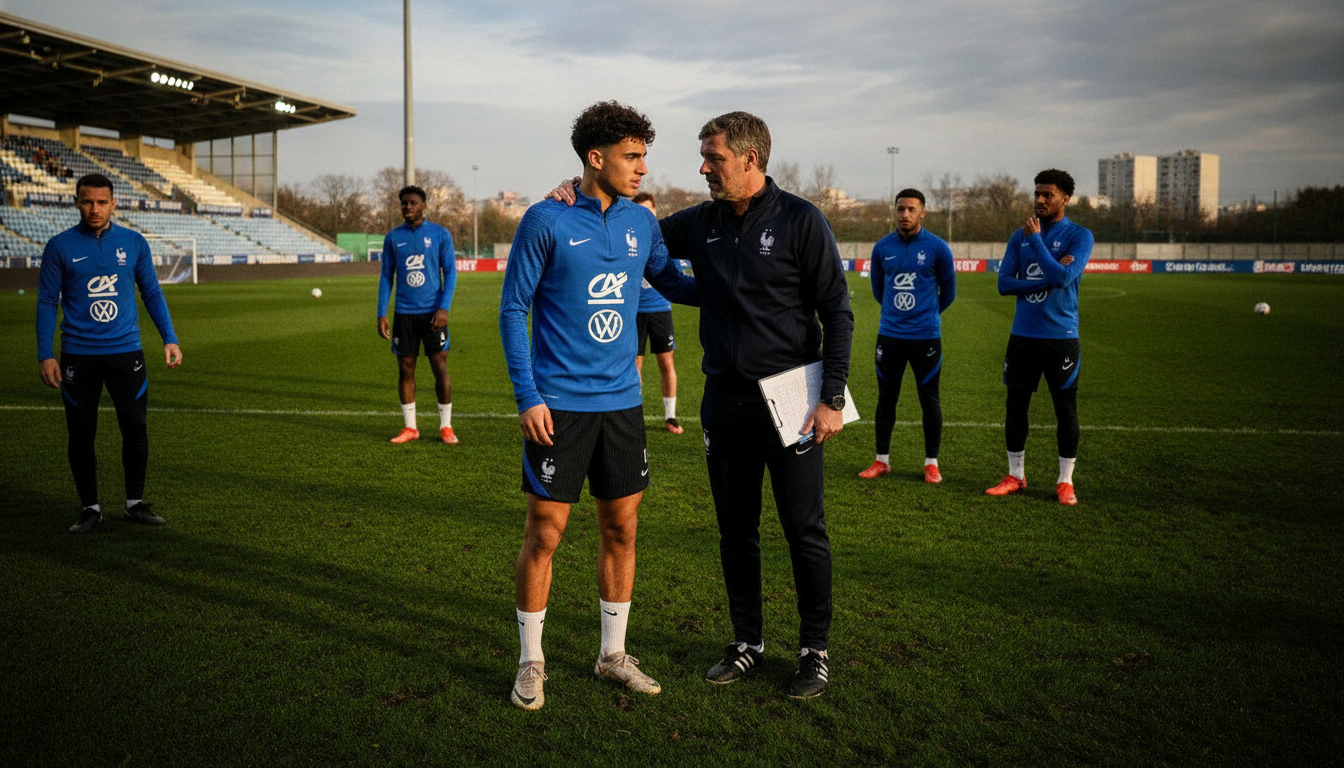
France head coach Didier Deschamps moved quickly to rebut criticism aimed at Michael Olise after France exited the World Cup with a 2-0 semi-final loss to Spain.
Deschamps acknowledged that Olise was not at his peak in the defeat, but he emphasized the winger’s broader influence across the tournament and warned against harsh short-term judgments.
The coach highlighted Olise’s character and steady development, suggesting the young Bayern Munich player remains a long-term asset for Les Bleus.
Deschamps Defends Michael Olise After Semi-Final Scrutiny
Deschamps told reporters that singling out Olise for blame was unfair and that France’s defeat was a collective outcome rather than the responsibility of one individual.
He pointed to the emotional weight of the occasion and the quality of the opponent as factors that affected several players on the night.
The coach framed the criticism as premature, noting that growth often arrives unevenly across big tournaments.
The manager also contrasted Olise’s trajectory with other players who required time to reach elite levels, stressing that progression is not linear.
Deschamps underlined the winger’s temperament and off-field conduct as reasons to temper public censure and to maintain confidence in his future contributions.
His remarks were positioned as a clear signal of institutional backing for a player who has recently taken significant steps on the international stage.
Olise’s World Cup Output and Consistency
Throughout the tournament, Michael Olise featured in every match for France and produced a significant number of decisive actions in the attacking third.
His assist totals positioned him among the tournament’s leading creators and offered a counterpoint to criticism centred on a single performance.
Coaches and analysts watching the competition noted Olise’s influence in unlocking defences and his ability to combine pace with creative passing.
Beyond raw numbers, Olise’s movement and link-up play added a dimension to France’s attack that opponents had to account for across multiple games.
His consistency in selection reflected the coaching staff’s faith in his tactical fit within France’s system.
Even in matches where the end result was disappointing, his presence on the pitch altered opposition planning and opened spaces for team-mates.
Tactical Assessment of the Semi-Final Display
Against Spain, France struggled to impose its rhythm and Olise often found his avenues restricted by a compact defensive setup and aggressive pressing.
Opponents targeted key channels and doubled up in transitional moments, which limited the winger’s time on the ball and his ability to create high-quality chances.
Those structural issues, rather than individual error alone, contributed to a night in which few attackers reached their usual standards.
Analysts observed that Spain’s midfield control and disciplined positioning forced France into longer possession spells without penetration.
In that context, Olise was asked to undertake extra defensive responsibilities and to operate in tighter pockets than he typically does at club level.
Such tactical constraints help explain why his attacking output dipped compared with earlier matches in the tournament.
Role with France and Club Context at Bayern Munich
At Bayern Munich, Olise has been developing in a demanding environment that has accelerated his technical and physical growth.
The club context has exposed him to high standards of training and tactical variety, which have translated into more complex responsibilities at international level.
France’s staff have sought to harness his club-honed traits — wide acceleration, combination play, and vision — while adapting them to the national team’s collective framework.
Deschamps has used Olise in multiple attacking roles, testing his capacity to operate as a pure wide outlet, an inverted winger, and a hybrid creator.
This versatility is a strength but also requires ongoing adjustment as opponents tailor their defensive plans.
The coaching team appears willing to invest time in refining his situational decision-making, acknowledging that adaptability can take time to deliver consistent returns.
Public Reaction and Media Scrutiny
The semi-final defeat triggered a wave of commentary from pundits and social media users, with Olise’s display becoming a focal point for frustrated observers.
Criticism ranged from tactical analysis to sharper personal critiques, reflecting the heightened scrutiny players face at major tournaments.
Supporters and some journalists pushed back, citing his tournament statistics and the broader context of the loss.
Deschamps’ public defense can be interpreted as an attempt to calm an emotive discourse and to redirect attention toward structural lessons for the squad.
His stance also underscored the federation’s interest in protecting young talent from damaging narratives that could impede long-term development.
The exchange between coaching assurances and media reaction is likely to continue as the national conversation shifts to rebuilding and future fixtures.
Next Steps for Michael Olise and France
Olise now heads into an off-season period that will be shaped by club commitments at Bayern Munich and targeted preparation with the national team ahead of the next international window.
Both Bayern and France’s technical staff will be tasked with balancing workload, refining tactical roles, and focusing on areas where marginal gains can produce sharper performances.
For Olise personally, the immediate objectives are to maintain form, add versatility to his game, and convert positional learning into greater consistency.
France will also need to reassess its tactical approach after the World Cup, identifying how to better support wide attackers when facing high-pressing or highly structured opponents.
Player development pathways and match scheduling will play a role in shaping the next phase of integration for younger contributors like Olise.
Deschamps’ endorsement suggests that Olise will remain central to those plans, provided he continues to deliver at club level and demonstrate the resilience expected of international players.
The wider coaching staff will likely place emphasis on situational training that replicates the pressures of knockout football, aiming to reduce performance variability in pivotal matches.
That practical work, combined with measured media messaging, will be important in ensuring that the winger’s momentum from the tournament is preserved rather than dissipated.
For fans and neutral observers alike, the coming months will offer the first clear signals of how Olise responds to elite-level scrutiny and translates potential into sustained impact.
Michael Olise leaves the World Cup with enhanced standing despite the disappointment of a semi-final exit, and Didier Deschamps’ public defence frames the next chapter as one of continued development rather than final judgement.