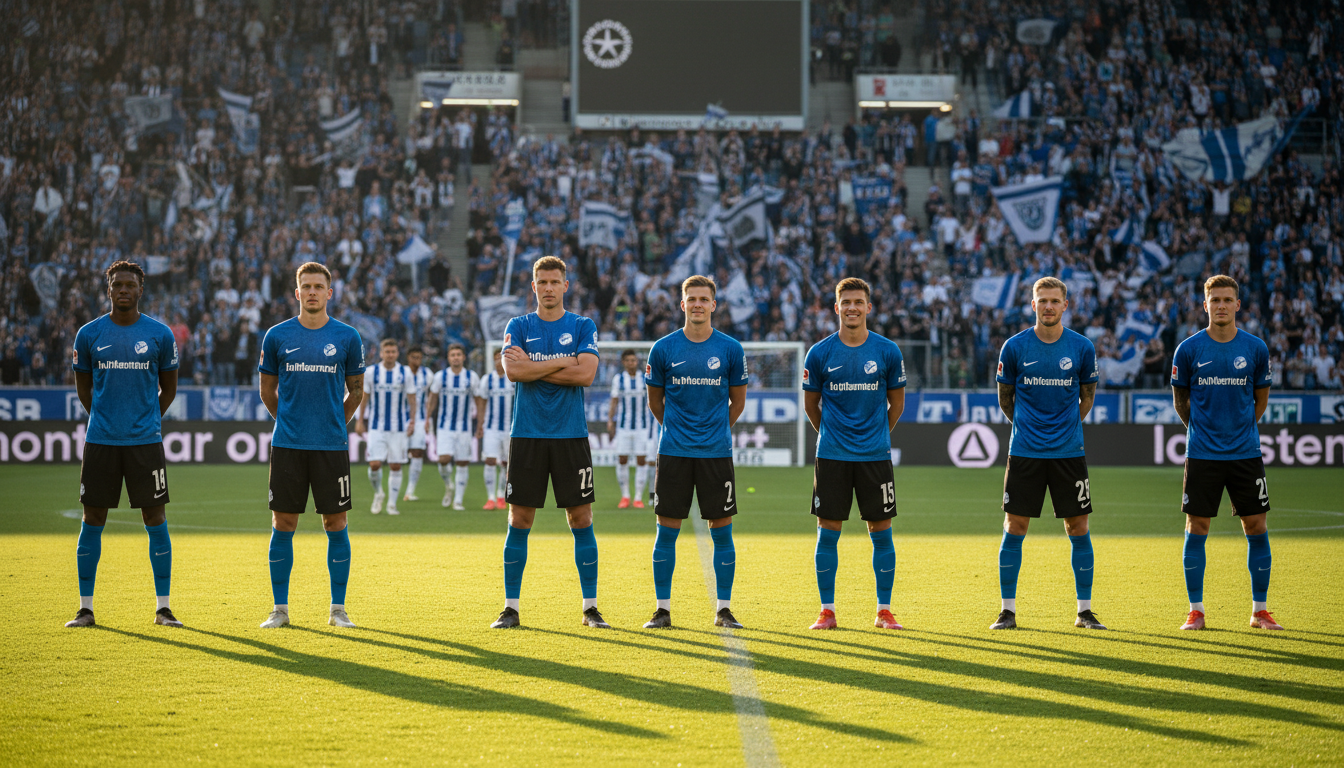
Arminia Bielefeld vs Hertha BSC lineups: Confirmed XIs, tactical notes and key matchups
Arminia Bielefeld vs Hertha BSC lineups confirmed ahead of the 2. Bundesliga meeting at the Schüco Arena, with both coaches making multiple changes to their starting elevens. This article details the formations, the personnel switches announced before kick-off, and the tactical implications those selections carry for today’s fixture.


Match summary and confirmed XIs
Arminia Bielefeld field a 4-3-3 against Hertha BSC’s 4-2-3-1 in the afternoon fixture at the Schüco Arena. Mitch Kniat has made five changes to his side following the midweek defeat in Kaiserslautern, while Stefan Leitl has adjusted three positions after his team’s win over Fürth.
The confirmed Arminia Bielefeld lineup reads as follows in a 4-3-3 shape: Kersken in goal; a back four of Christopher Lannert, Bauer, Maximilian Großer and Arne Sicker; a midfield triangle of Corboz, Russo and Sam Schreck; and an attacking trio of Momuluh, Joel Grodowski and Wörl. Hertha BSC starts in a 4-2-3-1 with Ernst in goal, Eitschberger, Gechter, Kolbe and Janne Berner across the back, Eichhorn and Pascal Klemens as double pivot, Cuisance, Seguin and Reese supporting lone striker Sebastian Grønning.
Five changes for Bielefeld and what they indicate
Kniat’s five alterations signal a clear reset after the loss in Kaiserslautern, prioritizing fresh defensive options and attacking reinforcements. Christopher Lannert and Maximilian Großer come into the backline, while Arne Sicker and Sam Schreck provide breadth and energy on the left and in midfield respectively.
The insertion of Joel Grodowski up front suggests Arminia want a more direct focal point in attack, with Momuluh and Wörl offering pace and width to stretch Hertha’s defense. Corboz and Russo in the middle point to a plan that balances possession control with vertical passing lanes into the front three.
Those personnel shifts also reflect Kniat’s attempt to stabilise the defense while injecting momentum in transition phases. The changes should alter how quickly Arminia seek to move the ball from midfield into attack and how aggressively the full-backs participate in forward play.
Hertha’s three switches and the strategic tweak
Stefan Leitl has made three changes from the victory over Fürth, replacing Michal Karbownik, Josip Brekalo and Marten Winkler with Janne Berner, Pascal Klemens and Sebastian Grønning. Those decisions adjust both personnel and balance, particularly in wide areas and in the holding midfield.
Klemens’ inclusion alongside Eichhorn in a deeper midfield pairing shows Leitl’s preference for greater stability and ball recovery in central areas. That double pivot will be asked to screen the defence and recycle possession for the more creative trio ahead of them.
Bringing in Grønning as the lone striker gives Hertha a focal point who can occupy Arminia’s center-backs and link play for Cuisance, Seguin and Reese. Janne Berner’s selection at left-back indicates an intent to manage the wide defensive channels against Arminia’s pacey wingers.
Tactical matchups that could decide the game
Arminia’s three attackers versus Hertha’s wide defenders is a primary tactical chess match to follow, particularly Grodowski against Gechter and Sicker’s overlaps against Berner. How effectively the full-backs combine with their wingers will determine each side’s ability to create clear chances.
The midfield battle between Corboz, Russo and Schreck on one side and Eichhorn and Klemens on the other will shape control of the tempo. If Arminia’s trio can progress the ball into advanced areas quickly, they will force Hertha’s midfield to concede ground and invite pressure.
Set-piece threats also merit attention, given both sides’ recent reliance on dead-ball situations. A physical centre-forward like Grønning could be decisive from corners, while Arminia’s midfield runners may exploit second balls in the box.
Managerial approaches and how they contrast
Kniat’s selection points to a reactive, transition-oriented approach aimed at restoring confidence after defeat. His changes suggest he expects to cede some possession to Hertha and focus on quick counters and vertical penetration through the flanks.
Leitl, by contrast, has tinkered modestly after a win, keeping a structure that favors central solidity and patient build-up. His three switches are more evolutionary than revolutionary, indicating a belief in continuity while addressing specific matchup concerns.
Both managers will be monitoring in-game moments closely, with substitutions likely to target midfield control and attacking urgency. Bench management and the timing of changes could swing the balance if the contest remains tight into the final third of the match.
Individual players to watch
Joel Grodowski returns to the starting line-up for Arminia and will be expected to lead the press and hold up play for incoming runners. His physical presence offers a different attacking profile compared with the outgoing options, and his ability to bring others into play will be tested.
Pascal Klemens’ midfield role for Hertha is noteworthy; his defensive positioning and capability to link with Cuisance could determine how effectively Hertha can neutralise Arminia’s transitions. Cuisance himself remains the creative fulcrum and could be decisive with a quick ball into the channels.
Defensive battles will involve Bauer and Großer for Arminia against Seguin and Reese for Hertha in progressive wide movements. Goalkeepers Kersken and Ernst should also be ready for moments that require concentration, whether from long-range shooting or set-piece deliveries.
Possible in-game scenarios and tactical adjustments
Should Arminia fall behind early, expect Kniat to push the full-backs higher and introduce an additional attacking option to overload Hertha’s defensive lines. Conversely, a Hertha lead would likely invite deeper defending, with Leitl replacing a forward for an extra midfielder to protect the lead.
Both sides might increase crosses into the box if central build-up is stifled, a route that plays into Grønning’s strengths as a target man. Pressing intensity could fluctuate, with the team conceding possession choosing to sit deeper and defend in numbers to avoid dangerous counters.
Substitution patterns to watch include changes that affect the midfield axis and wing play, as these are the most likely levers to alter the match’s rhythm. Fresh legs on the flanks late in the game could exploit tired full-backs and create match-defining moments.
The teams are listed in the announced formations as follows: Arminia Bielefeld (4-3-3) — Kersken; Lannert, Bauer, Großer, Sicker; Corboz, Russo, Schreck; Momuluh, Grodowski, Wörl. Hertha BSC (4-2-3-1) — Ernst; Eitschberger, Gechter, Kolbe, Berner; Eichhorn, Klemens; Cuisance, Seguin, Reese; Grønning.
With definite starting elevens now public, both sets of supporters have clarity on how the managers intend to approach the fixture. The announced 4-3-3 versus 4-2-3-1 shapes frame expectations for a contest defined by wing play, midfield transitions and aerial battles in the penalty areas.
This afternoon’s match will test the resilience of Arminia’s defensive rebuild and Hertha’s capacity to convert possession into clear-cut opportunities. The team that better executes its transitional moments and wins the midfield duels will likely dictate the scoreboard.
All tactical indicators point to a competitive 2. Bundesliga encounter where adjustments at halftime and the use of the bench may prove decisive in the closing stages. The confirmed lineups set the stage; the first whistle will reveal whether selection choices translate into on-pitch advantage.