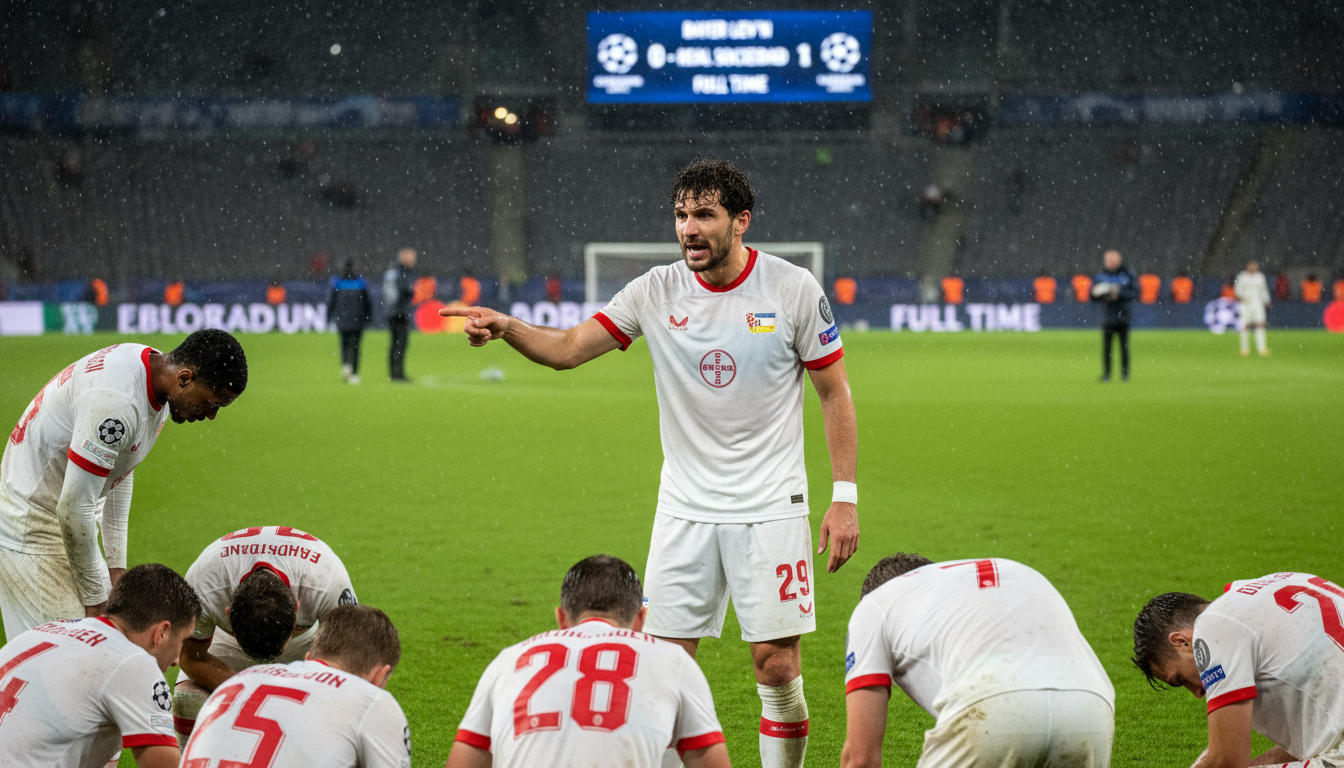
Robert Andrich delivers blunt verdict on Bayer Leverkusen after 3-1 defeat leaves Champions League hopes hanging
Leverkusen captain Robert Andrich criticized his side’s mentality after the 3-1 defeat to VfB Stuttgart on May 9, 2026, leaving Bayer Leverkusen’s Champions League hopes in jeopardy.


Andrich’s Post-Match Verdict
Robert Andrich offered a stark post-match assessment after Bayer Leverkusen fell 3-1 to VfB Stuttgart on May 9, 2026.
The captain singled out a lack of collective grit and admitted the performance reflected deeper, season-long problems.
Andrich also took a share of the blame, saying the issues were not just tactical but rooted in the dressing room’s mentality.
Early Lead, Rapid Collapse
Leverkusen shocked Stuttgart by taking the lead inside the opening minute, but that advantage lasted only briefly.
Despite the bright start, the visitors were unable to sustain intensity and were overrun for large periods of the match.
Stuttgart’s control of possession and sharper transitions exposed gaps in Leverkusen’s structure that the hosts exploited repeatedly.
Tactical Shortcomings Exposed
Across 90 minutes, Leverkusen rarely matched Stuttgart’s tempo or physicality, and tactical cohesion was inconsistent.
Pressing triggers were misread and midfield rotations left space for Stuttgart’s forwards to drive between the lines.
Those mismatches translated into sustained losing periods of the match, which ultimately swung momentum heavily in Stuttgart’s favor.
Questioning Dressing Room Unity
Andrich’s comments went beyond tactics to question the squad’s internal dynamics and collective resilience.
He said personalities tended to “keep things to themselves” and that there were not enough players actively uniting the group under pressure.
The captain’s frank remarks suggest concern that fragments of the squad are not aligning around a shared response in critical moments.
Captain Accepts Responsibility
While critical of the group, Andrich also accepted personal responsibility for recurring shortcomings.
He acknowledged standing in front of the media after similar defeats many times this season, implying a pattern he finds difficult to ignore.
That balance of criticism and ownership is notable from a leader and signals an attempt to spur change rather than simply cast blame.
Standings and Mathematical Chances
The defeat leaves Bayer Leverkusen in sixth place with one league match remaining, dramatically narrowing the route to next season’s Champions League.
To secure a top-four finish, Leverkusen must beat Hamburger SV while also relying on Stuttgart and Hoffenheim to drop points on the final day.
The scenario is not impossible but is contingent on several unfavorable results for rivals, which places additional pressure on the squad for the season finale.
Managerial Questions Looming
Sunday’s result will intensify scrutiny on the coaching staff and match preparation heading into the final fixture.
Questions will center on whether the tactical plan, player selection and in-game adjustments adequately addressed Stuttgart’s approach.
Club management will also weigh the psychological preparation and leadership framework designed to maintain unity during stressful run-ins.
Impact on European Ambitions
Missing out on Champions League qualification would carry both sporting and financial consequences for Leverkusen.
European revenue, recruitment leverage and the club’s ability to retain key players can all be influenced by final league position.
For a squad with continental aspirations, the loss to Stuttgart therefore reverberates beyond a single match and into broader strategic planning.
Player Responses and Accountability
Following Andrich’s statements, other squad members will face pressure to respond, either publicly or through performance.
Captains and senior players can shape an immediate turnaround by establishing clearer communication and visible collective effort in training.
Younger squad members will also be observed for their reaction under pressure, as their temperament could affect the club’s short-term trajectory.
Fixture: Hamburg Next Weekend
Leverkusen’s decisive final fixture is a home match against Hamburger SV, who have their own objectives to secure this season.
The club must produce a professional and emotionally controlled display to keep any faint Champions League hopes alive.
Preparation for the meeting will likely prioritize defensive stability, transition management and the reestablishment of cohesion among the midfield.
Transfer Window Considerations
The public airing of internal issues may accelerate discussions ahead of the summer transfer window.
Leverkusen’s sporting directors will evaluate whether adjustments to personnel, leadership roles or recruitment priorities are needed.
Targeted signings could be aimed at bolstering defensive resilience or adding proven leaders who can influence the dressing room dynamic.
Historical Context and Club Expectations
Bayer Leverkusen have routinely pursued European football and the club’s infrastructure expects continental competition to be part of long-term planning.
A failure to reach the Champions League would represent a setback relative to recent seasons and the club’s stated ambitions.
Supporters and stakeholders will measure the result against both on-pitch performance and perceived progress under the current coaching regime.
Possible Tactical Revisions
Tactically, Leverkusen may need to revisit pressing schemes and midfield roles to prevent future collapses when matches tighten.
Simplifying in-game instructions and clarifying who assumes leadership during transitional phases could reduce confusion.
A focus on discipline in shape, timing of press and compactness while out of possession would address several weaknesses exposed by Stuttgart.
Psychological Reset Required
Beyond tactics, a psychological reset is necessary to rebuild trust and collective courage in high-pressure moments.
Group sessions, leadership workshops and clearer lines of communication could help turn the captain’s critique into constructive change.
How quickly the team responds to internal reflection will influence both the result against Hamburg and preparations for the summer.
Stuttgart’s Performance and Momentum
VfB Stuttgart’s display underscored their capacity to punish early lapses and sustain a high-intensity game plan.
Their pressing and efficient use of transitions kept Leverkusen under constant threat and ultimately dictated the rhythm of the match.
Stuttgart’s result will energize their own campaign while placing added scrutiny on Leverkusen’s inability to adapt.
Fan and Media Reaction
Andrich’s bluntness is likely to dominate headlines and social conversation around the club in the coming days.
Fans will debate whether the captain’s public remarks were necessary and whether they mark a turning point in accountability.
Media scrutiny will extend to training ground dynamics and the club’s response, increasing pressure on decision-makers.
Leverkusen now face a short, decisive window to respond on the pitch and reset off it, with Champions League qualification hanging on improbable permutations and a must-win final fixture.