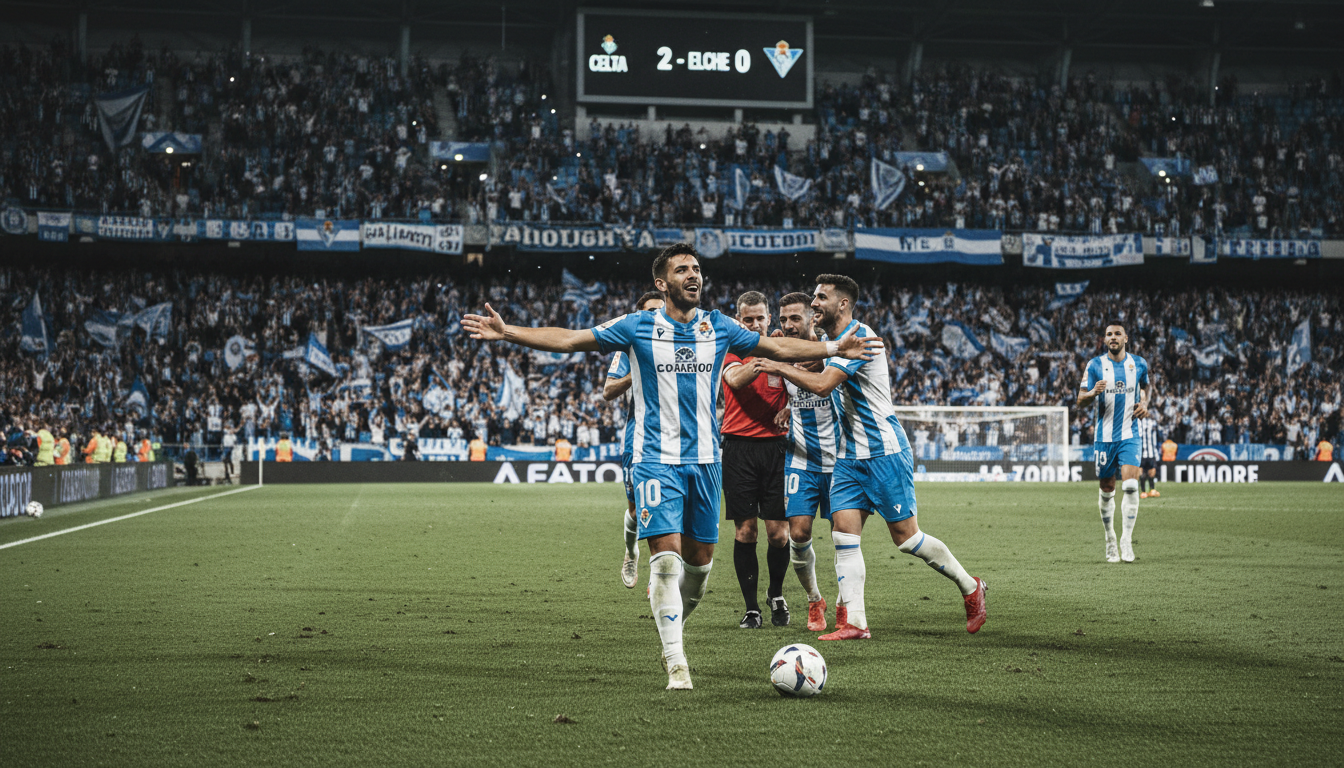
Celta vs Elche: Álvarez and Aspas give Celta a 2-0 half-time cushion at Balaídos
Celta vs Elche: Celta de Vigo led 2-0 at Balaídos after goals from Hugo Álvarez and Iago Aspas, controlling the game while Elche pushed for a comeback.


Celta take early control in Vigo
The hosts established control early and carried that dominance to a 2-0 advantage at the break in the Celta vs Elche fixture. Hugo Álvarez opened the scoring after a defensive lapse from the visitors, and Iago Aspas doubled the lead with a composed finish following a long pass. Celta’s ability to transition quickly from defence to attack created the clearest openings of the first half.
Elche showed resilience but struggled to convert possession into clear chances against a compact Celta backline. The visitors had more of the ball overall, but Celta’s direct threat on the break proved decisive. By half-time the scoreboard reflected the balance of danger rather than the share of possession.
Goals and decisive sequences
The first strike arrived on 14 minutes when Celta capitalised on a loose clearance on the left flank, Javi Rueda picked up the loose ball and provided a low cross that Hugo Álvarez buried at the far post. That goal forced Elche to chase the match and briefly altered their tactical approach, prompting the away side to push numbers forward. The second goal on 30 minutes stemmed from a long outlet by Ilaix, with Ferran Jutglà holding the ball up for Aspas to arrive and place a composed finish into the far corner.
Both goals highlighted contrasting routes to danger: a scrappy sequence inside the box for the opener and a vertical, decisive pass for the second. Celta’s forward line combined experience and youth to convert limited opportunities into a two-goal cushion. Elche responded with a few half-chances but lacked the final touch to reduce the deficit before the interval.
Tactical control and match tempo
Claudio Giráldez’s Celta prioritized control of dangerous moments rather than dominating possession, using quick breaks to exploit space behind Elche’s higher defensive line. The home side used Ferran Jutglà’s pace on the flanks to unsettle the visitors and create overloads near the penalty area. When required, Celta slowed the tempo with patient possession to protect their lead and limit transitions.
Eder Sarabia’s Elche arranged themselves to press higher in search of an equaliser, frequently positioning ten players in the opponent’s half when in possession. That approach produced more territory for Elche but left gaps at the back which Celta looked to exploit on counter-attacks. The tactical battle tilted in Celta’s favour when their forwards converted their moments of threat.
Individual performances and key moments
Iago Aspas provided the experience and timing the hosts needed, scoring and linking play effectively in the attacking third. Ferran Jutglà emerged as a persistent threat down the flank, troubling Elche defenders with his direct runs even when his final touch was imperfect. Hugo Álvarez’s finish showcased Celta’s opportunism inside the box and offered a timely reminder of the squad’s depth.
For Elche, midfielder Gonzalo Villar picked up a yellow card after an early foul on Aspas, and the visitors had to regroup after Radu, Celta’s goalkeeper, made an early save to deny André da Silva. Goalkeeper Dituro for Elche faced sporadic danger but the clearest problems for the away side were defensive miscommunications that led to the home goals. Javi Rueda’s involvement in the opener and Ilaix’s long distribution that led to the second were two of the match’s vital contributions.
Substitutions, officiating and backstage context
At half-time and into the second period both managers prepared to influence the match through personnel changes, with Elche bringing on Víctor Chust and Martín Neto for Affengruber and Gonzalo Villar to seek fresh energy. Celta later introduced El-Abdellaoui for Iago Aspas, a tactical swap that also conserved minutes for the veteran striker. Referee Ricardo de Burgos Bengoechea oversaw a contest that produced a handful of cautions and contentious moments, including an unpunished challenge on Jutglà early in the second half.
Match officials were assisted by VAR and Daniel Jesús Trujillo Suárez was on duty in the review role, though the decisive incidents in the first 45 minutes remained on-field decisions. Both benches adjusted to the flow of the contest: Giráldez focused on maintaining defensive balance while Sarabia sought attacking impetus to pull Elche back into the game. Injuries and absences had also shaped lineups, with both teams missing regular contributors heading into the fixture.
Implications for LaLiga positions and next steps
The 2-0 interval advantage provides Celta with a platform to chase European qualification ambitions and to consolidate momentum at home. Giráldez had previously framed the season as a fight for a European berth, and a win here would bolster that pursuit by delivering three points against a team in a relegation fight. For Elche, the result so far represents a setback to recent positive form and increases pressure on Sarabia’s side to find consistency on the road.
Looking beyond this single match, both clubs must manage fixture congestion and squad rotation as LaLiga reaches its decisive phase. Results in matches such as Celta vs Elche carry implications for both ends of the table; Celta can strengthen a push toward continental places while Elche must accumulate points to ease relegation concerns. The remainder of this match and upcoming fixtures will reveal how coaches adapt tactically and which players step up under pressure.
Celta led at half-time by two goals and will aim to protect that advantage while probing for a third that would effectively settle the contest. Elche must sharpen their final delivery and defensive organisation if they are to salvage a result from Balaídos. The second half will determine whether Celta translates a strong opening 45 minutes into three points or whether Elche can respond and change the outcome.