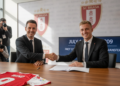
Fisnik Asllani Chooses RB Leipzig as Hoffenheim Move Nears; Release Clause and Salary Talk Remain
Fisnik Asllani chosen RB Leipzig over Barcelona; Hoffenheim’s 23-year-old could move after Leipzig activates his €25-29m release clause; salary talks remain.


Fisnik Asllani has elected to join RB Leipzig, with the Kosovo international’s transfer described as imminent as clubs negotiate final financial terms. The 23-year-old forward’s decision to favour Leipzig over reported Barcelona interest crystallises a transfer that now hinges on salary agreement and clause activation. Hoffenheim’s decision to leave Asllani out of the club’s pre-season travel party underlines the likelihood of a swift resolution away from the squad.
Asllani’s decision and the remaining hurdles
Sources close to the deal indicate Asllani has given his preference to Leipzig, bringing the transfer to a decisive stage. The only outstanding obstacle appears to be an agreement on personal terms, with salary the focal point of those discussions. Leipzig are said to intend to trigger the release clause in Asllani’s contract, which ties the clubs’ hands on the fee once activated.
The precise value of the clause varies in reporting, but the figure most commonly cited places it between €25m and €29m. Activating the clause would allow Leipzig to bypass protracted negotiations over the transfer fee and move directly to formalise a contract with the player. That financial certainty has made Leipzig the club positioned to conclude the deal quickly if salary demands can be reconciled.
Omission from Hoffenheim’s Seefeld camp signals departure
Hoffenheim excluded Asllani from their squad that travelled to Seefeld, Austria, for the pre-season training camp running from August 2 through August 9. The decision to leave him behind is consistent with an agreement between player and club that his future should be resolved away from the day-to-day environment of the first team. Clubs commonly take this step to allow potential transfers to progress without disrupting preparations.
Asllani had also been omitted from Hoffenheim’s recent friendly lineups amid the growing transfer speculation. Hoffenheim’s sporting management acknowledged ongoing discussions with interested clubs during the early stages of the pre-season. The forward’s absence from team activities has given both parties space to focus on contractual and medical formalities should the transfer be confirmed.
Release clause mechanics and transfer fee context
The activation of a release clause simplifies the purchasing club’s route but still requires alignment on wages, bonuses and ancillary conditions. Because the clause is fixed to a range most outlets have cited, the buying club’s obligation to the selling club is straightforward once it activates the clause. Remaining negotiations therefore centre on the player’s remuneration and the specifics of a new employment contract.
From a market-value perspective, Asllani’s assessment rose sharply after a breakthrough season, increasing his external valuation well beyond the amount stipulated in the clause. That divergence makes the clause a valuable asset for Hoffenheim and an opportunity for Leipzig to secure a promising forward at a fee some consider below market. The deal’s completion would register among Hoffenheim’s more significant sales and add to Leipzig’s recruitment expenditure.
Leipzig’s attacking rebuild and tactical intentions
RB Leipzig are actively reshaping their forward line and seek options to compete with their established attacking figures, including Brazilian striker Rômulo. The club’s recruitment drive has targeted a centre-forward who can offer versatility across the front line and provide competition for places. Asllani’s capacity to play as a traditional number nine, as a support striker or from wider attacking positions matches that profile.
Reports suggest Leipzig view Asllani as the leading target in their search for an additional striker, although the club has also been linked to other forwards in recent days. The two-way flexibility he offers would allow Leipzig’s coaching staff to adapt formations and rotate personnel across competitions. That tactical adaptability strengthens Leipzig’s options as they prepare for domestic and European challenges in the coming season.
Competing approaches and other reported targets
Leipzig’s pursuit of a new striker unfolded alongside rumours linking them to other forwards, producing a flurry of claims and denials. One high-profile name was reported to be close to agreement, but subsequent information contradicted those claims, leaving Asllani as the clearer priority. Such cycles of advance and retraction are common in a busy transfer window where agents, clubs and intermediaries all have incentives to influence market movement.
The club has reportedly sought to reorganise existing attacking resources before committing to new arrivals, preferring to resolve departures internally where possible. That tactical roster management can ease integration for any incoming signing and limit the necessity for significant squad turnover. If Leipzig do finalise Asllani’s acquisition, it will likely come alongside other internal adjustments to their forward roster.
Asllani’s recent form and suitability for Leipzig
Last season represented Asllani’s most productive campaign at senior level, with double-digit goals and a significant number of assists across competitions. His ability to combine goal threat with creative output caught the attention of larger clubs and contributed to a rapid rise in perceived market value. Equally, his youth and versatility make him an attractive option for a team seeking both immediate impact and future resale value.
Standing at a decisive stage in his development, Asllani offers Leipzig a player with a blend of pace, mobility and finishing ability suited to high-intensity systems. Analysts note that his transition from substitute appearances to a regular starting role has coincided with improvements in decision-making and movement off the ball. Those traits would help him adapt to Leipzig’s pressing game and quick transitions.
Hoffenheim’s broader summer business and financial picture
Asllani’s exit would form part of a sweeping offload at Hoffenheim this summer, with the club managing a substantial number of departures as they refresh the squad. Aggregate sales this window have approached significant six-figure totals, reflecting a strategic emphasis on player trading and reinvestment. On the incoming side, Hoffenheim have spent on a smaller number of recruits to retool the playing group.
Club officials have balanced departures and arrivals as they prepare for the season ahead, seeking to ensure competitive readiness while maintaining fiscal stability. The sales income generated by outgoing players has given Hoffenheim flexibility in the market and underlined their role as a club that develops talent for larger teams. Asllani’s transfer, if completed, will be among the more valuable moves in that ongoing reshuffle.
Completion of a transfer before Hoffenheim’s training camp ends would allow both clubs to progress planning with clarity. For Hoffenheim, early resolution reduces uncertainty during pre-season, while Leipzig would gain an additional option as they finalise their tactical preparations. Either outcome carries practical benefits for the squads and coaching staffs involved.
Negotiations over wage structure and contract length are the final step before a formal announcement can be expected. Both player and buying club typically work through base salary, bonuses, appearances clauses and potential release mechanisms in these final sessions. Once those elements are finalised, clubs usually move to medicals and registration processes to conclude the transfer.
Fisnik Asllani’s likely move to RB Leipzig marks a notable shift for a player who has risen quickly through the ranks, and it reflects wider dynamics in the transfer market where release clauses and tactical fit often determine outcomes. The coming days should clarify whether salary terms can be agreed and whether Leipzig will activate the contractual clause to secure the forward’s services.