Spanish football map 2026: Málaga back in LaLiga as regions are reshaped
Spanish football map 2026 shows Málaga promoted to LaLiga after eight years, Deportivo and Racing return, and regional representation is sharply rebalanced.


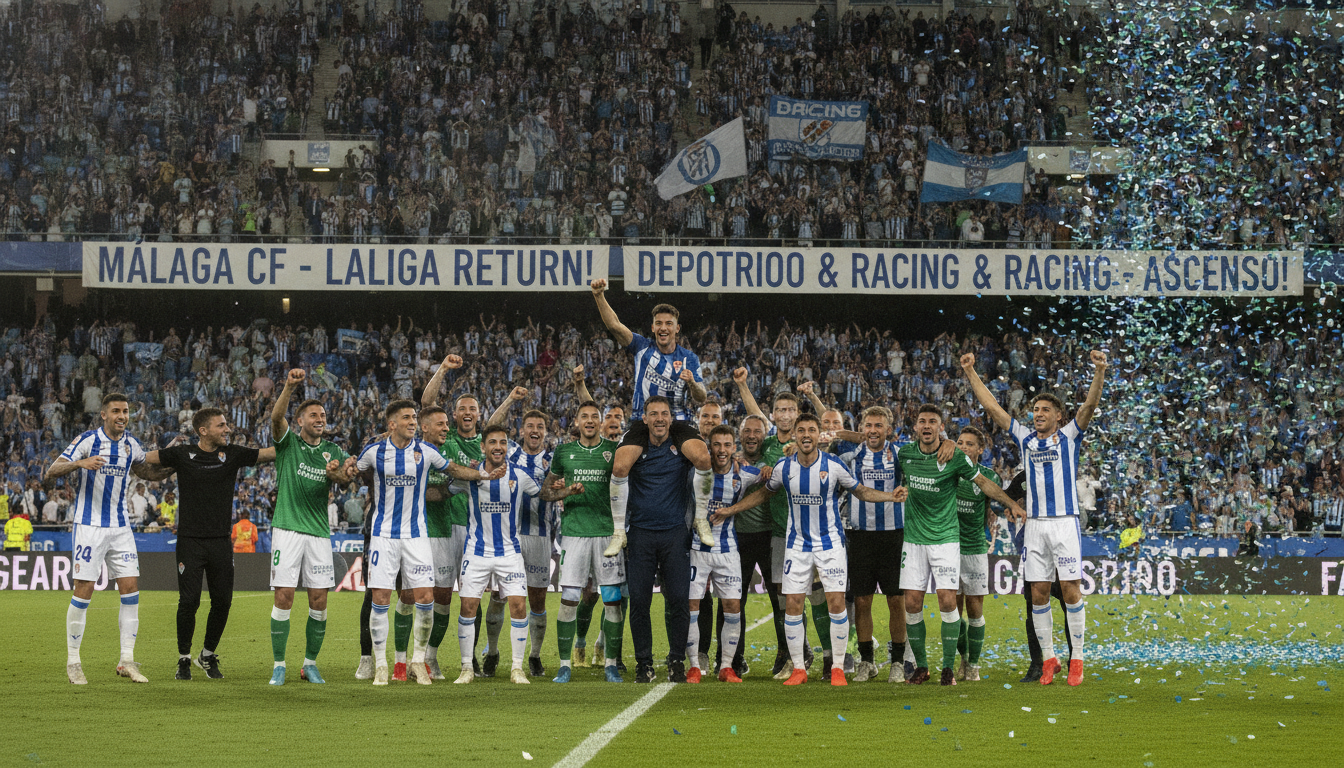
The 2025–26 season ended with decisive playoff results that reshaped the Spanish football map 2026 and set the composition for the 2026–27 professional leagues. Málaga clinched promotion to LaLiga, returning to the top flight after an eight-year absence, while historic clubs Deportivo and Racing earned their places among the country’s elite. The weekend’s outcomes also confirmed a notable geographic shift that will influence fixtures, regional derbies and television markets next season.
Málaga returns to LaLiga and the north reclaims ground
Málaga’s promotion completed a dramatic rise back to the top division and punctuated a season of significant movement between tiers. Deportivo and Racing also secured promotion, restoring two storied northern clubs to Primera and altering the balance of representation in their regions. Those returns mean Cantabria and Galicia will each have a presence in LaLiga, shifting the regional map that shaped recent campaigns.
The promotions change more than team lists; they reintroduce historic rivalries and fan interest that had been dormant at the top level. Málaga’s comeback after eight years brings a southern Andalusian club back into the national spotlight alongside Sevilla and Real Betis. For Deportivo and Racing, the step up carries both sporting and financial consequences that will ripple through transfer planning and stadium revenues.
Clubs arriving to or leaving the top flight will affect scheduling and travel patterns for the calendar, with consequences for midweek fixtures and broadcasting windows. The composition of LaLiga will now feature established powers alongside these returning sides, creating a mix of stability and fresh match-ups. That blend is likely to shape narratives early in the 2026–27 season as newly promoted teams seek to consolidate.
Four communities provide the bulk of LaLiga clubs
The headline statistic from the season’s end is the concentration of teams in four autonomous communities that will supply the majority of LaLiga clubs. The Community of Madrid, the Valencian Community, the Basque Country and Andalusia together account for the lion’s share of top-flight fixtures next season. That means roughly 70 percent of matchups will involve clubs from those regions, reinforcing established media and commercial strongholds.
Madrid will continue to be the country’s central hub with Real Madrid, Atlético, Getafe and Rayo in the same tier, ensuring frequent capital derbies. The Valencian Community will be represented by Villarreal, Valencia, Levante and Elche, preserving a cluster of teams with strong local followings. The Basque and Andalusian contingents likewise offer high-profile encounters, with Athletic, Real Sociedad and Alavés on one side and Sevilla, Betis and Málaga on the other.
This geographic clustering affects more than fan travel; it informs sponsorship, regional advertising and fixture prioritization for prime television slots. The concentration also forces smaller regions to compete for national attention as broadcasting schedules prioritize marquee matchups. Clubs outside these four regions will need to capitalize on unique narratives and local support to maintain visibility.
Islands absent from the top tier for the first time since 1996–97
One of the most striking outcomes of the final weekend is that no team from the Canary Islands or the Balearic Islands will feature in LaLiga next season. This marks the first time since the 1996–97 campaign that the Spanish top flight will lack an insular representative. The absence removes long-standing geographic variety from the top table and ends regular island-based derbies at the highest level.
The lack of island clubs in the top division will have practical effects on travel itineraries and broadcast scheduling, with fewer long-haul away trips to or from the islands required. It also removes a cultural and fan-driven element long associated with LaLiga, as island supporters have historically provided distinct matchday atmospheres. For the islands themselves, the challenge now is to rebuild pathways back to the top tier through investment and sporting projects in lower divisions.
At the same time, the Segunda División will regain some traditional island rivalries, and the Canary derby between Tenerife and Las Palmas is set to return to the second tier. Those fixtures will help sustain local passions and may increase attendance and regional interest in the Segunda campaign. The restoration of island derbies at that level will provide consolation for supporters and present commercial opportunities for clubs and league organizers.
Segunda reshaped with filials, returning derbies and a pan-regional mix
The second tier will reflect a complex reshuffle, combining traditional clubs with reserve teams and fresh promotions that change competitive dynamics. Two filial sides will participate in the Segunda División after Celta Fortuna joined Real Sociedad’s reserve team, a pairing not seen at this scale since the 2017–18 season. The presence of B teams poses competitive questions about development, promotion eligibility and match intensity when they face independent clubs.
Beyond reserve sides, the Segunda will host high-profile derbies that were absent last season, including the Tenerife–Las Palmas and Sporting–Oviedo matchups, both of which carry deep local significance. Those derbies are expected to drive ticket sales and regional television interest, helping to balance the league’s commercial prospects. Clubs promoted into the second tier will also reshape local calendars and create fresh logistical demands for travel and stadium preparation.
Geographically, the Segunda will be played across 11 autonomous communities, plus the autonomous city of Ceuta and the Principality of Andorra, producing a broad national footprint. Andalusia remains the most represented region in the second tier by club count, while other regions such as Castilla y León and the Canary Islands will be well represented. League administrators and clubs will need to coordinate on travel, matchday security and broadcasting to manage the diverse spread of fixtures.
Aragón and three other regions lose professional representation
The fallout of relegation and promotion leaves several autonomous communities without any team in either of Spain’s two professional divisions. Aragón will be particularly affected after both Real Zaragoza and Huesca dropped to Primera RFEF, ending a long tradition of representation at the professional level. Those departures leave fans, local sponsors and regional broadcasters facing a season without top-tier live matches in the area.
Extremadura, the Region of Murcia and La Rioja will also have no clubs in the Primera or Segunda divisions next season, creating pockets of national absence that have social and economic implications. Local economies that benefit from matchday spending and team-related commerce will likely feel the impact, and regional football federations may face pressure to accelerate development initiatives. For the affected communities, the priority will be supporting clubs in lower tiers to mount immediate promotion bids.
The loss of professional football in these regions also changes the national calendar and reduces the diversity of regional narratives that typically feed into media coverage. It may concentrate television attention on the more populated football hubs and increase the market disparities between regions. Supporters and policymakers in the affected areas will now debate strategies to revive professional presence and to protect community-level football infrastructures.
RFEF assembly on June 30 and calendar reveal for 2026–27
Administrative deadlines and calendar planning are now fixed as the season closes, with the Royal Spanish Football Federation convening its ordinary General Assembly on June 30. The meeting will ratify season-end matters and include the public presentation of the official fixtures and competition calendars for 2026–27. The federation has chosen to unveil those schedules in a high-profile event that echoes last year’s simultaneous presentation format.
As in the previous cycle, the RFEF plans to present the full slate of domestic competition calendars — covering both football and futsal, men’s and women’s competitions — in a synchronized public ceremony. That coordinated reveal is aimed at providing clarity to clubs, broadcasters and fans ahead of pre-season planning and ticket sales. The announcement will also set the framework for transfer windows, international breaks and domestic cup scheduling.
Clubs will use the period after June 30 to finalize pre-season tours, friendly fixtures and transfer business with the official calendar in hand. For promoted and relegated clubs, the timing is crucial to structure training programs and to meet registration deadlines. The calendar presentation will therefore mark the operational starting point for the 2026–27 competitive cycle at all professional levels.
Primera RFEF and Segunda RFEF groups take shape
Beyond the two professional divisions, the reshuffling extends into the Primera RFEF and Segunda RFEF where group allocations underline regional clustering and historic continuity. The 40-team Primera RFEF is provisionally split into two groups with a heavy Galician and Castilian presence in the north-western cluster and a southern and central mix in the second group. That configuration preserves traditional regional pairings while facilitating travel planning for clubs across contiguous provinces.
The Segunda RFEF will be organized into five groups reflecting fine-grained regional distribution, with Galicia, Asturias, Cantabria and the Basque territories forming one cluster and Catalonia, Aragon and La Rioja combined in another. Other groups will assemble clubs from Murcia and Valencia, the Balearic Islands with nearby Valencian clubs, and a broad southern group drawing Andalusia and Extremadura sides. This structure aims to reduce travel burdens while maintaining competitive balance across Spain’s fourth-tier competition.
For many clubs in Primera RFEF and Segunda RFEF, the coming season represents a critical juncture to rebuild sporting and economic foundations after recent promotions or relegations. Group composition will determine derbies, regional sponsorship opportunities and potential broadcasting interest for cup ties. Local rivalries preserved by the groupings will be essential to sustaining attendance and community engagement at smaller venues.
The closing weekend dramatically reconfigured territories and rivalries across Spanish football, producing a 2026 map that mixes tradition with stark regional imbalances. The next season’s fixtures and financial plans will reflect those changes as clubs adapt to new travel patterns and competitive landscapes.
Spanish football map 2026 will be tested immediately as clubs begin pre-season preparations and the RFEF releases the official calendars, setting the stage for a year in which regional identity and competitive ambition will both be under the spotlight.