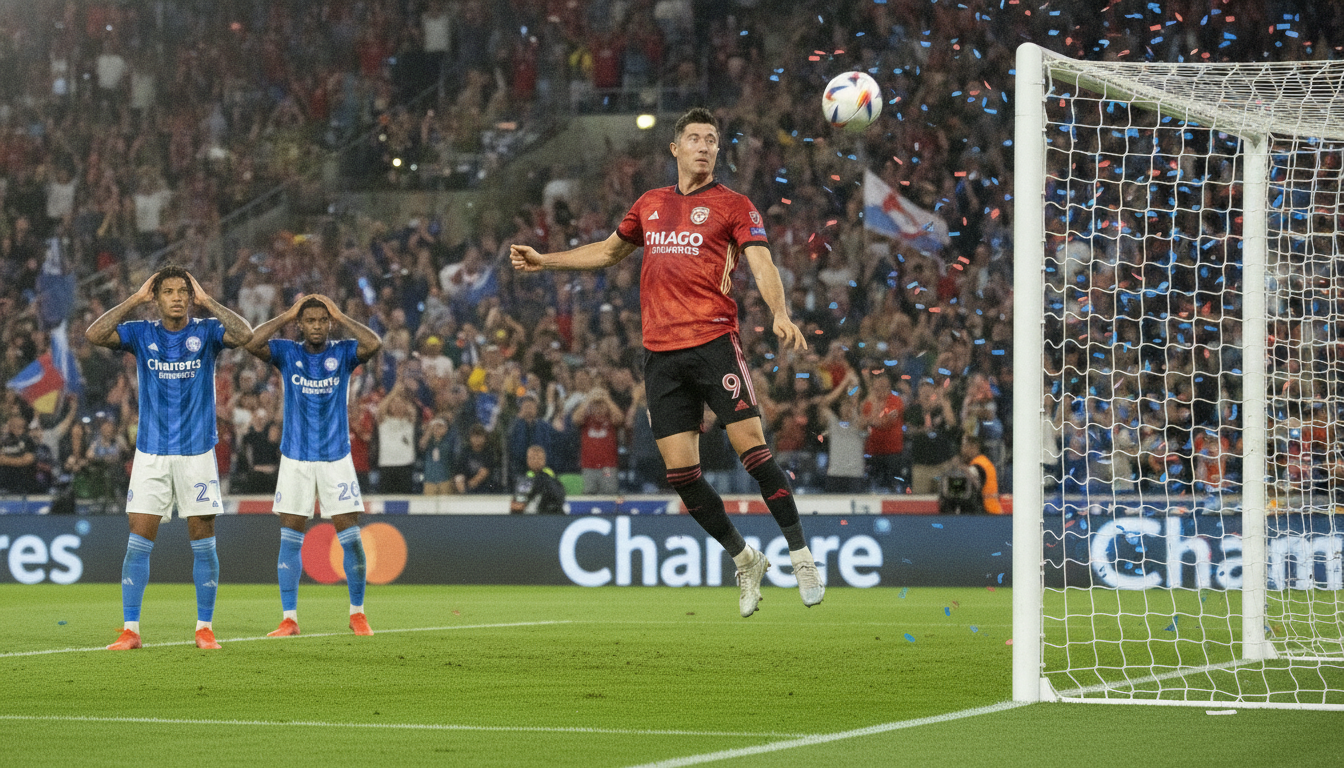
Robert Lewandowski Scores Twice as Chicago Fire Beat Charlotte FC in MLS Debut Goals
Robert Lewandowski scored a brace for Chicago Fire in a 2-1 win over Charlotte FC, announcing his arrival in MLS with decisive finishing that shaped the result. The Polish striker, in his third appearance for the club, opened the scoring in the 20th minute and then sealed the victory with a 68th-minute winner. The match underlined Lewandowski’s immediate impact and renewed attention on Major League Soccer as a landing place for elite European talent.


Lewandowski brace secures Chicago Fire 2-1 win
Robert Lewandowski’s two goals were his first for Chicago Fire and came in a match that the club needed to turn momentum in its favor. He tapped home a composed finish in the 20th minute after being played in behind the defense, then produced a clinical strike in the 68th to break a 1-1 deadlock. The pair of goals gave Chicago all three points and sent a clear message about the striker’s role as the focal point of the Fire attack.
The timing of Lewandowski’s contributions underlines how quickly he has adapted to the MLS rhythm despite limited time with his new teammates. The goals were textbook examples of his poacher’s instincts—movement into space and decisive execution inside the box. For Chicago, the immediate return of goals from their high-profile signing will ease pressure around scoring and boost confidence in the locker room.
Key moments: build-up play and the decisive finish
The opener arrived after a sustained period of Chicago pressure that culminated in a quick combination down the flank and an incisive pass into the penalty area. Lewandowski’s movement created enough separation to receive the ball with his back to goal, and he turned sharply to finish with composure past the goalkeeper. That early cushion forced Charlotte to chase the game and opened space in transition for the visitors.
The winning goal in the 68th minute stemmed from a set-piece sequence that unsettled Charlotte’s defensive shape before a low cross found Lewandowski in a narrow gap. He took a single touch to adjust and stroked the ball into the net, showing the same lethal instincts that defined his career in Europe. Those two strikes combined individual quality with team patterns that Chicago will look to replicate as the season progresses.
Thomas Müller converts penalty to earn Vancouver point
On the same night, Thomas Müller, another former Bayern Munich teammate of Lewandowski, converted a penalty to salvage a 1-1 draw for the Vancouver Whitecaps against Los Angeles FC. Müller’s spot-kick demonstrated his composure from the spot and provided Vancouver with a valuable point against one of the Western Conference’s stronger sides. The result left LAFC frustrated but highlighted the immediate contributions veteran European players are providing across MLS.
Müller’s impact extended beyond the penalty as he influenced build-up play and positional rotations that created chances for the Whitecaps. His spatial intelligence and experience added a new dimension to Vancouver’s attacking structure, similar to how Lewandowski’s presence altered Chicago’s attacking emphasis. Both players showcased skill sets that translate to MLS—finishing, positioning, and game management at critical moments.
Tactical implications for Chicago Fire’s attack
Chicago Fire’s deployment of Lewandowski centered on creating service between the lines and maximizing his ability to occupy defenders with intelligent holds and timed runs. The team adjusted its patterns to direct more crosses and through balls into the channels where Lewandowski thrives, while midfielders offered late arrivals into the box to capitalize on rebounds. That intentional shaping of attacking moves suggests the coaching staff is already tailoring game plans to the Polish striker’s strengths.
Defensively, Chicago will need to manage transitions carefully as opponents target spaces vacated by players pushing forward to supply Lewandowski. Opposing teams will attempt to disrupt long passes and cut off supply lines, making midfield control a priority for the Fire in coming fixtures. If Chicago can maintain balance between creative supply and defensive cover, Lewandowski’s presence should lift overall team productivity rather than create tactical vulnerabilities.
MLS momentum as former Bundesliga stars make early impacts
The early returns from Lewandowski and Müller add to a growing narrative of MLS attracting high-profile European talent who can influence results immediately. Over the past two decades, names such as Thierry Henry, Zlatan Ibrahimović and Wayne Rooney have set precedents for players transitioning from elite European leagues to the U.S. and Canada. Lewandowski and Müller now join that lineage, and their early performances will be measured against the benchmark of previous imports who reshaped club fortunes and raised the league’s profile.
Clubs signing marquee Europeans often seek both on-field production and off-field attention, and these initial performances supply both. For the league, the arrival of players with decorated international resumes enhances visibility and raises competitive expectations. How sustained those impacts will be depends on fitness management, tactical fit, and adaptation to travel demands unique to North American competition.
Market and fan reaction around Lewandowski’s arrival
Fan interest and commercial attention around Chicago Fire spiked with Lewandowski’s signing and was reflected in match-day chatter and social coverage following his brace. Merchandise sales, media interest and ticket inquiries are typical side effects of a high-profile acquisition, and the immediate on-field return tends to amplify those factors. For club executives and sponsors, early success helps justify investment and can accelerate broader strategic goals tied to growth and branding.
Local supporters and neutral observers will now monitor how Lewandowski’s form holds up across fixture congestion and varying travel schedules. Equally important will be the club’s ability to deliver a team structure that supports his strengths and mitigates physical wear over a long season. If Chicago balances commercial momentum with careful sporting management, the club could leverage Lewandowski’s profile into sustained competitive gains.
Expectation management will be crucial as media and fans set benchmarks based on past European exploits. While Lewandowski’s pedigree carries high expectations, MLS presents different tactical and logistical challenges than the Bundesliga. Patience from stakeholders, combined with measured squad rotation and tactical clarity, will be essential to convert headline-grabbing moments into consistent performance.
The appearances of Lewandowski and Müller in the same week serve as a reminder that MLS continues to evolve as a destination for top talent, and early returns suggest both players are capable of influencing outcomes. Their presence will shift how opponents prepare and could spur rival clubs to explore comparable signings in the transfer market.
Looking ahead, Chicago Fire will aim to build on the momentum created by Lewandowski’s brace while maintaining squad balance and tactical flexibility. Vancouver will seek to integrate Müller’s creative intelligence across more phases of play to convert draws into wins. For MLS, the short-term narrative is one of growing competitiveness and renewed interest as globally recognized players make immediate on-field contributions.
The coming weeks will reveal whether Lewandowski’s two-goal night is the start of sustained dominance or a highlight in a longer adaptation process, but for now his first goals in MLS have delivered a tangible return on both sporting and symbolic levels.