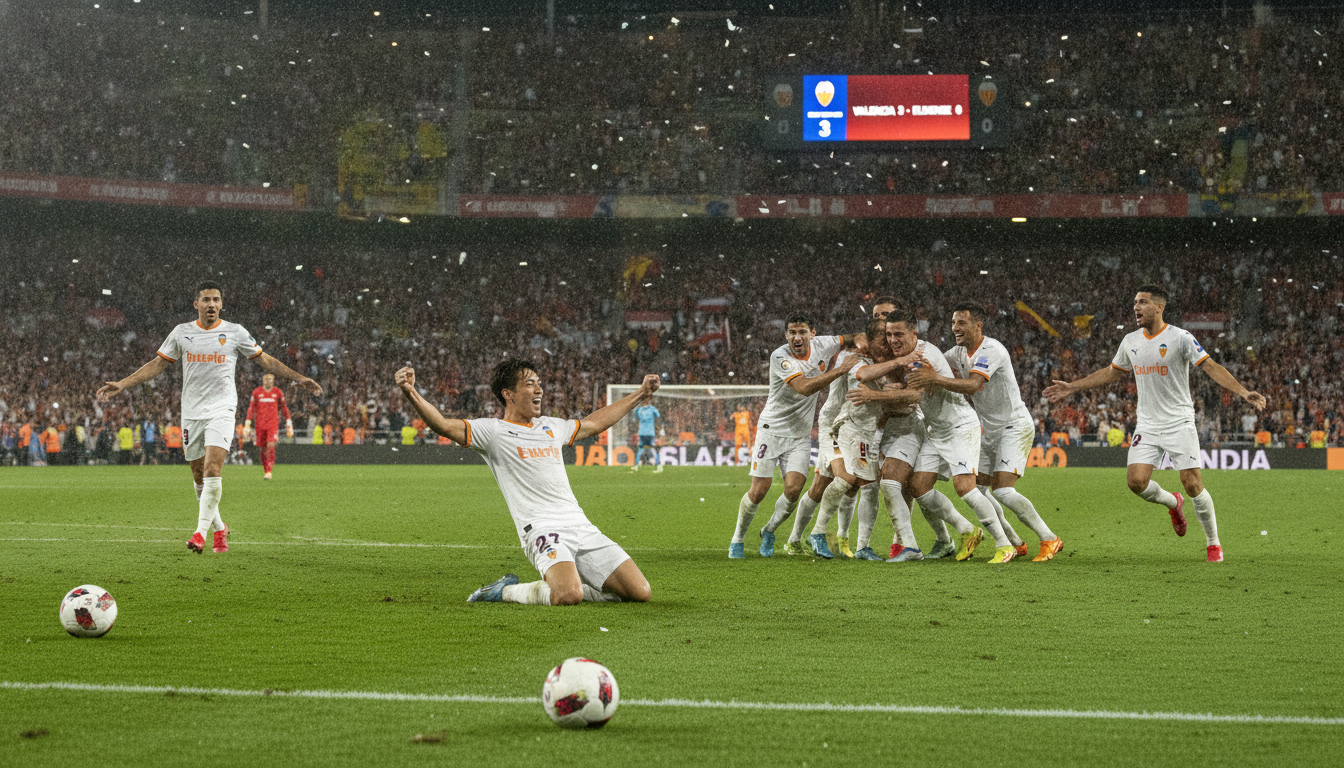
Valencia cruise to a 3-0 win over Eldense at Antonio Puchades
Valencia defeated Eldense 3-0 in a commanding first-half performance at the Antonio Puchades, with Ryunosuke Sato, Jesús Vázquez and Dani Raba on the scoresheet. The result — Valencia 3-0 Eldense — arrived before halftime and was secured in front of 1,400 spectators. Carlos Corberán’s side controlled the game from the outset, leaving Claudio Barragán’s visitors chasing for most of the match.


Valencia imposing early control
Valencia imposed a high tempo from the opening whistle, pressing Eldense into errors and creating clear chances in the final third. Ryunosuke Sato opened the scoring in the 24th minute, finishing a quick move that punctured Eldense’s defensive shape. The hosts doubled their lead nine minutes later through Jesús Vázquez, whose contribution from defense added a secondary attacking threat.
Valencia wrapped up a decisive first-half advantage when Dani Raba struck on 43 minutes to make it 3-0, a scoreline that reflected the balance of play. By halftime the match had effectively been decided, with Valencia combining patient build-up and direct transitions to exploit space. The crowd of 1,400 at Antonio Puchades bore witness to a compact, efficient performance from Corberán’s side.
Key moments that turned the game
The opening goal altered the game’s momentum and forced Eldense to change defensive posture, which Valencia exploited with greater width and sharper passing. Sato’s strike came from a move that originated on the right flank and highlighted Valencia’s readiness to attack quickly after winning possession. Jesús Vázquez’s follow-up goal underlined how full-backs and wide defenders were integrated into the offensive plan.
Dani Raba’s near-halftime finish removed any realistic chance of an Eldense comeback and allowed Valencia to manage the tempo after the break. The timing of the three goals — 24’, 33’ and 43’ — left Eldense with little margin to respond tactically. Those moments defined the match and demonstrated Valencia’s ability to convert dominance into tangible returns.
Tactical approach from Carlos Corberán
Carlos Corberán selected a starting XI that balanced physicality and technical options, with V. Abril in goal and a backline of Rubo, Diakhaby, De Haas and Jesús Vázquez. In midfield Guido and Ugrinic provided both screening and forward distribution while Otorbi, Raba and Ryunosuke supplied directness behind striker Sadiq. That formation gave Valencia multiple routes to goal: through the flanks, with overlapping full-backs, and via quick interchanges in tight spaces.
Corberán’s setup emphasized control of the central channels while inviting full-backs to advance when opportunities appeared. The early pressing scheme disrupted Eldense’s build-up and forced turnovers in dangerous areas. After establishing a three-goal cushion, Valencia shifted to a more conservative balance, allowing Corberán to protect the lead without entirely relinquishing attacking intent.
Eldense’s response and limitations
Eldense lined up with Ramón Vila in goal and a back four of Clemente, Cantó, Smand and D. Ruiz, supported by a midfield of Antonio David, Macho and Justin. Fidel and Rodri Val supplied wide movement, with Nieto operating as the primary forward target. Despite that structure, Eldense struggled to control possession and frequently conceded territory in their own half.
Claudio Barragán’s team showed commitment but lacked cohesion under sustained Valencia pressure, and the visitors’ attempts to press higher often left gaps behind. Substitutions in the second half — including the introduction of players from a deeper bench — sought to restore balance but could not neutralize Valencia’s early advantage. The single yellow card of the match, issued to Pepelu in the 84th minute, was one of the few notable disciplinary incidents for Eldense.
Individual performances and tactical contributors
Ryunosuke Sato’s opener and forward movements were crucial in destabilizing Eldense’s defensive lines and created space for teammates. Jesús Vázquez combined defensive solidity with attacking incursions, his goal reinforcing Valencia’s multi-dimensional threat. Dani Raba’s finish just before the interval capped a probing and varied attacking display.
Goalkeeper V. Abril provided a calm presence behind a reconfigured backline, while Rubo, Diakhaby and De Haas formed a cohesive defensive unit that limited clear chances after the break. On the Eldense side, Ramón Vila and the back four were kept busy and made several interventions, but the team was ultimately overrun during Valencia’s decisive period.
Match context and implications for both clubs
The Valencia 3-0 Eldense scoreline serves as a confidence-boosting result for Corberán’s squad and a clear sign of the team’s capacity to convert dominant spells into goals. For Eldense, the loss highlights areas for tactical refinement, particularly in midfield compactness and handling quick transitions. Both coaching staffs will use the match as a reference point for upcoming fixtures and squad rotation choices.
Attendance of 1,400 at Antonio Puchades reflected a modest but engaged crowd, and the match provided an early-season benchmark for player form and fitness. Valencia’s ability to deliver three goals before halftime gives them a platform to build consistency, while Eldense must address the defensive lapses that allowed rapid scoring sequences. The referee, Juan Manuel Gordillo from Valencia, managed the game with few stoppages and issued a single booking late in the contest.
Valencia’s starting lineup featured V. Abril in goal, a back four of Rubo, Diakhaby, De Haas and Jesús Vázquez, midfield pairing of Guido and Ugrinic, and an attacking midfield trio of Otorbi, Raba and Ryunosuke, with Sadiq leading the line. The bench included Wanjala, Gamón, Tárrega, Gayá, Pepelu, Dieng, Almeida, Rioja, Guerra, Hugo Duro and Iker Córdoba, offering depth that encouraged Corberán to protect the lead during the second half. Eldense’s roster included starters Ramón Vila, Clemente, Cantó, Smand, D. Ruiz, Antonio David, Macho, Justin, Fidel, Rodri Val and Nieto, with additional options such as Borja, Bustillo, Juanpa and others available.
The three first-half goals established a margin that Valencia managed intelligently, shifting between possession control and selective pressing as the match progressed. Corberán’s substitutions and game management in the second half focused on maintaining structure and avoiding unnecessary risks. Eldense pressed intermittently but could not generate the momentum required to stage a comeback.
This result will shape immediate planning for both teams as they prepare for their next fixtures, reinforcing Valencia’s tactical blueprint and exposing specific adjustments Eldense must make defensively. With three clear goals in the first 45 minutes, Valencia demonstrated a level of cohesion that will be examined by opponents in the coming weeks.
Valencia’s efficient first-half display at Antonio Puchades produced a decisive 3-0 victory over Eldense, a result that highlighted the hosts’ attacking variety and defensive organization while leaving visitors with clear areas to address going forward.