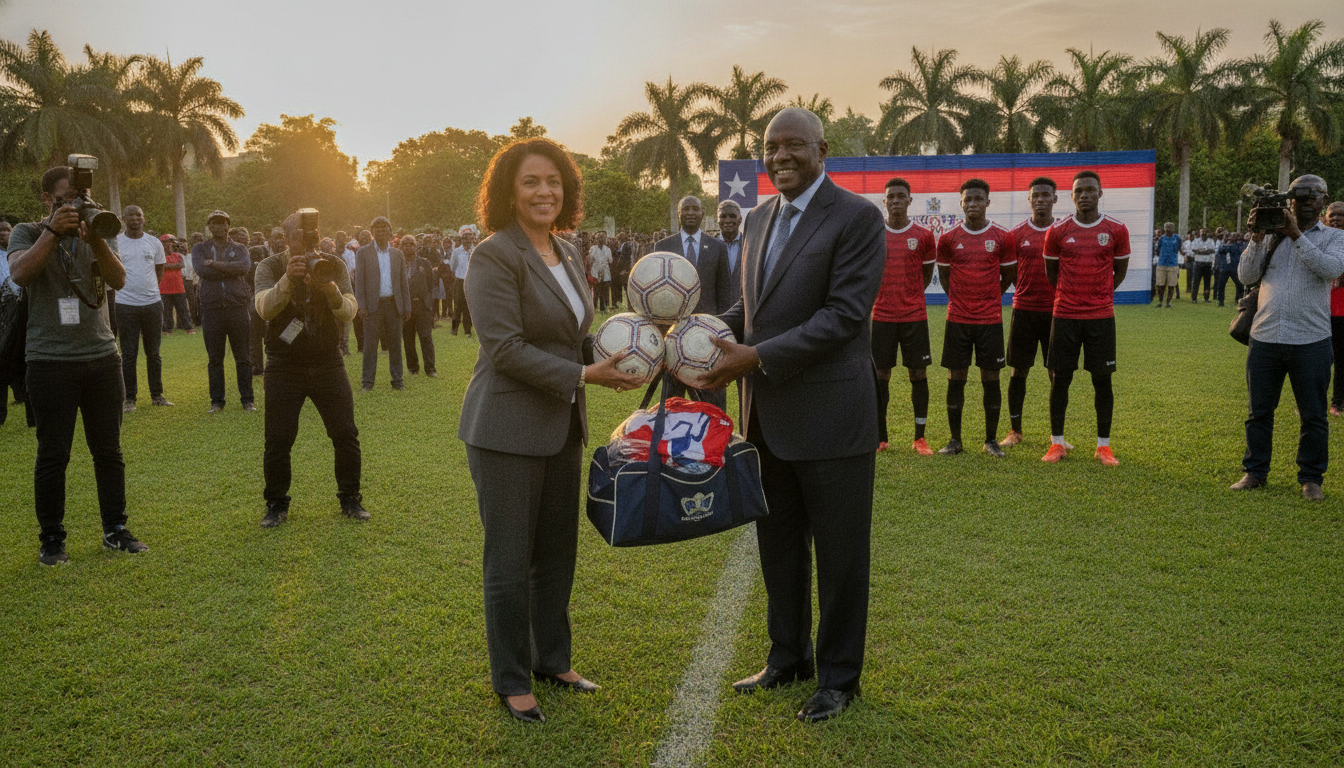
Liberia football equipment donation: Ambassador Alieu Kebe presents gear to President Boakai ahead of Independence Day
Ambassador Alieu Kebe presented football gear to President Joseph Boakai on July 26, 2026, a Liberia football donation to boost youth development nationwide.

Liberia’s Ambassador for Youth and Sports Development, Alieu Kebe, delivered a consignment of football jerseys, balls and miscellaneous sporting equipment to President Joseph Nyuma Boakai on the eve of the country’s 179th Independence Day.
The Liberia football equipment donation was framed as a personal contribution aimed at strengthening grassroots sport and creating more opportunities for young athletes across the country.
The presentation took place in Monrovia and was accompanied by public comments from both Kebe and President Boakai about the role of sport in national cohesion and youth empowerment.
Details of the donation
Kebe handed over a package that included game jerseys, training balls and assorted kit intended for clubs and community programs throughout Liberia.
He described the items as a starter contribution that can be distributed to local teams, schools and youth centers to support regular training and organized fixtures.
The ambassador emphasized that the donation is intended to be practical and immediate, enabling coaches and volunteers to resume or expand community-level activity.
Kebe’s rationale and youth development agenda
Alieu Kebe framed the donation as part of a wider commitment to using sport as a vehicle for social progress and talent identification.
He said investing in football and other sports aligns with broader national development goals and offers a nonformal pathway for leadership, discipline and livelihood skills among young Liberians.
Kebe also pledged to coordinate with national and local stakeholders to ensure the equipment reaches underserved regions and that follow-up programs are put in place.
President Boakai’s response and government backing
President Joseph Nyuma Boakai welcomed the donation and publicly commended Kebe’s initiative as complementary to government efforts.
Boakai urged other public figures and private partners to invest in grassroots programs, saying that supporting young athletes is essential to building Liberia’s sporting future.
The president reiterated the administration’s commitment to improving sports infrastructure and expanding opportunities for competition both domestically and abroad.
Football’s cultural significance in Liberia
Football remains the most popular sport in Liberia and continues to play a central role in national identity and community life.
The country’s international profile in the sport was highlighted by the career of George Weah, whose achievements are frequently cited as inspiration for the next generation.
Local leagues, school competitions and informal neighborhood matches form the backbone of talent development and public enthusiasm for the game.
Current efforts to expand infrastructure and programming
In recent years, government agencies and civil society groups have increased focus on rehabilitating playing fields, upgrading training facilities and launching youth leagues.
These initiatives aim to create safer, more structured environments for young players and to provide regular competitive calendars that aid scouting and athlete progression.
Kebe’s donation is being positioned as a complementary effort that can help address immediate equipment shortages while institutional upgrades continue.
Targeting grassroots reach and equitable access
A central theme in Kebe’s remarks was the need to ensure that equipment and programs reach beyond the capital to rural counties and informal settlements.
He stressed that talent exists nationwide and that equitable access to basic gear is a first step toward broader talent discovery and social inclusion.
Stakeholders at the handing-over pledged to develop transparent distribution plans to get kits to community coaches and school programs with demonstrated need.
Partnerships and private-sector involvement
Officials noted that public donations cannot meet all needs and called for stronger private-sector partnerships and donor coordination.
Local businesses, international NGOs and diaspora groups were invited to co-fund facility upgrades, coach education and youth tournaments that can sustain interest and development.
Kebe indicated he would open dialogues with potential partners to scale distribution and to fund periodic evaluation of program impact.
Implications for talent identification and international competition
Expanded grassroots activity and improved access to equipment are expected to broaden the pool of players eligible for national programs and scouting opportunities.
Regular play, coached training and inter-county competitions increase the likelihood that promising athletes will be identified and supported to reach national teams or professional pathways.
Officials framed these steps as essential if Liberia intends to raise competitive standards and represent the country more strongly in regional and international events.
Community-level reactions and expectations
Coaches and community leaders who received initial notices about the donation welcomed the support while urging follow-through with training and logistical assistance.
Many emphasized that equipment alone, while crucial, must be paired with coaching, transportation for fixtures and administrative support to produce lasting benefits.
Kebe acknowledged those concerns and said follow-up meetings would be held to outline distribution schedules and to identify priority recipient programs.
Timing with Independence Day and patriotic messaging
The donation was delivered in the context of Liberia’s 179th Independence Day celebrations on July 26, 2026, a moment when national pride and calls for unity are especially resonant.
Kebe framed the gesture as one that promotes patriotism and offers a unifying activity for young people across different communities.
Officials said planned sporting events during the Independence Day period will feature the donated kits as tangible symbols of investment in the country’s youth.
Monitoring, evaluation and accountability measures
To maximize the donation’s impact, Kebe and collaborating stakeholders discussed simple monitoring mechanisms for tracking distribution and use of the equipment.
They proposed that recipient organizations submit inventory lists, usage reports and periodic updates to demonstrate that kits are being used for coaching and matches.
Transparent reporting will also be used to attract additional support by demonstrating responsible stewardship of resources.
Longer-term ambitions for sport and social development
Beyond the immediate donation, both Kebe and President Boakai spoke of a longer-term vision in which sport contributes to education, health and economic opportunities for young Liberians.
They highlighted the potential of organized sport to reduce social tensions, provide structured activity for adolescents and create pathways to employment in coaching, administration and allied sectors.
This vision includes investments in coach certification, youth leadership programs and links between athletic training and educational attainment.
Liberia’s newest initiative of distributing football kits ahead of the 179th Independence Day is a measurable step toward renewed focus on grassroots sport and youth inclusion.
Ambassador Alieu Kebe’s donation and the government’s expressed backing signal a coordinated intent to leverage football’s broad appeal for social and athletic development.
Sustained progress will depend on transparent distribution, expanded partnerships and continued investment in facilities, coaching and competitive opportunities for young Liberians.