Super Falcons stunned as Malawi win 3-2 in WAFCON opener
Nigeria’s Super Falcons were upset 3-2 by debutants Malawi in the WAFCON opener, a surprise result that leaves the defending champions with immediate group-stage questions.


Match summary: Malawi 3, Super Falcons 2
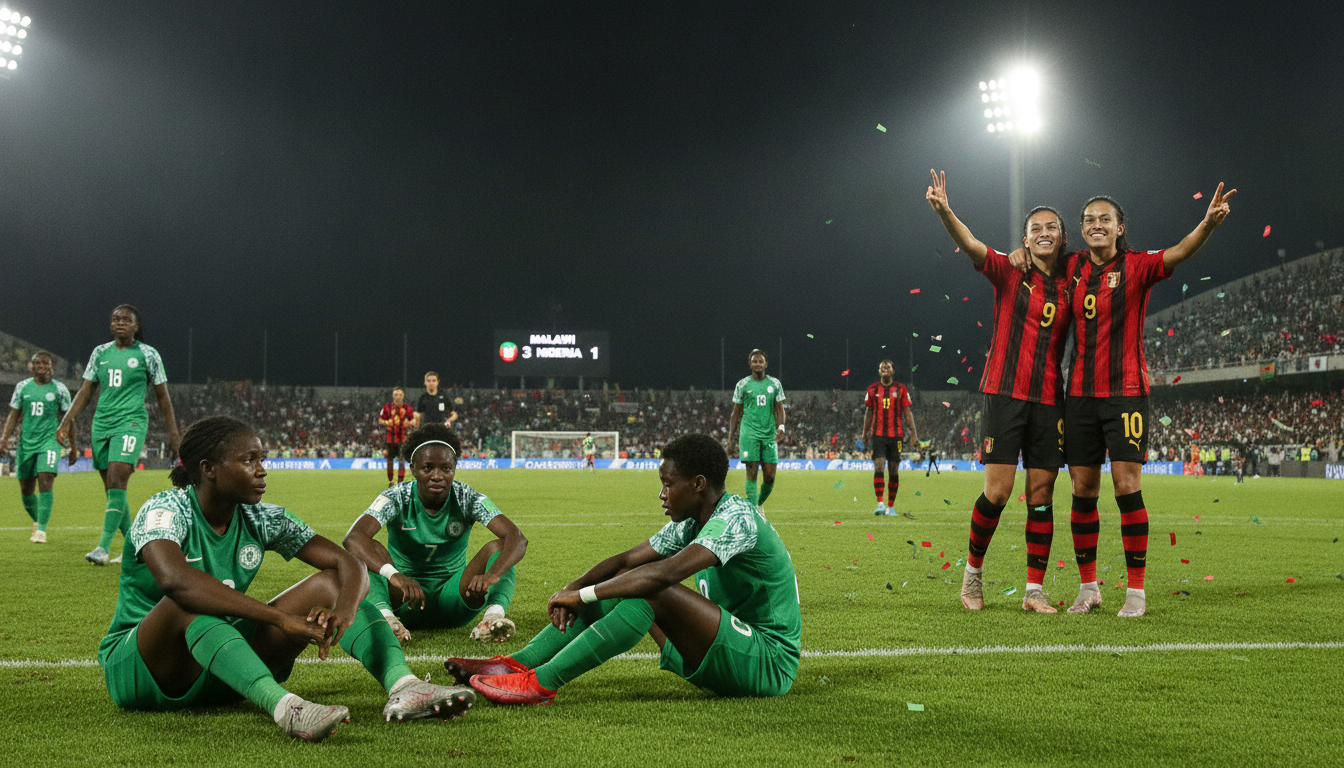
Nigeria, the tournament’s defending champions, began their WAFCON campaign as heavy favorites but fell to a spirited Malawi side 3-2. The result came in a Group C clash that saw Malawi score three times through the Chawinga sisters, while Nigeria replied twice through Rasheedat Ajibade and substitute Uchenna Kanu. The defeat marks a difficult start for the Super Falcons and hands Malawi a landmark victory on their tournament debut.
The scoreline reflected a game of momentum swings and sharp finishing from the visitors. Malawi capitalized on moments of defensive hesitation from Nigeria and maintained composure to close out the win. For the Super Falcons, the match exposed cracks in tempo and organization that their opponents exploited.
Chawinga sisters provide decisive impact
Temwa Chawinga produced a standout performance with two clinical finishes to open and extend Malawi’s lead. Her sister Tabitha added a third goal to complete the surprise, combining speed, positional awareness, and composure inside the box. The partnership created persistent problems for Nigeria’s defense, which struggled to track their movements and cover the space behind the backline.
Malawi’s attacking patterns often revolved around quick combinations and direct transitions, allowing the Chawingas to receive service in dangerous areas. Their movement off the ball dragged defenders out of position and created openings for one-on-one opportunities. The sisters’ interplay and decision-making under pressure proved the match-defining element.
How Nigeria responded but fell short
After conceding, the Super Falcons showed urgency and managed to pull two goals back through established attacking options. Rasheedat Ajibade delivered a composed finish to reduce the deficit and regain some momentum for Nigeria. Later, substitute Uchenna Kanu struck to bring the scoreline within a single goal and set up a tense final phase.
Despite the late fightback, Nigeria could not find the equalizer they needed to salvage a point. The team created several promising chances but struggled with final-phase control and the timing of runs into the penalty area. Errors in transition and a lack of cutting passes in the box limited the Super Falcons’ ability to convert pressure into goals.
Referee decision and penalty controversy
A pivotal moment came when Esther Okoronkwo was brought down inside the box, a challenge that prompted debate over whether a penalty should have been awarded. Okoronkwo later acknowledged the team’s flat start but declined to dwell on the decision, suggesting the match needed to be viewed in its entirety rather than on one call. The incident intensified discussion among coaches and pundits about officiating standards and VAR application at the tournament.
The controversy highlighted broader concerns about consistency in match control at major tournaments. Whatever the referee saw in real time, the moment shifted momentum and left Nigeria with a tangible grievance that will likely be reviewed by coaching staff. For Malawi, the decision — or lack of one — did not alter their game plan, and they continued to press for control of the match.
Tactical issues and defensive lapses for Nigeria
Tactically, the Super Falcons appeared sluggish out of the blocks and were slow to adapt to Malawi’s directness. Defensive positioning at times lacked cohesion, leaving gaps that were exploited by the Chawinga sisters and their supporting runners. Midfield links between defense and attack were intermittently missing, forcing forwards to chase long passes rather than receive service in rhythm.
Coaching decisions and personnel choices will come under scrutiny as Nigeria seeks to correct course. The balance between protecting space centrally and tracking wide threats was not maintained, and substitution timing did not immediately halt Malawi’s momentum. The team’s inability to assert control in the middle third allowed the visitors to play with confidence and dictate the tempo for extended periods.
Psychological and group-stage implications
The loss has immediate consequences for Nigeria’s chances in Group C, placing pressure on remaining fixtures and raising the stakes for the next match. For Malawi, the victory is a major morale boost and serves notice that debutant teams can produce shock results on big stages. Group dynamics have shifted, and other teams will now prepare differently knowing Nigeria dropped points early.
From a psychological perspective, the Super Falcons must manage the sting of an unexpected defeat while preventing it from undermining squad cohesion. Quick recovery will be essential, both in terms of physical training and restoring belief ahead of their next fixture. How the coaching staff addresses the tactical shortcomings and mental rebound will shape Nigeria’s path through the group.
Coaching staff and next steps for Nigeria
The Super Falcons’ technical team will have little time to regroup and make adjustments ahead of their next outing. Training priorities are likely to focus on defensive compactness, sharper transitional pressing, and improving the quality of final third service. Tactical drills to close gaps on overlapping runs and tighter marking in the box will be key to preventing repeat vulnerabilities.
Rotation and squad management could come into play as the tournament progresses, with fresh legs potentially required to restore intensity. The staff must also consider set-piece organization and match-readiness to handle direct opponents who exploit high defensive lines. Clear communication of roles and responsibilities will be necessary to stabilize performances.
Malawi’s rise and tournament outlook
Malawi’s performance provides a template for how underdog teams can challenge established nations through disciplined execution and individual moments of quality. The Chawinga sisters’ finishing and Malawi’s willingness to defend resolutely under pressure were pivotal. Their result will alter how Group C opponents plan and may inspire other debutant sides to play with similar boldness.
Sustaining this level of performance over the tournament will require depth and consistency, particularly in managing fitness and handling the strategic adjustments opponents will make. Malawi must prepare for teams that will now target neutralizing the Chawinga threat, which means developing alternative attacking patterns to remain unpredictable.
The Super Falcons remain tournament favorites on paper, but this result underscores the fine margins that decide matches at major competitions. Nigeria’s response in the coming days will be telling for their title defense prospects and could determine whether the loss is an early wake-up call or the start of a deeper crisis.
Esther Okoronkwo and her teammates emphasized learning from the defeat and focusing on improvement rather than recrimination. The squad’s capacity to translate analysis into corrective action will define their short-term recovery and long-term campaign. With group-stage matches coming thickly, swift tactical refinement and restored confidence will be essential.
Recovery will hinge on clarity from the coaching staff, accountability within the squad, and a collective commitment to execute fundamentals under pressure. If the Super Falcons can address the specific breakdowns exposed in this match, they still possess the individual talent and experience to progress. However, they will need to demonstrate that capability on the field rather than on reputation alone.
Nigeria faces a critical period in the WAFCON group stage where every match carries heightened significance following this shock defeat. The team’s handling of preparation, personnel choices, and in-game adaptability will determine whether they can reassert their status. For Malawi, the win is a historic statement that will reverberate through the rest of the competition.
The match served as a reminder that tournament football often rewards teams that combine tactical discipline with clinical finishing, regardless of pedigree. Both sides will now shift focus to recovery and strategy ahead of their next fixtures, with Nigeria aiming to respond and Malawi seeking to build on a landmark result.