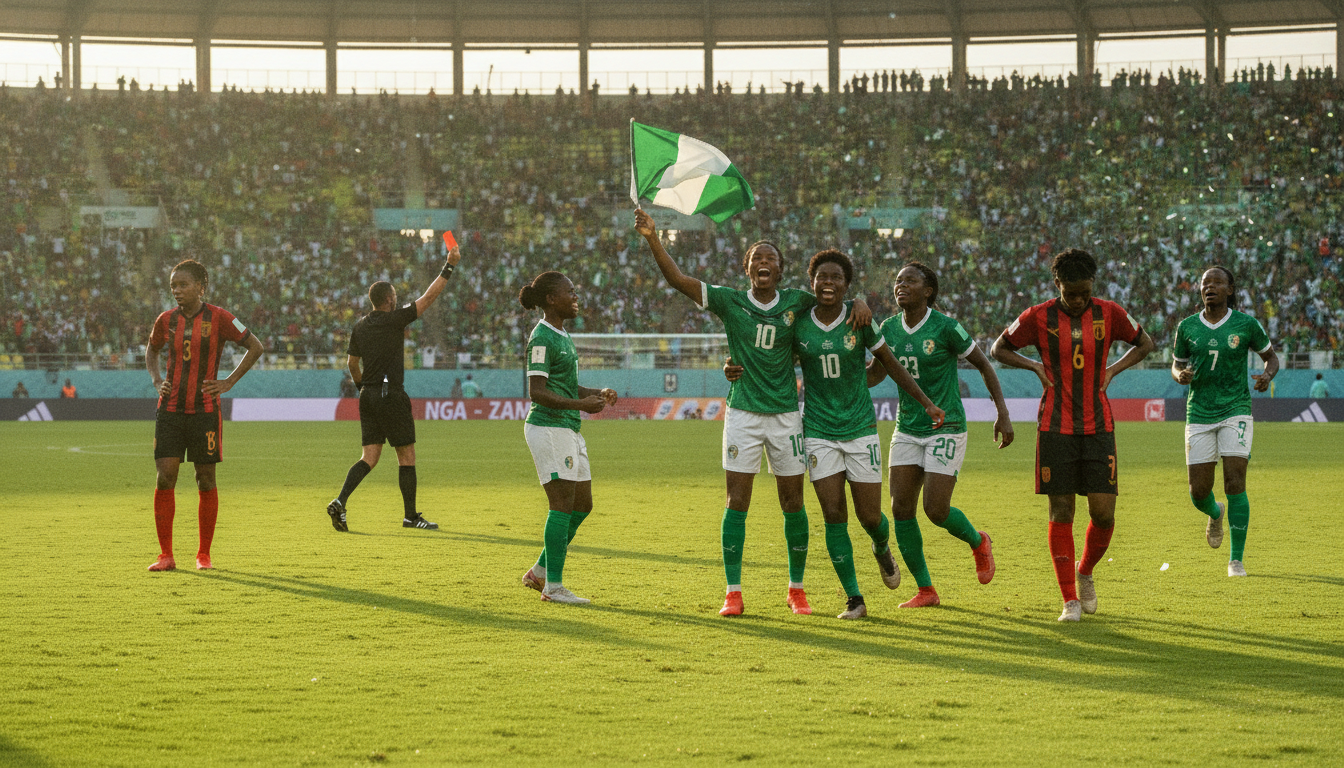
Super Falcons defeat Zambia 1-0 in WAFCON as Oshoala’s early strike and ten-player resilience earn vital win
Asisat Oshoala’s early goal and a reshaped defence saw the Super Falcons defeat Zambia 1-0 in Rabat, preserving their WAFCON title defense and momentum.


The Super Falcons secured a hard-fought 1-0 victory over Zambia’s Copper Queens in Rabat on Saturday, August 1, 2026, with Asisat Oshoala’s eighth-minute finish proving decisive. Nigeria’s win came despite being reduced to ten players shortly before halftime after a second yellow for defender Tosin Demehin, and it underscored the team’s tactical discipline and defensive resolve. Head coach Justin Madugu reorganized his side at the interval, allowing goalkeeper Chiamaka Nnadozie and a compact backline to withstand persistent Zambian pressure. The result keeps Nigeria on course in the WAFCON group stage as they prepare to face Egypt on Wednesday, August 5.
Oshoala’s eighth-minute finish decides tight encounter
Asisat Oshoala opened the scoring in the eighth minute when she ran onto a clipped pass into the box and finished calmly past the goalkeeper. The strike gave the ten-time African champions an early advantage and set the tone for a match dominated by tactical caution and physical duels. Oshoala’s movement and finishing demonstrated why she remains central to Nigeria’s attacking threat at major tournaments. That early goal proved vital once the game became contested and stretched after the first half’s contentious moments.
Nigeria’s front line pushed with intent from the first whistle, seeking to capitalize on moments of space behind Zambia’s defense. Oshoala combined well with Uchenna Kanu on the left and tested the Copper Queens’ organization with direct runs. Her clinical finish did not just produce the match’s only goal but also forced Zambia to alter their approach, chasing possession and committing numbers forward to find an equalizer.
Turning point: Demehin’s dismissal after VAR intervention and second foul
The match’s tempo shifted dramatically in the final stages of the first half when central defender Tosin Demehin was shown a yellow card following a heavy challenge on Barbra Banda. A subsequent Video Assistant Referee review initially identified an offside in the build-up and overturned the call, but a later collision in the 40th minute earned Demehin a second booking and a red card. The dismissal reduced Nigeria to ten players at a crucial juncture and required an immediate tactical recalibration from the defending champions.
The sending-off intensified pressure on Nigeria as Zambia pressed to exploit the numerical advantage before halftime. Zambia’s physical approach and direct play sought to draw the Super Falcons out of shape, but the home side managed the remaining minutes of the half without conceding. The incident introduced a new strategic layer to the match, forcing Nigeria to balance defensive solidity with the need to relieve pressure on the back line.
Madugu’s tactical reshuffle stabilizes the team after the red card
Faced with a numerical disadvantage, coach Justin Madugu made a timely tactical change early in the second half, bringing on Shukurat Oladipo in place of debutant Rofiat Imuran. That substitution signaled a shift toward defensive compactness and structured counter-attacking rather than open play. Madugu’s adjustments emphasized zonal discipline, tighter midblock spacing, and quick vertical transitions when Nigeria regained possession.
The switch to a more conservative shape prevented Zambia from carving out clear-cut chances and allowed the Super Falcons to remain dangerous on the break. Uchenna Kanu and later substitute Esther Okoronkwo offered pace and directness, probing for openings when the Copper Queens committed players forward. Madugu’s game management under pressure illustrated a pragmatic approach prioritizing result preservation over aesthetic dominance.
Nnadozie and the rearguard absorb intense late pressure
Goalkeeper Chiamaka Nnadozie played a central role in the victory, making a series of important saves and organizing a restructured defence under sustained late pressure. Her command of the penalty area and timely interventions forced Zambia to attempt low-percentage efforts from distance. The goalkeeper’s composure and communication were crucial as Nigeria weathered waves of Zambian attacks in the closing stages.
The defensive unit, with Oladipo and other experienced heads stepping into adjusted roles, maintained tight lines and limited clear sightlines for the Copper Queens’ attackers. Nigeria’s backline defended deeper and used fouls judiciously to break up promising moves, while midfielders tracked runners and protected the central corridors. That collective effort ensured the Super Falcons preserved their slender lead until the final whistle.
Zambia’s sustained search for an equalizer falls short
Zambia dominated possession for much of the second half and repeatedly probed Nigeria’s rearguard, but they lacked a decisive breakthrough in the penalty area. Barbra Banda and other attacking options posed moments of danger through physicality and movement, yet the Copper Queens could not convert their pressure into a match-altering opportunity. Inefficiencies in the final third and an inability to create high-quality shots developed into a recurring problem for Zambia.
Set-piece deliveries and late crosses generated scramble situations but no clear finishes, as Nigeria’s defenders cleared lines and Nnadozie claimed aerial threats. The Copper Queens’ tactical plan to overload the channels and stretch Nigeria’s single-goal lead produced opportunities but ultimately failed to find a clinical edge. Their performance highlighted attacking intent but also a need for greater composure and variety in finishing moves.
Broader implications for Nigeria’s WAFCON campaign and group dynamics
The win keeps the Super Falcons in a favorable position in their WAFCON group and reinforces their credentials as title contenders despite the disciplinary setback. Securing three points under adverse conditions will be viewed positively by the coaching staff and squad as the tournament progresses. The victory also offers a morale boost heading into the midweek fixture against Egypt and provides practical lessons about game management and roster depth when playing a player short.
For Zambia, the result represents a missed chance to climb the group table and apply pressure on the favorites. The Copper Queens showed determination and capacity to control phases of play, but the outcome emphasizes the margins that separate possession dominance from winning results. Both teams now face specific tactical and personnel questions ahead of their remaining group matches.
Looking ahead: Egypt clash on August 5 presents new tests
Nigeria’s next game is scheduled for Wednesday, August 5, 2026, when they face Egypt, a side still seeking points after two opening defeats. The match will test Nigeria’s ability to recover physically and mentally in a short turnaround, while offering an opportunity to consolidate group-stage ambitions. Madugu will need to consider rotation, recovery protocols, and possible reintegration of players depending on suspension and fitness statuses following the Zambia game.
Egypt arrives seeking its first victory and will likely adopt a cautious but opportunistic game plan to unsettle the Super Falcons. The upcoming fixture will be pivotal in determining the complexion of the group and may decide which teams progress with momentum into the knockout rounds. Tactical nuance, discipline to avoid avoidable bookings, and execution in the final third will be decisive factors for both sides.
Nigeria’s defense of the WAFCON trophy continues to rely on a blend of veteran leadership and strategic pragmatism. Oshoala’s early strike and the team’s capacity to reorganize under pressure provided the platform for Saturday’s result. As the tournament moves forward, the Super Falcons will look to refine their approach, manage player workloads, and convert narrow leads into more comfortable outcomes.
Squad management and disciplinary control will be key themes for the coaching staff in the days ahead. Maintaining concentration for 90 minutes and avoiding second cautions that lead to expulsions must be prioritized in training sessions. The victory over Zambia offers evidence that the group can adapt under duress, but it also underlines how slender margins can define a campaign at this level.
The Super Falcons depart Rabat with three points and renewed focus on the immediate challenge in Cairo. Their ability to replicate defensive resilience and produce clinical moments in attack will shape whether they progress as group leaders or face tougher paths in the knockout rounds. Fans and analysts alike will watch how Madugu balances aggression with caution in the matches to come.
Nigeria’s performance against Zambia will be dissected for its tactical decisions and mental resolve. The team’s response to adversity — particularly the red card and the disciplined second-half structure — offers a blueprint for navigating the rest of the tournament. Asisat Oshoala’s finish will be remembered as the decisive intervention, but the collective defensive effort ultimately sealed the Super Falcons’ narrow victory.