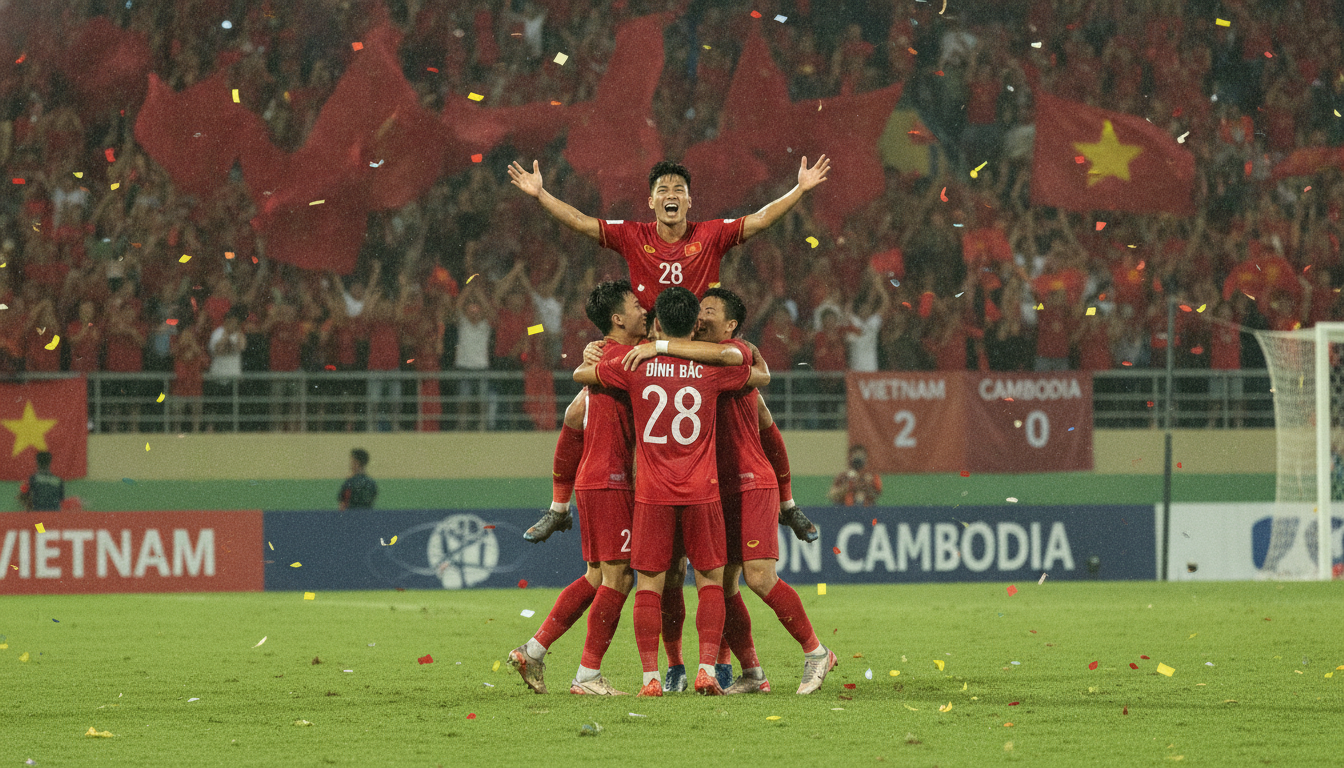
Vietnam vs Cambodia: Đình Bắc brace sends Vietnam top of Group A with 3-1 win
Nguyễn Đình Bắc’s brace lifted Vietnam to a 3-1 victory over Cambodia in Hanoi as Vietnam topped Group A at the ASEAN Hyundai Cup 2026, securing a semi-final berth.


Vietnam secured top spot in Group A with a hard-fought 3-1 win over Cambodia at the Mỹ Đình National Stadium on August 7, 2026. Nguyễn Đình Bắc struck in the 18th and 89th minutes to take his tournament tally to five goals and ensure the defending champions advanced with three wins and a draw in the group phase.
The match produced tense moments, a spirited comeback by Cambodia and a late own goal that proved decisive. Coach Kim Sang-sik’s side will now prepare for the semi-finals buoyed by momentum but with clear tactical takeaways from the encounter.
Đình Bắc brace sends Vietnam top of Group A
Nguyễn Đình Bắc put Vietnam ahead early, converting a composed run and finish after linking with Nguyễn Hoàng Đức in the 18th minute. The 21-year-old forward added a late, confident lob in the 89th minute to seal the result and underline his role as Vietnam’s leading scorer in the tournament.
Đình Bắc’s two goals completed a personal haul of five for the competition, a strike rate that has been central to the Golden Star Warriors’ progression. His movement and finishing stretched Cambodia’s back line throughout the 90 minutes.
Captain Nguyễn Quang Hải returned to the starting XI, providing leadership and attacking impetus in midfield. Vietnam’s record in the group — three wins and a draw — ensured they top the section and avoid any uncertainty heading into the knockout stage.
Key moments at Mỹ Đình National Stadium
The visitors created the first notable opening in the 14th minute when Samuel Bong dispossessed Nguyễn Thành Chung and forced a long-range attempt that sailed over the bar. That missed opportunity proved costly as Vietnam responded quickly with their first goal.
Vietnam’s opener arrived after a neat sequence involving Nguyễn Hoàng Đức and Đình Bắc, with the forward turning away from a defender before sprinting onto the pass and finishing past goalkeeper Salim Koy. Vietnam continued to press and created several further chances through quick combination play.
Cambodia’s substitute Iago Bento Fernandes drew his side level in the 71st minute, capitalising on a long pass and outpacing the Vietnamese right flank. The equaliser brought the contest back to life and forced Vietnam to reassert control in the final quarter.
Tactical shifts and Kim Sang-sik’s adjustments
Coach Kim Sang-sik made a single starting change by restoring Nguyễn Quang Hải to the lineup, a move aimed at adding creativity and tempo in the middle. Vietnam largely relied on their fast transition play, using wide runs and quick vertical passes to unsettle Cambodia’s defence.
Cambodia introduced two changes at half-time that injected greater directness and pace into their attack, culminating in Iago Bento’s 71st-minute finish. Vietnam adjusted by tightening midfield cover and seeking to exploit space behind the visitors’ advancing full-backs.
The two coaches’ tactical responses shaped the match narrative: Vietnam’s patience and superior movement eventually produced the late winning goal, while Cambodia’s substitutions demonstrated the value of proactive changes in shifting momentum.
Cambodia fightback highlighted by Iago Bento
Iago Bento Fernandes emerged as Cambodia’s most dangerous outlet after coming off the bench, using pace and timing to unsettle Vietnam’s defence. His 71st-minute strike was a product of a long ball that freed him in behind and a composed low finish that beat Phạm Xuân Mạnh’s marker.
Cambodia’s spirited second-half display showed signs of tactical clarity and belief, particularly in their willingness to commit numbers forward. The equaliser gave them genuine hope of claiming a result against the tournament holders.
Despite ultimately falling short, Cambodia’s route to the 71st-minute equaliser reflected a competitive approach and effective use of substitutes. Their performance offers a template to build on as they review the match and plan for future fixtures in the regional calendar.
Defining errors and late decisive action
The turning point arrived in the 84th minute when Im Vakhim diverted an attempted clearance into his own net, restoring Vietnam’s advantage amid a period of sustained pressure. The own goal underlined how small defensive moments can dramatically swing a tightly contested group-stage match.
Vietnam’s second decisive attack came from Đình Bắc’s late lob, a composed finish that punished the visitors for pushing forward in search of an equaliser. The timing of the goals — early and very late — showcased Vietnam’s ability to score at critical moments.
Goalkeeping interventions and near-misses also played a role, with Salim Koy producing key saves to keep Cambodia in the contest. Vietnam’s clinical finishing and readiness to capitalise on defensive errors were ultimately the decisive factors in securing all three points.
Implications for the semi-finals and Vietnam’s preparations
Finishing top of Group A gives Vietnam a clearer route into the latter stages and the advantage of momentum heading into the semi-finals. The team’s mix of youthful attackers and experienced campaigners will be central as Kim Sang-sik prepares tactical plans for stiffer opposition.
Vietnam will want to refine defensive concentration after conceding a soft equaliser and an own goal, even as the squad celebrates a successful group campaign. Maintaining fitness and integrating any remaining squad options will be priorities in the short window before the knockouts.
For Cambodia, the match offers positives to extract despite elimination from title contention, notably the impact of substitutes and moments of attacking cohesion. The coaching staff can use the performance as a benchmark when evaluating squad depth and individual contributions.
Nguyễn Đình Bắc’s tournament form will attract attention from within the region and beyond, and Vietnam must manage his workload carefully while sustaining attacking fluidity. The semi-final challenge will demand tactical discipline and sustained attacking threat against higher-quality opposition.
Final preparations will focus on recovery, opponent analysis and fine-tuning set-piece routines that proved influential in a match decided by narrow margins. Vietnam’s supporters will expect the team to carry this form into the knockout phase and compete for a successful title defence.
Vietnam’s group-stage campaign concluded with three wins and one draw, a return that underlines their consistency in the ASEAN Hyundai Cup 2026. The squad has demonstrated a blend of defensive resilience and attacking inventiveness that will be tested anew in the semi-finals.
The result in Hanoi provided a showcase for emerging talent and reinforced Vietnam’s status as the team to beat in the region. As fixtures tighten, the ability to manage games and convert decisive moments into goals will determine how far this squad can go in defending their title.