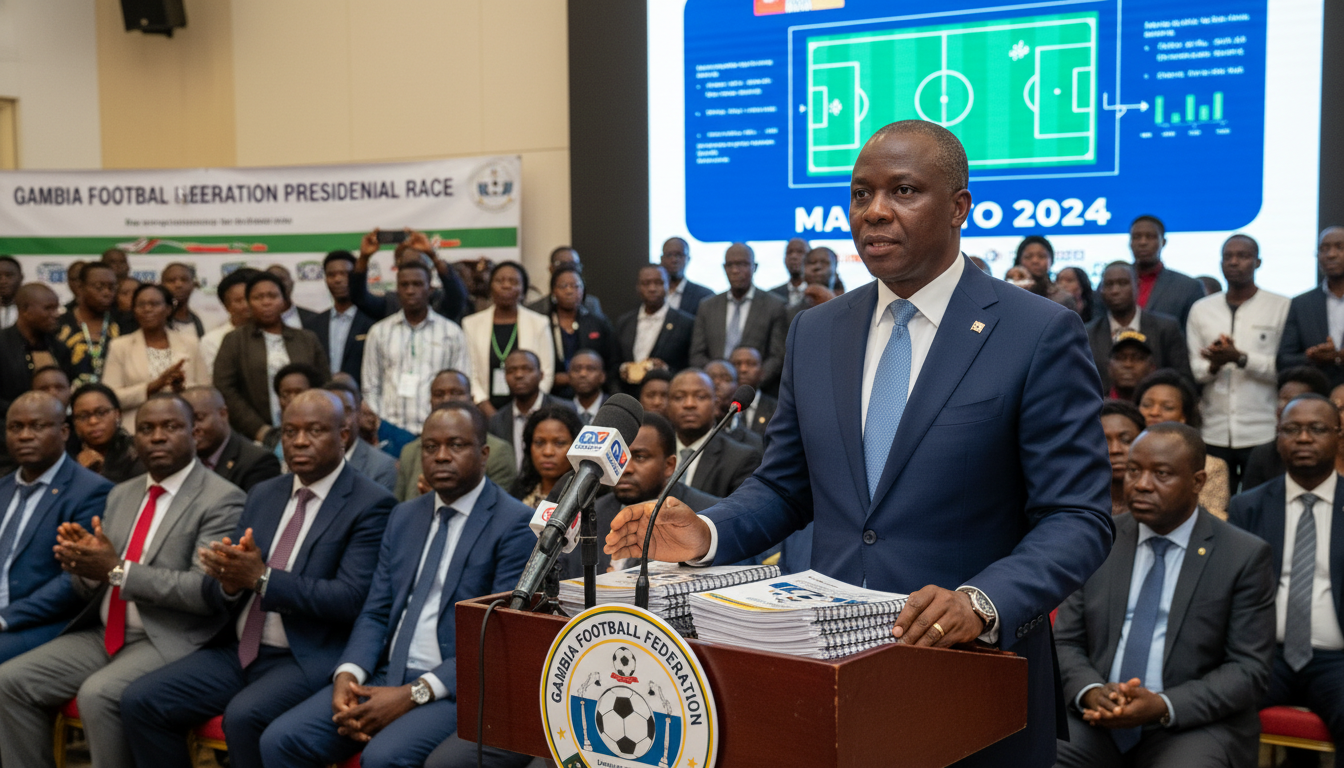
Kamaso unveils "The Starting XI" manifesto as he bids to lead the Gambia Football Federation
Sadibou Kamaso unveils "The Starting XI" manifesto as he vies to lead the Gambia Football Federation, promising transparency, league reform and youth support.


The race for the Gambia Football Federation presidency intensified after administrator Sadibou Kamaso launched a comprehensive 2026–2030 manifesto titled The Starting XI. The document, presented under the slogan "Restore Confidence," lays out an 11-point reform agenda aimed at overhauling governance, professionalising the domestic league and boosting youth and women’s football. Kamaso framed the proposals as a response to what he described as eroded trust in federation leadership and inadequate infrastructure across the regions.
Kamaso’s vision and campaign launch
Kamaso opened his campaign by appealing directly to clubs, regional associations, coaches, players and the media for broad support. He positioned his bid as a corrective to existing governance gaps and said the federation must re-establish transparent, accountable stewardship. His manifesto sets a timetable and detailed measures he says will bring structural change over a four-year term.
The document highlights Kamaso’s experience in multiple GFF roles as the foundation for his candidacy. He points to past service on the Finance Committee and Emergency Committee, as well as club-level administrative posts, to underline his familiarity with federation operations. Kamaso argued that those credentials give him the practical knowledge to implement the reforms he proposes.
Eleven-point blueprint focuses on governance and oversight
At the heart of the manifesto is an 11-point program that targets governance, constitutional reform and stronger oversight mechanisms. Kamaso commits to establishing Legal and Compliance divisions, alongside Monitoring and Evaluation units, to improve transparency in federation activities. He also pledged regular public briefings and clearer procurement procedures to ensure public funds are traceable.
Financial controls and accountability feature prominently in the blueprint after what the manifesto calls years of lax oversight. The proposals include stricter auditing practices, enhanced treasury controls and a push to diversify revenue so the federation is not overly dependent on external grants. Kamaso says these measures are designed to restore credibility and reassure stakeholders that federation resources will be spent on football priorities.
Professionalisation plan for the domestic league
A keystone of Kamaso’s agenda is the League Clubs Excellence Programme (LCEP), intended to move Gambian league football away from its long-standing amateur status. The programme proposes club licensing, governance assessments and capacity support in areas such as finance, medical care and youth development. Kamaso envisions a League Management Company in which clubs would own shares and have a direct voice in running the competition.
The manifesto includes a detailed financial package to incentivise improvement, with proposed prize money increases and direct club support. Champions of the Male First Division would reportedly earn D2 million, while participating clubs would receive preparatory grants of D250,000 each. The plan also earmarks D1 million for the Women’s First Division winners and an overall D25.9 million allocation for prize money and club assistance, measures Kamaso says will make football a more viable profession locally.
Infrastructure, regional development and playing surfaces
Kamaso argues poor pitches and dated facilities have hindered player development and discouraged investment across many parts of the country. His manifesto commits to ensuring every region has at least one pitch meeting minimum league standards as a baseline for competition. He also foresees longer-term upgrades to stadiums capable of hosting international fixtures where feasible.
Support for Regional Football Associations is another priority, with promised office spaces, equipment and operational funding to strengthen grassroots administration. The campaign argues that better-resourced RFAs will improve talent identification, governance at local level and the smooth delivery of league programmes. Kamaso links facility improvements to broader aims of protecting player welfare and raising match standards nationwide.
Youth pathways, anti-fraud measures and Nawettan integration
Youth development is central to Kamaso’s strategy, with a focus on clearer pathways from school and Nawettan football into club academies and national age-group teams. The manifesto proposes a digital registration database for young players and stricter verification processes to reduce age-cheating incidents that have previously plagued Gambian youth football. Annual youth and school tournaments would be staged to help scouts and clubs find talent.
The plan explicitly seeks to integrate traditional Nawettan competition into the formal pyramid through collaboration with regional bodies, which the manifesto says will formalise scouting and open access to national development programmes. Kamaso presented these measures as practical steps to ensure young players have transparent routes to professional opportunities and international exposure.
Women’s football and technical development commitments
Women’s football is given a prominent role in the proposed reforms, with commitments to increase female participation at administrative and coaching levels. Kamaso pledged a dedicated development programme aimed at building a sustainable pool of female players, coaches and officials to represent the country at all levels. The manifesto also promises improved financial support for the women’s league and targeted investments in training and competition.
On the technical side, the blueprint calls for expanded coaching education, upgraded referee training and administrative capacity-building to raise professional standards. The campaign stresses that better-qualified coaches and referees are essential for player progression and for improving the overall competitiveness of Gambian teams in regional and continental competitions. Kamaso links technical investment directly to long-term performance objectives.
Financing, commercialization and player welfare measures
The manifesto describes the federation’s current finances as underperforming and outlines several revenue-generation initiatives to reduce dependency on FIFA funding. Proposed measures include commercialization of the league, merchandise programmes, improved sponsorship strategies and optimized use of federation assets such as the GFF Football Hotel. Stricter financial oversight mechanisms are intended to ensure funds are allocated to football development rather than administrative inefficiencies.
Player welfare receives targeted attention with plans for a medical fund to support players suffering serious injuries and proposals for medical schemes covering participants in the first and second divisions. Kamaso proposes that funding for welfare measures would come from multiple streams including FIFA and CAF grants, gate receipts and television rights, with the aim of creating more reliable safety nets for athletes.
Looking ahead, the manifesto outlines a mix of immediate actions and longer-term investments that would require buy-in from clubs, regional associations and government stakeholders. Kamaso’s campaign frames the proposals as pragmatic and prioritised, with quick wins expected alongside structural reforms that will take longer to realise.
As the leadership contest develops, Kamaso’s manifesto has injected fresh energy into conversations about the future direction of Gambian football. Supporters and critics alike have taken note of the level of detail in The Starting XI, and the plan is likely to intensify scrutiny of both policy and personalities in the weeks leading up to the federation’s next electoral cycle.
Whether the promises can be fully implemented will depend on coalition-building within the GFF, the willingness of clubs and sponsors to commit resources, and the federation’s capacity to manage complex projects. For now, Kamaso has set a clear agenda that frames governance, professionalisation and youth development as the pillars of his proposed administration.
The campaign’s next phase will test whether the detailed proposals translate into tangible backing from the football community and whether Kamaso can persuade voters that his roadmap will restore confidence in the Gambia Football Federation.