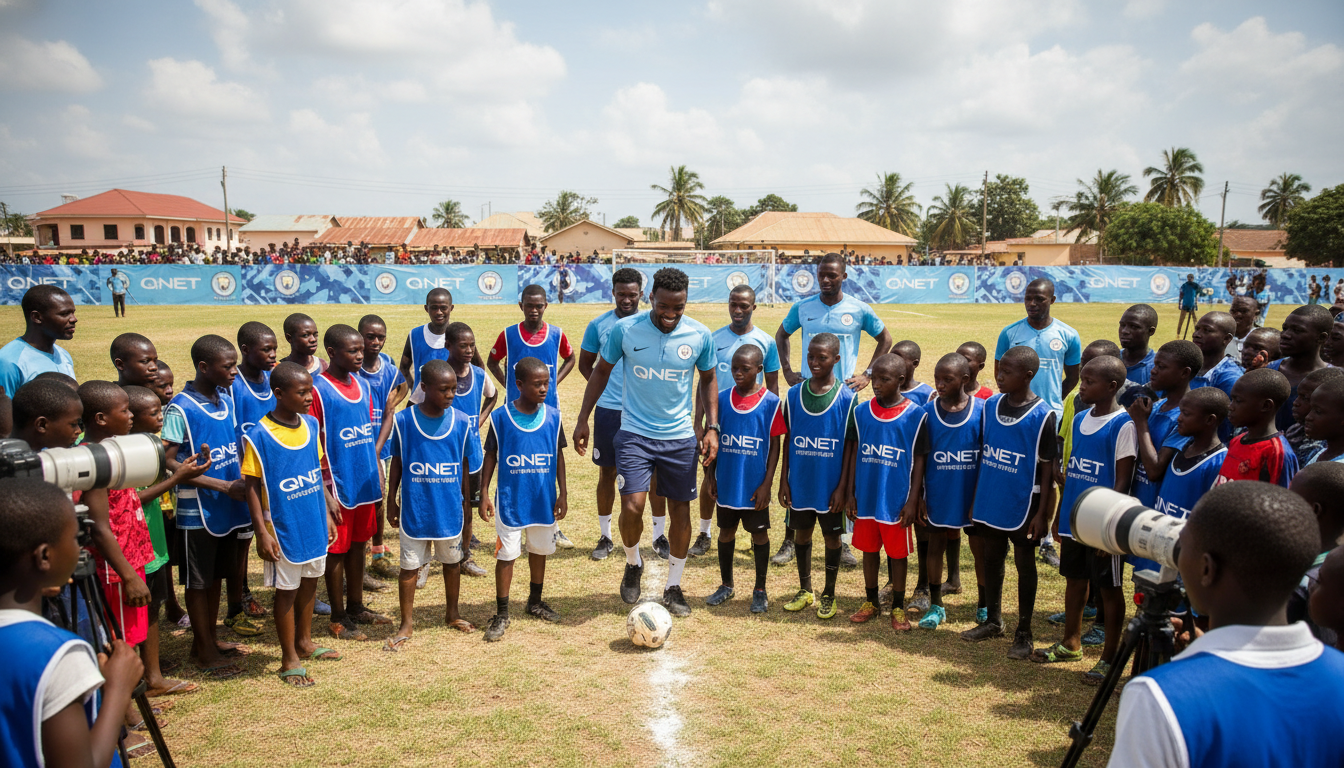
QNET and Manchester City Deliver Four-Day Accra Football Clinic to 25 Young Players
QNET and Manchester City ran a four-day Accra football clinic at East Legon, training 25 young players in football and life skills and promoting inclusion.


A four-day Accra football clinic staged at the East Legon Astro Turf brought professional coaching and life-skills education to 25 young athletes, organizers said.
The program, delivered through a partnership between direct-selling firm QNET and English club Manchester City, combined on-pitch training with sessions intended to strengthen character and community engagement.
Four-day clinic staged in East Legon
The clinic ran from Thursday through Sunday and attracted a select group of children from the Accra area for concentrated coaching and mentoring.
Organizers said the facility at East Legon was chosen to provide a high-quality artificial surface that mirrors the conditions used in professional youth development programs.
Professional coaches from Manchester City led the technical sessions and worked alongside local facilitators to transfer training methods and drills.
Coaches focused on ball control, tactical movement, and situational play while integrating feedback loops designed to accelerate learning within the compact, four-day schedule.
Coaching curriculum paired with life skills
Beyond passing and finishing drills, trainers incorporated life skills coaching intended to prepare participants for broader opportunities off the pitch.
Sessions addressed teamwork, communication, discipline, and resilience, with activities structured to allow young players to apply sporting principles to everyday decision-making.
Program leaders emphasized that technical proficiency without character development leaves young athletes ill-prepared for the demands of professional pathways.
By running classroom-style talks and on-field scenarios, the clinic sought to bridge the gap between sporting talent and the personal competencies recruiters and clubs commonly seek.
QNET leadership and regional oversight
The initiative was led by Trevor Kona, QNET’s Chief Network Development Officer, who framed the clinic as part of the company’s longer-term youth development commitments in Africa.
He was supported on the ground by Cherif Bassirou Abdoulaye Sarr, Deputy Regional Manager for Sub-Saharan Africa, who helped coordinate logistics and stakeholder engagement for the event.
Officials from QNET described the partnership with Manchester City as a vehicle for transferring professional standards and institutional knowledge to local communities.
They stressed that the program’s value lay not only in coaching delivery but also in creating linkages that could yield future mentorship, scouting, and community projects.
Inclusion highlighted by girl’s participation
Organizers and regional managers highlighted the inclusion of six girls among the 25 participants as a deliberate step toward gender balance in youth sports.
Those involved described the girls’ presence as evidence that young women have a place in both competitive sports and professional development programs across the continent.
Coaches reported positive responses to mixed-gender training dynamics, noting that the girls engaged fully in drills and tactical work and matched their peers in intensity and learning.
Program representatives said that promoting female participation was a priority for future sessions and that additional outreach would encourage broader enrollment.
Community ties and entrepreneurship focus
Beyond short-term athletic development, QNET representatives framed the clinic within a broader strategy of community empowerment and entrepreneurship across Africa.
Officials said the company intends to pair sports initiatives with opportunities that build local capacity, including business training and platforms for youth to pursue sustainable livelihoods.
Speakers at the event underscored that sport can be a gateway to social mobility and community cohesion when paired with deliberate efforts to create economic pathways.
QNET’s messages emphasized that investment in youth sports should sit alongside mentorship in entrepreneurship and civic engagement to produce long-term benefits for participants and their neighborhoods.
Event drew former players and club officials
The closing day included an event at the Accra Marriott Hotel where former footballers, QNET representatives, and Manchester City officials gathered to mark the clinic’s conclusion.
Organizers said the viewing party provided a moment to celebrate participant progress, share feedback, and discuss next steps for expanding the program’s reach.
Attendees at the reception highlighted the importance of visibility and networks in spotting talent and creating pathways to higher levels of play and education.
Manchester City staff who participated in the clinic reportedly used the occasion to outline potential follow-up activities and explore further collaboration with local stakeholders.
The clinic’s format—combining short-term intensive coaching with community-oriented programming—was described by participants as a model that can be replicated in other regions.
Organizers expressed intent to monitor participant progress, gather assessments from coaches and parents, and refine future clinics to increase player exposure and developmental outcomes.
Final assessments from coaches and QNET personnel praised the participants’ enthusiasm and adaptability, while noting that sustained progress will require ongoing training and community support.
Officials signaled plans to evaluate the pilot’s impact and to consider additional events that extend the benefits to larger cohorts and underrepresented groups in Ghana and the wider region.
The Accra football clinic represented a targeted effort to apply international coaching standards to local talent while promoting inclusion, entrepreneurship, and community development through sport.