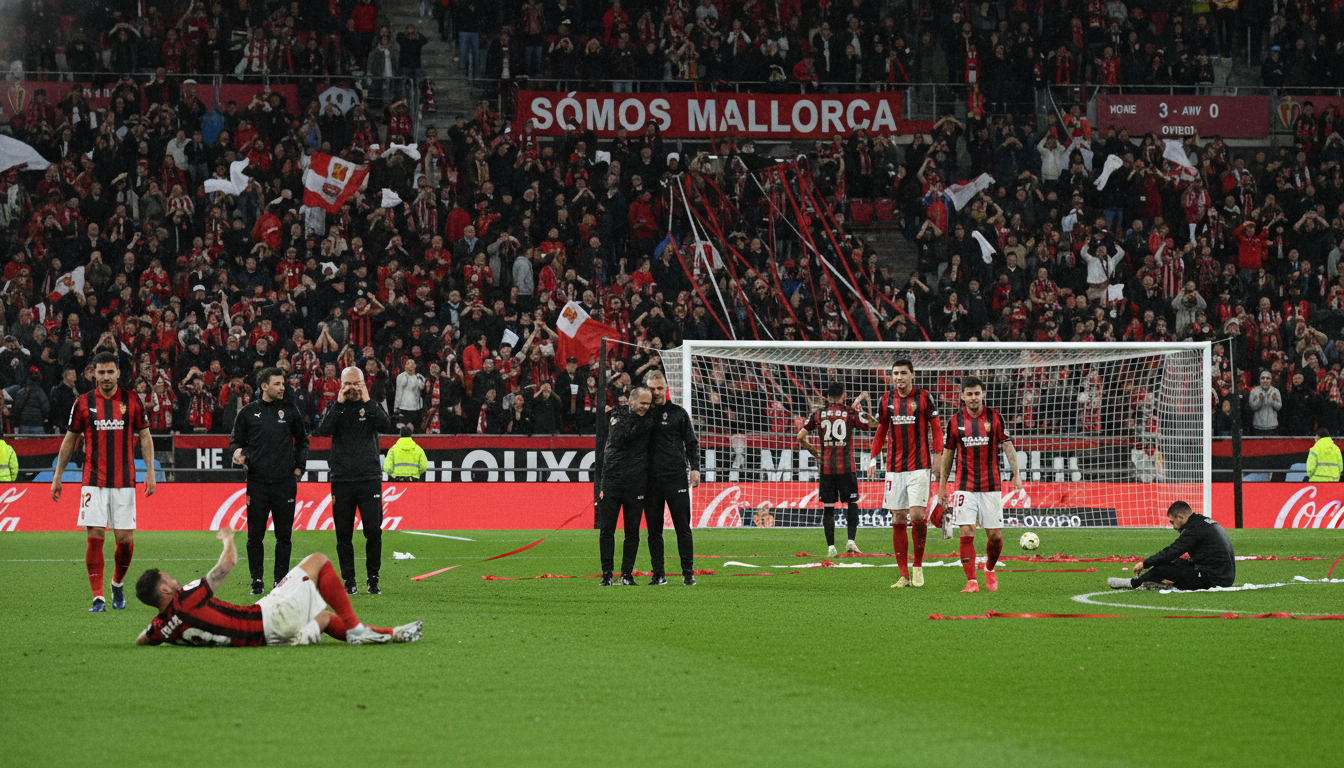
Real Mallorca relegated despite 3-0 win over Real Oviedo
Real Mallorca relegated after a 3-0 victory over Real Oviedo; fans boo president Andy Kölberg and sporting director Pablo Ortells as the club drops to Segunda with 42 points.


Real Mallorca relegated to the Segunda División despite a convincing 3-0 win over bottom-placed Real Oviedo at Son Moix, a result that proved ultimately insufficient because of unfavorable outcomes elsewhere. The Mallorcan side, which entered the evening with only a 4% chance of survival, finished the season on 42 points and will end a five-year spell in LaLiga. Emotions ran high as supporters protested in the stands and targeted the club president and sporting director for what they see as a season of mismanagement.
Match summary and final scoreline
The evening at Son Moix produced a scoreline that looked encouraging on the surface but delivered the opposite outcome for Mallorca’s top-flight hopes. Pablo Torre opened the scoring before half-time, Manu Morlanes added a second late in the second half, and Vedat Muriqi sealed the 3-0 victory with a late strike. Despite the three goals, the combination of other results meant Mallorca could not escape relegation.
The final whistle confirmed Mallorca’s drop with 42 points, bringing a painful close to a campaign that promised little margin for error. The contrast between the on-field victory and off-field consequences framed the night as one of triumph turned tragic for the club and its supporters.
Key moments that defined the match
The game began with Mallorca on the front foot, Takuma Asano forcing an early attempt that narrowly missed the target. Vedat Muriqi had an early headed chance that was well saved by Oviedo goalkeeper H. Moldovan, a sign of both Mallorca’s attacking intent and Oviedo’s organized defending.
Pablo Torre’s goal in the 42nd minute came from a precise Pablo Maffeo cross, with Torre finishing at close range to give the hosts the lead going into the break. That goal briefly rekindled hope among the Mallorca supporters that survival was still possible, but the scoreboard elsewhere did not bend in their favor.
Late in the match, Mallorca finally extended the lead when Manu Morlanes scored in the 83rd minute, and Muriqi added a third in the 88th minute to cap a dominant finish. Those late strikes ensured a commanding home result but could not alter the wider league arithmetic that condemned the club.
Injuries, substitutions and match management
Mallorca’s evening was marked by a concerning injury to Omar Mascarell, who left the pitch in tears in the 53rd minute and was replaced by Antonio Raíllo. The substitution was forced and added to the club’s physical and emotional burden during a tense fixture. Raíllo, recently recovering from ankle surgery, was brought in to stabilize the midfield and help close out the win.
Manu Morlanes produced a notable chance shortly after half-time when his shot was deflected and struck the post before Moldovan gathered the rebound. The sequence underlined both Mallorca’s pressure and Oviedo’s resilience in goal. Across the pitch, Oviedo defended in numbers and limited clear-cut opportunities until the late decisive moments.
Referee José María Sánchez Santos handled a game that featured a handful of cautions, including bookings for Santi Cazorla, Manu Morlanes and Samu Costa. The match was closely contested in the midfield and saw tactical adjustments from both benches as each side sought to impose itself in key phases.
Supporters’ reaction and tensions at Son Moix
The mood in the stadium turned sour despite the scoreline, with Mallorca fans expressing their anger toward the club hierarchy at full time. A pañolada — a chorus of whistles and jeers traditionally aimed at the executive box — greeted the end of the match, and supporters directly blamed president Andy Kölberg and sporting director Pablo Ortells for the relegation.
Those protests reflected mounting frustration after a season in which expectations and reality diverged sharply for the island club. The demonstrations were made more conspicuous by the extraordinarily low official attendance figure reported for the fixture, which registered as zero spectators at Son Moix, underscoring an unusual backdrop for a match with relegation implications.
Fans pointed to recruitment decisions, strategic planning and on-field results as factors behind the club’s descent, and the critical tone in the stands suggested a rupture between supporter sentiment and the board that will complicate off-season planning.
Consequences for players and individual stories
Vedat Muriqi finished the season with a high goals tally yet faces the personal disappointment of relegation alongside his club. The Kosovo striker netted once in this game to add to a prolific season, but the broader outcome leaves his immediate future and international prospects in question. The match report noted Muriqi’s 23-goal season, an impressive return that nonetheless could not prevent Mallorca’s drop.
Other individual narratives also crystallized as the campaign closed. Santi Cazorla, a veteran presence who drew a yellow card in this match, saw his time in Spain’s top tier come to an end with Mallorca’s relegation. Younger players such as Pablo Torre and Takuma Asano delivered moments of quality that will be evaluated by the club as potential building blocks for the next season.
For coaching staff and sporting directors, the immediate task will be to assess contracts and squad composition with an eye toward the financial and competitive realities of the Segunda División. Player departures are likely, and some performers will attract attention from clubs remaining in the top flight.
Wider implications and the club’s immediate outlook
Relegation carries both sporting and economic consequences for Mallorca, affecting revenues, sponsorship, and transfer strategy. Dropping to the Segunda División will require a reevaluation of budget priorities and a likely reshaping of the first-team squad to match the demands of the second tier. The club must balance a desire for an immediate return with fiscal prudence.
From a competitive standpoint, Mallorca will enter a challenging second-tier environment where the calendar and opponents differ substantially from LaLiga. The sporting project that will be put together by the board and technical staff must address squad depth, recruitment, and the psychological recovery of a squad and fanbase bruised by a late-season collapse.
Off the pitch, the public unrest directed at the president and sporting director adds a governance dimension to the club’s problems. Management will face pressure to outline a clear plan for recovery and to engage with supporters to rebuild trust ahead of pre-season and transfer market activity.
Final assessments of the season will hinge on decisions taken now about coaching, recruitment and financial planning. Mallorca’s leadership will be judged on how rapidly and convincingly it can present a credible route back to the top flight.
The game at Son Moix will remain a bitter memory for Mallorca — a night when three goals and a home victory could not alter the final verdict of relegation. The club departs LaLiga after five seasons among Spain’s elite, and now begins the difficult work of regrouping, addressing structural questions and plotting a path to return. The mood on the island is one of disappointment and demand for answers, and those responsible for the next chapter will face intense scrutiny in the weeks ahead.