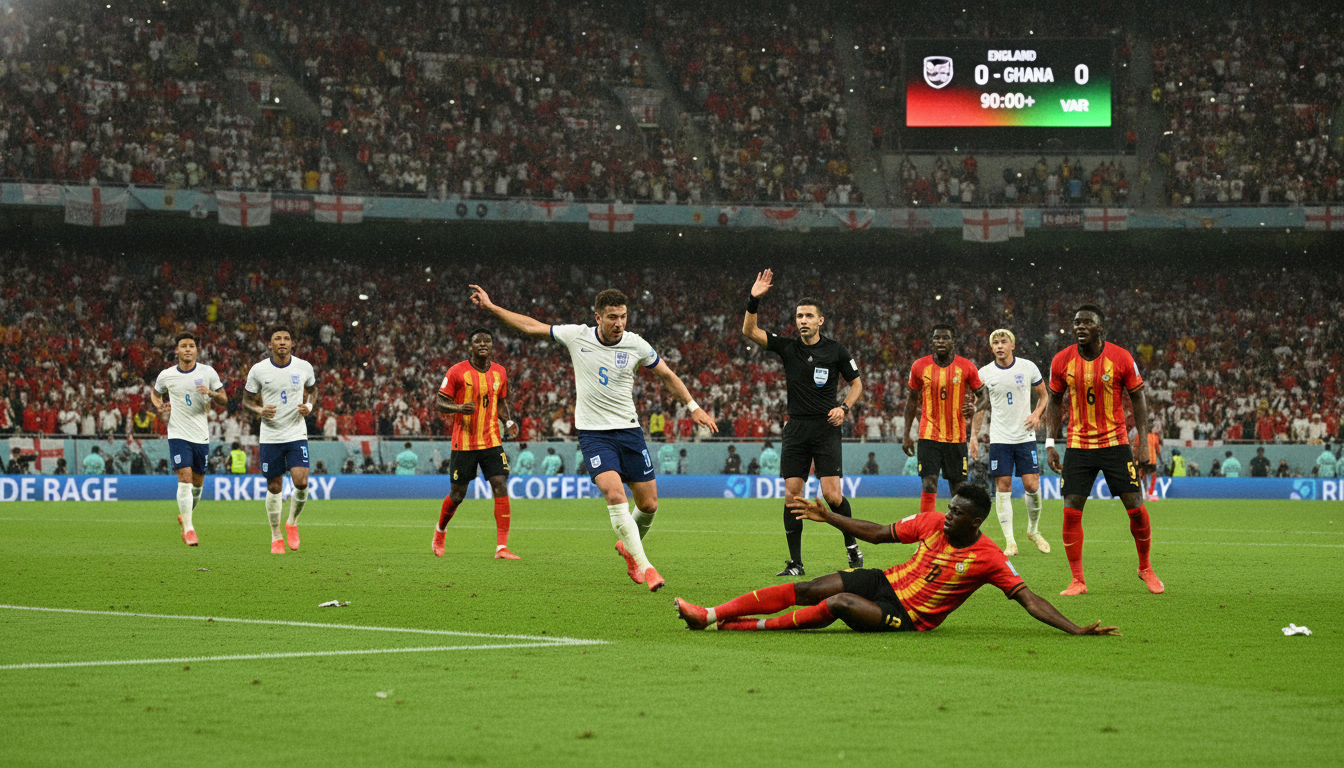
England vs Ghana VAR Controversy: Missed Penalty Clouds Goalless Draw in Foxborough
VAR silence over a missed penalty overshadows England vs Ghana goalless draw in Foxborough, triggering criticism from Ghana coach Carlos Queiroz and TV analysts.


Referee and VAR Decision Under Scrutiny
The goalless draw between England and Ghana at Foxborough was defined less by chances and more by a single, controversial moment that left spectators and officials divided. In the second half, England defender Ezri Konsa rose to challenge Prince Abu as the Ghanaian forward bore down on goal, a collision that many observers regarded as a clear foul. Referee Said Martinez waved play on and the on-field decision stood despite strong protests from the Ghana bench and visiting supporters. The video assistant referee, Armando Villarreal, did not intervene, and the absence of a review has become the central talking point after the match.
Television replays circulated immediately after the incident and showed Konsa making contact with the attacker while failing to touch the ball. That detail formed the basis of arguments that the challenge should have resulted in a penalty. The silence from VAR was notable because the incident occurred in a high-stakes phase of the game and presented what some analysts described as an obvious reviewable offence. The lack of intervention prompted questions about the application of VAR protocols and whether the threshold for referral was applied consistently.
Officials on the pitch and in the VAR booth have a mandate to correct clear and obvious errors, a standard that supporters of a review argued applied in this case. The match delegation has not released a public statement detailing the rationale for no action, leaving teams and fans to interpret the game-day outcome. That opacity has compounded frustration, particularly for Ghana, who saw a potential match-defining moment go unaddressed.
Television Analyst and Officials’ Reactions
Darren Cann, an English official working as a television analyst at the tournament, provided a candid assessment that added weight to criticism of the decision. Cann said he believed the challenge met the criteria for referral and that Konsa made no contact with the ball while bringing down the attacker. The analyst qualified his view with obvious partisan relief for England but was unequivocal on the technical point, noting the foul mechanics and the player’s airborne position.
Broadcast analysts and former referees on air dissected the angle, speed, and intent of the tackle, emphasizing the defender’s loss of control when contesting the ball. Their commentary focused on whether the VAR team saw the same replay angles and, if so, why they did not communicate a referral to the referee. Such analysis played a central role in shaping public perception of the incident and increased pressure on tournament officiating bodies to explain the decision-making process.
On social media and in post-match studios, former players and pundits echoed the view that the foul appeared to be a stonewall penalty. That consensus among independent viewers and ex-officials intensified scrutiny of both the on-field referee and the VAR operators, raising broader questions about the consistency of officiating in high-profile fixtures.
Carlos Queiroz’s Post-Match Rebuke
Ghana coach Carlos Queiroz made his frustrations clear in the post-match press conference, using pointed language to question the effectiveness of VAR at the tournament. He highlighted the moment and asked whether video intervention was still functioning at the World Cup, a rhetorical jab that underscored his displeasure. Queiroz’s comments were delivered with visible irritation and framed as a demand for accountability rather than a theatrical flourish.
The coach’s public reaction reflects a broader concern among team staff that key decisions can materially affect tournament outcomes when left unresolved. Queiroz also noted that his players had been denied a legitimate opportunity to influence the match outcome, an argument that resonates in competitive international fixtures where margins are fine. His remarks are likely to increase attention on any subsequent explanation offered by the match authorities.
Ghana’s technical team lodged formal protests in previous tournaments in similar circumstances, and observers expect a follow-up request for clarification here as well. Whether that will prompt a detailed review or a terse procedural reply remains to be seen, but Queiroz’s insistence ensures the issue will not fade quickly.
Match Flow and Tactical Context
Despite the controversy, the match itself was largely subdued and failing to live up to the offensive promise many anticipated. Both sides struggled to generate sustained attacking rhythm, and clear-cut chances were few outside the Konsa-Abu incident. England fielded a lineup that emphasized possession and control, while Ghana sought opportunities on the break with limited success.
The midfield battle was congested for long periods, and neither side managed to string together the kind of incisive passes that open defences at this level. Defenders on both teams were usually in position and disciplined, which contributed to the low-scoring and cautious nature of the encounter. As the game progressed, the single disputed moment took on outsized importance precisely because opportunities were otherwise scarce.
Coaches will extract tactical lessons from the display: England for finding creative outlets in the final third, and Ghana for maintaining defensive structure while seeking more penetration. For neutrals and analysts, the match reinforced the notion that singular moments, whether goals or contentious calls, can eclipse the broader tactical narrative in tournament play.
Implications for Tournament Progression
A draw in a fixture of this profile carries meaningful consequences for group dynamics and psychological momentum. For England, the clean sheet but lack of goals offers both reassurance in defence and concern in attack, with questions likely to be raised about finishing and creative spark. For Ghana, the feeling of an opportunity denied could galvanize players or introduce lingering frustration ahead of their next match.
Tournament groups often turn on fine margins, and an unawarded penalty has the potential to alter standings and goal difference at the end of a stage. Teams that perceive injustice may channel that energy positively, but they also risk internal distraction if the issue festers. Coaches and federation officials will monitor the emotional health of their squads in the coming days to ensure focus remains on preparation.
Beyond immediate fixtures, the episode will attract attention from those tracking officiating standards and may influence how teams approach appeals and post-match communications. National associations sometimes use such instances to press for procedural changes or clarifications, and this match provides a concrete example for those discussions.
VAR Protocols and Officiating Transparency
The incident has renewed debate about how VAR is implemented in practice and the transparency of its outcomes. The VAR process is intended to correct clear and obvious errors, but the absence of a visible review in this case left many searching for an explanation of how the standard was applied. Calls for clearer, more timely information about video reviews have grown louder following high-profile tournaments.
Officiating bodies face the challenge of balancing decisive intervention with the game’s flow, and the criteria for overturning on-field calls are intentionally strict. Nevertheless, stakeholders increasingly demand post-match clarity when contentious decisions arise, including a basic account of why a review was or was not triggered. That level of transparency can help restore public confidence, even when the result is unchanged.
There are also practical considerations about VAR operation: camera angles, communication delays, and human judgement all factor into whether an incident is identified and acted upon. The match in Foxborough may prompt tournament officials to review internal procedures, and it is likely that refereeing committees will examine the sequence to determine whether policy or execution was at fault.
Final paragraph.
The England vs Ghana VAR controversy in Foxborough is likely to reverberate beyond the scoreline, prompting questions from team staff, broadcasters, and fans about the consistency of match control and the role of video review. Without a formal explanation from the officiating authorities, the moment will remain a talking point as both teams turn attention to forthcoming fixtures and tournament objectives.