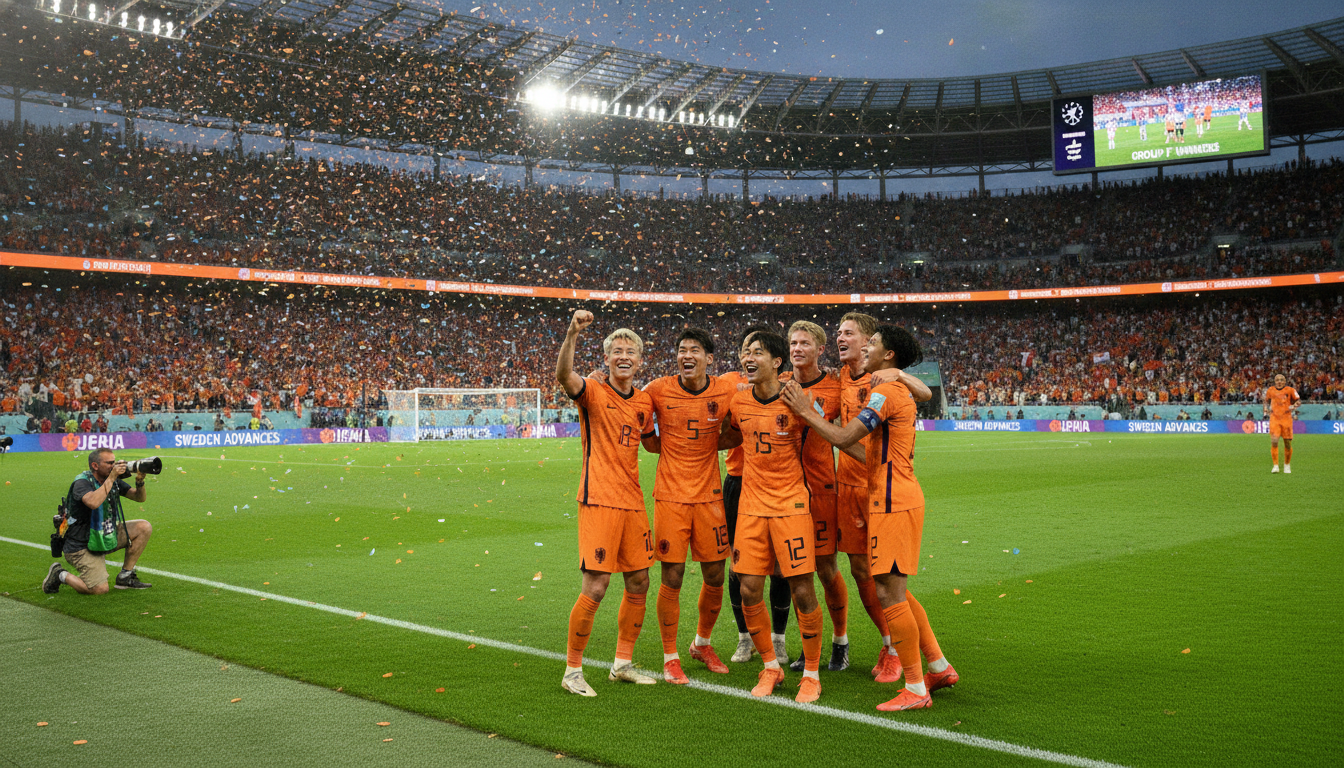
Netherlands Secure Top Spot in World Cup Group F with 3-1 Win Over Tunisia; Japan and Sweden Advance
Netherlands beat Tunisia 3-1 to claim top spot in World Cup Group F in Kansas City, while Japan and Sweden drew 1-1 in Dallas to also advance to the last 16.

The Netherlands finished Group F on top after a composed 3-1 victory over Tunisia in Kansas City, while Japan and Sweden played out a 1-1 draw in Dallas that sent both teams into the knockout stage. The result underlined Tunisia’s defensive struggles across the group and rewarded Ronald Koeman’s side with group-winning status. Japan and Sweden each produced second-half goals in a match that delivered intensity after a quiet opening period.
Netherlands gain control early to secure Group F lead
The Dutch seized initiative inside the opening minutes when a cross from the right ended up redirected past its own goalkeeper, handing the Netherlands an immediate advantage. The early setback unsettled Tunisia and allowed the Netherlands to settle into a patient, possession-based rhythm that often found space down the flanks. Virgil van Dijk’s influence at set pieces paid dividends when his movement created the opening for Brian Brobbey to convert a close-range header shortly after. That double-strike within the opening ten minutes effectively set the tone for a match the Netherlands managed with efficiency and composure.
The remainder of the first half saw the Dutch control possession without forcing a flurry of clear-cut chances, aiming instead to contain Tunisia’s forward transitions. Tunisia struggled to string passes together in midfield and frequently ceded territory, leaving their attack to look for isolated breaks. Koeman’s team rode that control through to halftime, conscious that a third goal would kill the contest and protect their top-of-group ambitions. The early cushion allowed substitutions later in the match to be introduced with the game firmly in the Netherlands’ grasp.
Key moments that decided the contest
Tunisia’s solitary response came after the interval when Hazem Mastouri rose to meet a corner and powered a header past the goalkeeper, briefly reviving his nation’s hopes. The goal reduced the deficit and forced the Netherlands to re-engage with more urgency, as Tunisia sought a dramatic comeback. Eight minutes after Mastouri’s strike, Jan Paul van Hecke restored a two-goal cushion by redirecting a corner at the near post, with the ball ricocheting off an opponent before crossing the line. That sequence extinguished Tunisia’s momentum and handed the Dutch a decisive buffer heading into the closing stages.
Throughout the match the Netherlands showcased a blend of aerial threat and set-piece precision that Tunisia could not consistently counter. Van Dijk’s role in orchestrating defensive stability and creating attacking openings from dead-ball situations was a decisive factor. Meanwhile, Tunisia’s attempts to respond were undermined by errors and a lack of cohesive pressure in midfield, which limited their ability to sustain attacks. The differing levels of execution in critical moments ultimately separated the sides.
Tunisia’s campaign ends amid defensive lapses and managerial turmoil
The defeat concluded a difficult tournament for Tunisia, whose group-stage results were undermined by heavy losses and inconsistent defending. The campaign was also marked by off-field disruption, including the early dismissal of their coach, a decision that compounded the team’s on-pitch volatility. Defensive lapses and an inability to control transitions repeatedly left the squad exposed against higher-quality opponents. Tunisia’s exit will prompt a period of review from the national federation as officials assess recruitment, tactics, and coaching stability ahead of future qualifying cycles.
Player performances for Tunisia oscillated between moments of commitment and lapses in concentration, particularly in defensive positioning around set pieces. The own goal that opened the match captured a tournament-long trend of misfortune and miscommunication at the back. Facing top-tier opposition highlighted structural issues that will need addressing if Tunisia are to compete more consistently at major tournaments. The closing match provided clear evidence that defensive organization and psychological resilience are immediate priorities.
Japan and Sweden draw to confirm knockout places
In Dallas both Japan and Sweden left the field with the results they required, each securing passage to the last 16 with a 1-1 stalemate. Daizen Maeda opened the scoring for Japan shortly after halftime with a well-timed finish that rewarded a period of sustained pressure. Sweden responded six minutes later when Anthony Elanga produced a composed finish to level the match, and the contest thereafter became a tactical battle between two teams content to manage the point. The draw ensured both sides progressed, maintaining the competitive balance of Group F into the next round.
The Japan–Sweden game lacked the frenetic pace of other fixtures but produced a decisive burst of action after the interval that ultimately decided both teams’ fates. Japan’s approach blended quick interchanges and off-the-ball runs designed to destabilize Sweden’s defensive lines. Sweden relied on direct movement and moments of individual quality to counter, with Elanga’s strike the highest-profile example. Both teams can take tactical positives from the match while remaining mindful of the greater tactical challenges they will encounter in the knockout phase.
Tactical takeaways and individual performances
The Netherlands demonstrated the value of early aggression combined with disciplined structure, converting set-piece opportunities and then controlling tempo through measured possession. Ronald Koeman’s side balanced direct threat from wide areas with central consolidation, limiting Tunisia’s ability to create sustained pressure. Brian Brobbey’s finish showcased the Dutch pedigree at close range, while Jan Paul van Hecke’s late intervention highlighted the squad’s depth and opportunism on set plays. Virgil van Dijk’s influence in both defensive and attacking phases underlined why he remains central to the Netherlands’ prospects.
Japan’s second-half approach underlined a capacity to exploit transitional moments, with Daizen Maeda’s goal reflecting well-drilled movement and timing in the box. Sweden’s equaliser came from a quick attacking response that demonstrated mental resilience and the ability to execute under pressure. For Tunisia, individual errors and recurrent lapses in concentration exposed structural weaknesses that nullified moments of promising play. The matches delivered clear tactical lessons for teams that will soon face higher-stakes knockout ties.
What the group outcomes mean for the knockout stage
Finishing top of Group F gives the Netherlands a more favourable route into the last 16, offering theoretical advantages in opponent quality and home/away logistics. The exact matchups will shape preparations, but claiming first place reduces the immediate risk of facing the strongest group winners early in the bracket. Japan and Sweden advance with momentum, but both will need to refine details in attack and defence before meeting opponents who will exploit any susceptibility. Tunisia’s elimination ends their immediate World Cup aspirations and allows other nations to consolidate position within the broader knockout picture.
Advancement for Japan and Sweden also preserves varied tactical narratives for the knockout stage, as both teams bring different styles and personnel profiles into single-elimination football. The outcomes leave tournament planners and opponents to consider matchups that could hinge on set-piece efficiency and transitional defense. For football federations, the group’s results provide material for performance analysis and future selection decisions. Teams now shift focus to recovery, scouting, and opponent-specific preparation as the tournament moves into its decisive rounds.
In the broader context of the tournament, Group F produced a mixture of predictability and surprise, with one established side confirming pre-tournament expectations and two resilient teams advancing through pragmatic results. Tactical nuance, goalkeeper performances and set-piece management emerged as recurring themes across the fixtures. As the competition tightens, small margins are likely to determine which nations progress further, underscoring the importance of fine-tuning specifics highlighted in this group’s final matches.
Netherlands players and coaching staff will return to training buoyed by the group victory and determined to sharpen the edges of their game, while Japan and Sweden must convert their group-stage solidity into knockout-stage ambition. Tunisia, meanwhile, face a rebuilding phase focused on correcting defensive frailties and restoring confidence within the squad. The final day in Group F therefore leaves different legacies for each team: satisfaction and momentum for some, reflection and overhaul for others.
The final whistle in both Kansas City and Dallas closed a group that delivered decisive early moments, set-piece drama, and pragmatic tactical choices that will inform how these teams approach the tournament’s next stage.