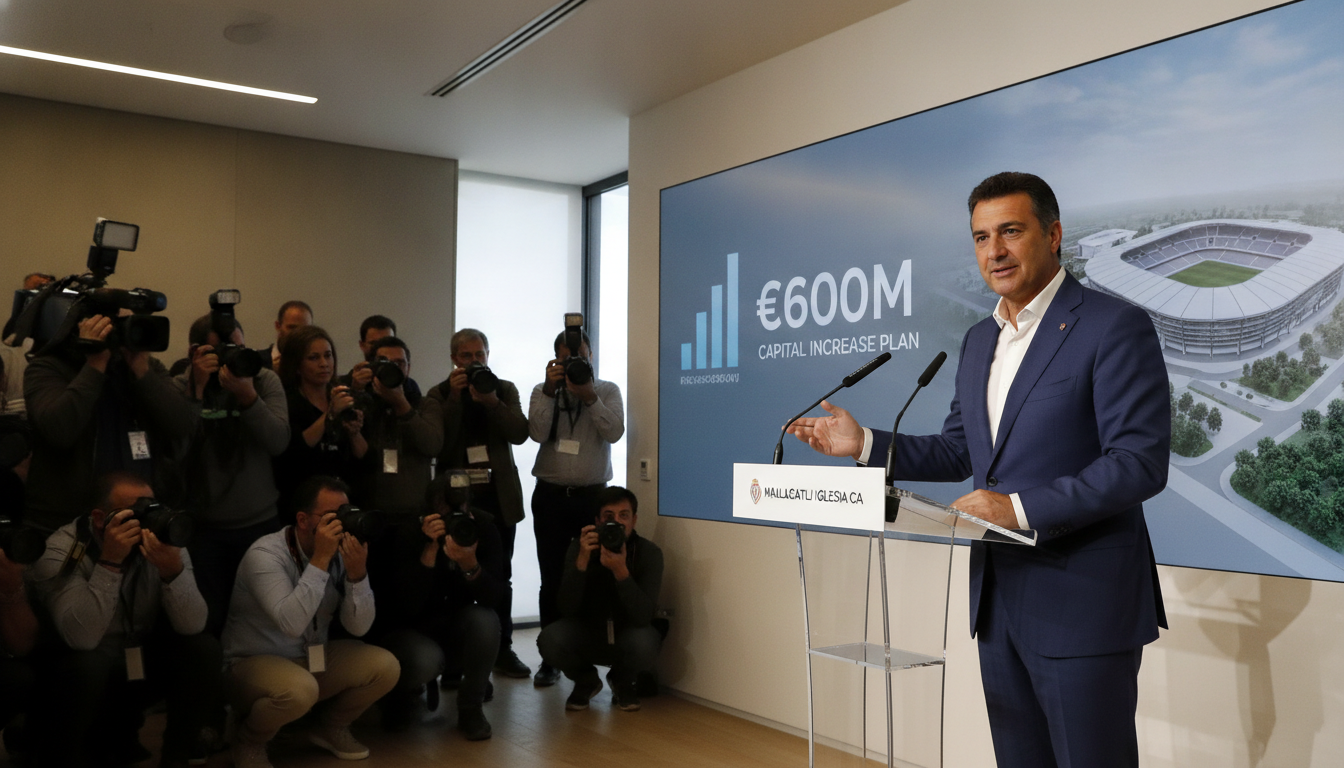
Jamal Satli Iglesias unveils €600m strategic bid to reshape Málaga CF
Jamal Satli Iglesias unveils a €600M plan for Málaga CF, proposing a capital increase, academy investment, hotel-asset financing and €50–70M in annual revenues.


Jamal Satli Iglesias has presented a comprehensive strategic proposal that could inject up to €600 million into Málaga CF, outlining both financial and sporting reforms aimed at long-term stability. The project, advanced by Management Empresarial Málaga (MEM) and supported by KPMG, ties an initial capital increase to a larger plan of recurring revenue generation and academy development. Satli Iglesias positioned the proposal as an alternative to current management, saying a takeover would prioritize a capital boost irrespective of Abdullah Al-Thani’s future with the club.
Project scope and headline commitments
The MEM blueprint sets out three primary objectives: generate steady income streams estimated between €50 million and €70 million per year, secure economic self-sufficiency while maintaining sporting competitiveness, and embed Málaga CF more deeply as a civic institution. Those aims are backed by concrete measures that include monetizing club-owned assets and investing in infrastructure to broaden commercial activity. KPMG’s involvement is cited as a validation of the financial planning behind the proposal and as support for the valuation and exit strategies MEM proposes.
Financing plan anchored in hotel asset sales
A first-phase financing strategy relies on the sale of an existing portfolio of operational hotel assets controlled by the group, a transaction already underway to demonstrate liquidity and capacity. The proceeds from that sale would be channelled into the club’s comprehensive redevelopment programme, covering both immediate needs and longer-term investments. MEM describes the asset disposals as a way to prove financial solvency without relying on speculative external borrowing, and to seed projects intended to create the recurring revenues outlined in its forecasts.
Sporting strategy centered on the academy and residency
At the heart of the sporting plan is a renewed emphasis on La Academia as a principal source of talent and revenue, though not its only pillar. MEM proposes strengthening the youth system to produce first-team players and transferable assets, while also building a residential facility aimed at hosting training camps and international development programmes. The residency is designed to attract foreign clubs for training stints and to position Málaga as a destination for player development, with revenue generated from hosting, accommodation and football programmes.
Governance, transparency and criticism of current leadership
Satli Iglesias framed the proposal as corrective to what he described as years of mismanagement, directly criticizing Abdullah Al-Thani’s stewardship and labeling his period in charge as “a disaster.” The plan emphasizes governance reforms, greater fiscal transparency and strict allocation of resources solely to the execution of the MEM blueprint. A priority measure, should MEM assume control, would be a capital increase intended to stabilize finances and fund the first tranche of investments independent of any immediate changes in ownership structure.
NAS Spain stake and potential exit scenarios
MEM currently controls a 49% stake in the NAS Spain group, and Satli Iglesias said the company would not seek to dissolve the entity as part of the plan. He acknowledged having received speculative offers for that 49% holding but left open the possibility of negotiating an exit if a credible, better-funded project emerged. Satli Iglesias added that MEM’s willingness to step aside would depend on the incoming group presenting a substantive, financially stronger proposal than the one MEM is advancing.
Revenue targets and commercial pillars
The plan anticipates creating diversified income sources to support an annual recurring revenue target of €50–70 million, driven by a mix of commercial, hospitality and football-related activities. MEM is targeting monetization from the club’s assets, increased matchday and hospitality income, academy player sales and the new residency’s programme fees. The proposal stresses a return on investment horizon tied to stabilizing the club’s operating balance and reinvesting in sporting competitiveness to protect the revenue base.
Implications for Málaga’s sporting project and city ties
MEM frames Málaga CF as a civic project with deep local roots, arguing that sustainable success must marry sporting ambition with community integration. Enhancements to the academy and the proposed residency aim to provide social benefits by creating pathways for local youth while attracting international attention and tourism revenue. The proposal positions the club as both a local institution and a regional economic asset, seeking to leverage football’s visibility to support broader urban and commercial objectives.
The plan’s backers argue KPMG’s involvement offers an independent review of assumptions and a framework for managing risks associated with asset sales and investment deployment. That advisory role is highlighted as a safeguard to ensure the funds generated by the initial asset disposals are applied to agreed priorities and subject to external scrutiny. MEM insists transparency mechanisms will accompany spending and governance changes to restore stakeholder confidence and prevent past errors from repeating.
If MEM were to take control, one immediate step would be the capital increase cited as essential to the project’s credibility and to strengthening the club’s balance sheet. The capital injection is pitched as a stabilizing measure to enable tactical transfers, infrastructure works and operational improvements without resorting to unsustainable debt. MEM’s public remarks suggest the capital increase would be structured to attract additional partners while retaining a controlling plan for how the funds are used.
The proposed academy-first sporting model acknowledges that not every graduate will remain at Málaga, but it treats player development as both a social mission and a revenue engine. By bolstering scouting, coaching and residential facilities, MEM aims to create a pipeline of first-team talent alongside sellable assets. The residency component also offers a distinct commercial product, renting training blocks and accommodation to visiting teams and camps to diversify seasonal income.
MEM’s statements also make clear that a deal would require negotiation with existing stakeholders, and that changes in control are not presented as unilateral. Satli Iglesias stressed readiness to exit if his group were perceived as the obstacle, provided any replacement offered a demonstrably superior financial and strategic plan. That stance opens a path for dialogue with current owners, minority holders and city authorities over a possible transition.
Market reaction and local sentiment are likely to be mixed, with some supporters welcoming new funds and a clearer strategic direction while others may be cautious about asset sales and changes to club identity. MEM frames its approach as preserving Málaga CF’s local link while professionalizing commercial operations, a balance that will be closely scrutinized by fans, municipal officials and football regulators. The coming weeks are expected to bring further detail about timelines, governance structures and the specifics of the asset sales.
Beyond the immediate financial mechanics, the proposal signals a broader debate about club ownership models in Spanish football, where sustainability and competitive ambition must coexist. MEM’s plan offers a case study in combining private capital, asset monetization and youth development to build a repeatable model for mid-sized clubs. How regulators, potential partners and the Málaga community respond will determine whether the proposal moves from outline to implementation.
This strategic proposal from Jamal Satli Iglesias sets out clear financial and sporting targets and frames them within a civic vision for Málaga CF, but it remains contingent on complex negotiations and successful execution of the initial financing steps. The plan’s emphasis on transparency, academy development and diversified revenues addresses long-standing concerns about the club’s sustainability. The next phase will reveal whether MEM’s proposed €600 million programme can gain the support required to reshape Málaga CF’s future.