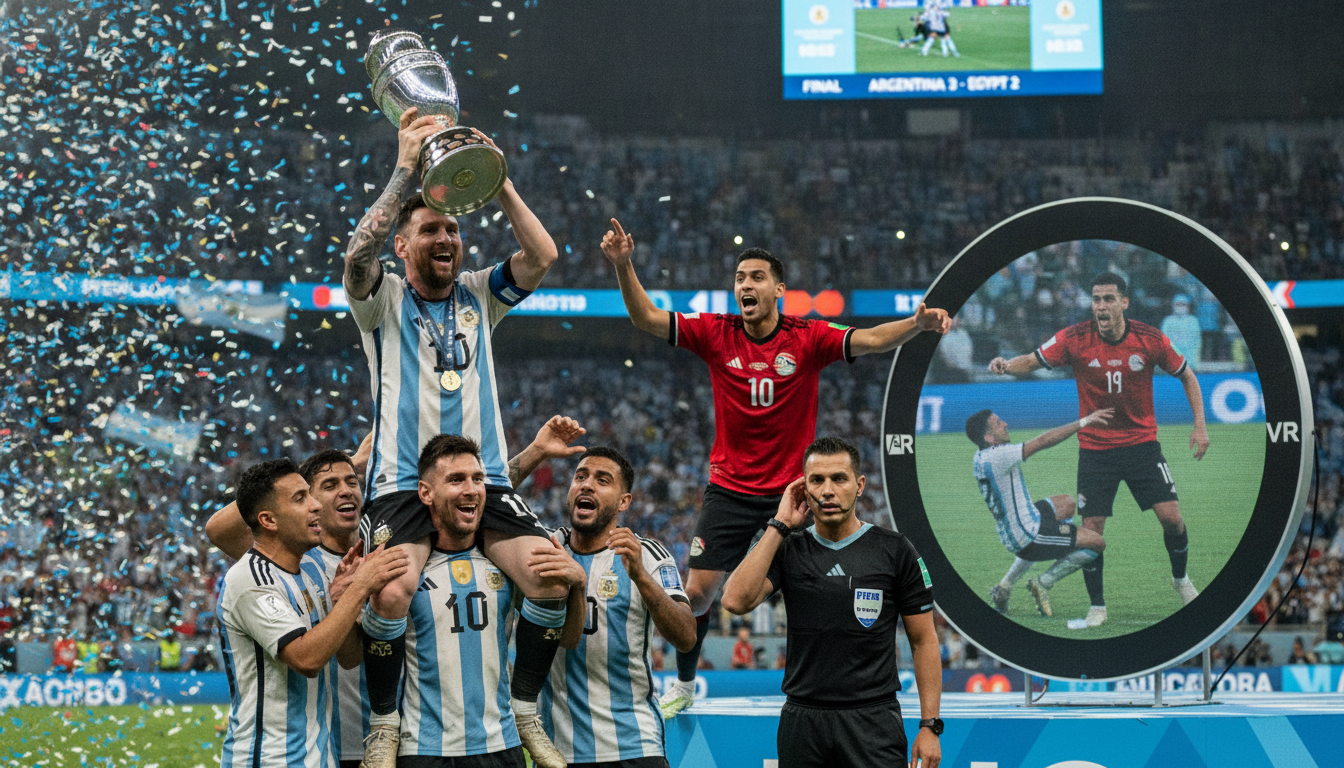
Argentina’s win over Egypt keeps defending champions on course after dramatic 3-2 comeback in Atlanta
Argentina’s win over Egypt in Atlanta ended 3-2 after late drama, VAR controversy and Lionel Messi heroics, keeping the defending champions on course.


Argentina produced a dramatic comeback to beat Egypt 3-2 at Mercedes-Benz Stadium in Atlanta, a result that keeps the defending champions on course for a second consecutive final. The match swung wildly in the final stages, with goals, overturned decisions and a charged atmosphere that will be debated long after the final whistle. The victory extends Argentina’s run in the tournament and renews the sense that the side are firm favourites as the competition heads into its decisive rounds.
Late turnaround in Atlanta
Argentina trailed for significant portions of the match but found momentum in the second half to overturn the deficit and secure a 3-2 victory. Egypt took an early lead and defended resolutely for long stretches, forcing Argentina to probe and press for openings. The defining sequences arrived late, when Argentina’s persistence paid off with decisive interventions and a finish that sparked wild celebrations in the stands.
The game was characterised by swings in tempo and urgency, with both sides creating chances and testing their opponents’ concentration under pressure. Argentina’s forwards began to find space as the match opened up, and substitutions injected fresh impetus at a critical moment. By the final quarter, the impetus had swung decisively in Argentina’s favour, producing the goals that ultimately decided the tie.
Key moments arrived in rapid succession and altered the game’s narrative, with each incident intensifying the drama on the pitch. The late equaliser and the winning strike came after sustained pressure and tactical adjustment, demonstrating Argentina’s depth and ability to respond in high-stakes situations. Those moments will feature prominently in match reports and highlight reels as the tournament progresses.
Messi’s influence and decisive interventions
Lionel Messi played a central role in the comeback, his presence and creativity repeatedly unsettling Egypt’s defensive organisation. Messi’s involvement in the final third drew opponents and created space for teammates, contributing directly and indirectly to the goals that turned the match. Whether through a key pass, a penetrating run or a calm finish, his influence was apparent at decisive moments.
Teammates reacted visibly to Messi’s contribution, lifting him in celebration after the final whistle and signalling the emotional release of a win that was hard fought. The combination of Messi’s experience and Argentina’s supporting cast delivered a clinical edge when it mattered most. That cohesion under pressure highlighted why Argentina entered the fixture as tournament favourites and why they remain difficult opponents in knockout football.
Beyond the individual moments, Messi’s leadership style helped shape the team’s response to adversity during the match. He coaxed teammates into higher-tempo play and stayed composed as refereeing decisions were reviewed, projecting the steadiness required in tight contests. The night in Atlanta reinforced the argument that Messi remains a decisive figure in major tournaments when the margins are narrow.
VAR decision and refereeing scrutiny
The result was clouded by a contentious VAR intervention and a high-profile refereeing decision, which will fuel debate among supporters and pundits alike. French referee François Letexier featured prominently following a late review that changed the course of play, provoking strong reactions from different quarters. Such decisions are already part of modern tournament football, but this incident in particular is likely to be dissected for its timing and impact.
Critics pointed to the scale of the intervention and suggested that the moment altered the balance of the match at a crucial juncture. Supporters of Argentina argued the technology corrected an on-field error and allowed justice to be served, while other voices questioned the consistency of such reviews across the competition. The exchange highlights the persistent tension between technological clarity and the fluidity of match flow.
Tournament organisers face renewed calls to ensure transparent communication around VAR protocols and to improve the speed and clarity of decisions. Players and managers, meanwhile, must adapt to the reality that off-field reviews can decisively change match outcomes. The episode in Atlanta will strengthen the case for clearer standards and better public explanation of how pivotal calls are reached.
Tactical shifts and managerial responses
Argentina’s manager made tactical adjustments that altered the team’s balance and unlocked Egypt’s defensive shape in the second half. A switch in attacking personnel and a reshaped midfield structure invited greater ball progression and more direct threat in the final third. Those changes added tempo and created mismatches that Argentina exploited in the closing stages.
Egypt’s coach set up a compact defensive block and sought to frustrate Argentina by cutting passing lanes and limiting space between lines. That strategy worked for long periods, but it left the team vulnerable to incisive transition play, which Argentina punished after sustained pressure. The match therefore illustrated the fine margins of tactical planning in knockout fixtures and the importance of in-game management when games evolve quickly.
Substitutions influenced the course of the match, with fresh legs and different skill sets unsettling tiring defenders. These moves showcased the depth available to Argentina and the value of bench options in tournament football. For Egypt, the evening will be analysed for missed opportunities and lessons on how to preserve leads against elite opposition over the final 20 minutes.
Tournament context and schedule implications
Argentina’s progression shifts the storyline of the tournament as the competition moves into its later stages, reinforcing the status of the defending champions as frontrunners. The result in Atlanta keeps Argentina on a path that, if navigated successfully, could see them reach another final and attempt to defend their crown. That prospect now looms larger for broadcasters, fans and organisers alike.
Elsewhere in the round of 16, other ties produced contrasting drama or, in some cases, periods of sterility on the ball as teams sought safety over spectacle. One of the evening’s earlier matches drew attention for its lack of attacking intent, underscoring the differing tactical approaches employed across knockout games. These contrasts highlight the unpredictable nature of tournament progression and the range of methods teams use to advance.
Looking ahead, Argentina must address recovery and preparation, with attention turning to injury management and tactical refinement for the quarter-final stage. Opponents will study the Atlanta performance to identify vulnerabilities to exploit, while Argentina will seek to consolidate the positives from the comeback. The balance between short-term repair and long-term tournament strategy becomes especially crucial at this stage.
Reactions from fans, media and football figures
The match generated a mixed reaction across social media and mainstream coverage, with praise for the spectacle and criticism of the officiating at key moments. Supporters of Argentina celebrated what they saw as a resilient performance and a testament to the team’s mentality under pressure. Egypt’s fans and neutral observers expressed frustration at how the late episodes unfolded, while acknowledging the quality on display.
Pundits weighed in on managerial decisions and the individual performances that shaped the result, emphasising the importance of experience in tight knockout football. Conversations around the game touched on legacy and narrative as much as on tactical detail, reflecting the emotional stakes attached to high-profile matches. The outcome will be referenced in discussions about tournament favourites and the pressures of defending a title.
National associations and coaching staff will now turn their energies to the next fixtures, digesting both the positives and lessons from the Atlanta encounter. For Argentina, the victory offers momentum and a psychological edge as the tournament intensifies. For Egypt, there is the task of regrouping and drawing constructive conclusions from a narrow defeat that was fought to the final whistle.
The defending champions now carry the weight of expectation as they progress, but the manner of the win also reinforces themes of resilience and experience that have characterised their recent international form. As the tournament advances, every result and officiating decision will be magnified, and the events in Atlanta will be an enduring reference point in debates about fairness, drama and the margins of victory.
Argentina’s comeback against Egypt unfolded as both a sporting spectacle and a flashpoint for broader conversation about refereeing and tournament structure. The team leaves Atlanta with momentum and the pressure that accompanies success, while opponents and observers will continue to examine the decisions that helped determine the outcome. The tournament’s next weeks promise further high-stakes football, and Argentina’s path remains one of the most closely watched as the competition heads toward its climax.
The final whistle in Atlanta confirmed a result that will be replayed across highlights packages and dissected by analysts, but it also reinforced a broader truth about knockout football: matches can pivot on a single decision, a brief tactical change, or the composure of an individual at a decisive moment.