

Egypt files FIFA complaint after World Cup loss to Argentina over alleged biased officiating
Egypt files a formal complaint with FIFA over alleged biased officiating in their World Cup Round of 16 loss to Argentina, requesting a review of on-field and VAR decisions. (156 characters)


Egypt filed a formal complaint with FIFA following their dramatic Round of 16 exit from the World Cup, alleging that match officials and the VAR team showed bias that changed the outcome. The Egyptian Football Association contends that two key decisions were mishandled and is asking FIFA to open an immediate investigation. The complaint follows a match in which Egypt surrendered a 2-0 lead and lost 3-2 after late controversial events.
Egypt’s complaint and requested investigation
The Egyptian Football Association, led by president Hany Abo Rida, submitted a formal dossier to FIFA alleging game-changing officiating errors and inconsistent rule application. The federation has asked FIFA not only to review the on-field referee’s calls but also to examine the performance of the VAR officials. EFA officials described a pattern of decisions that they say unfairly disadvantaged Egypt and asked FIFA to consider removing the officiating crew from the remainder of the tournament if the allegations are substantiated.
The complaint singles out specific incidents as central to Egypt’s case and seeks a full account of the match officials’ deliberations. The federation is requesting access to VAR footage, communication logs, and any internal referee reports relevant to the match. By emphasizing both on-field calls and VAR intervention, the EFA is underlining that the dispute is not limited to a single decision but to the overall management of critical moments.
Contested moments at the heart of the dispute
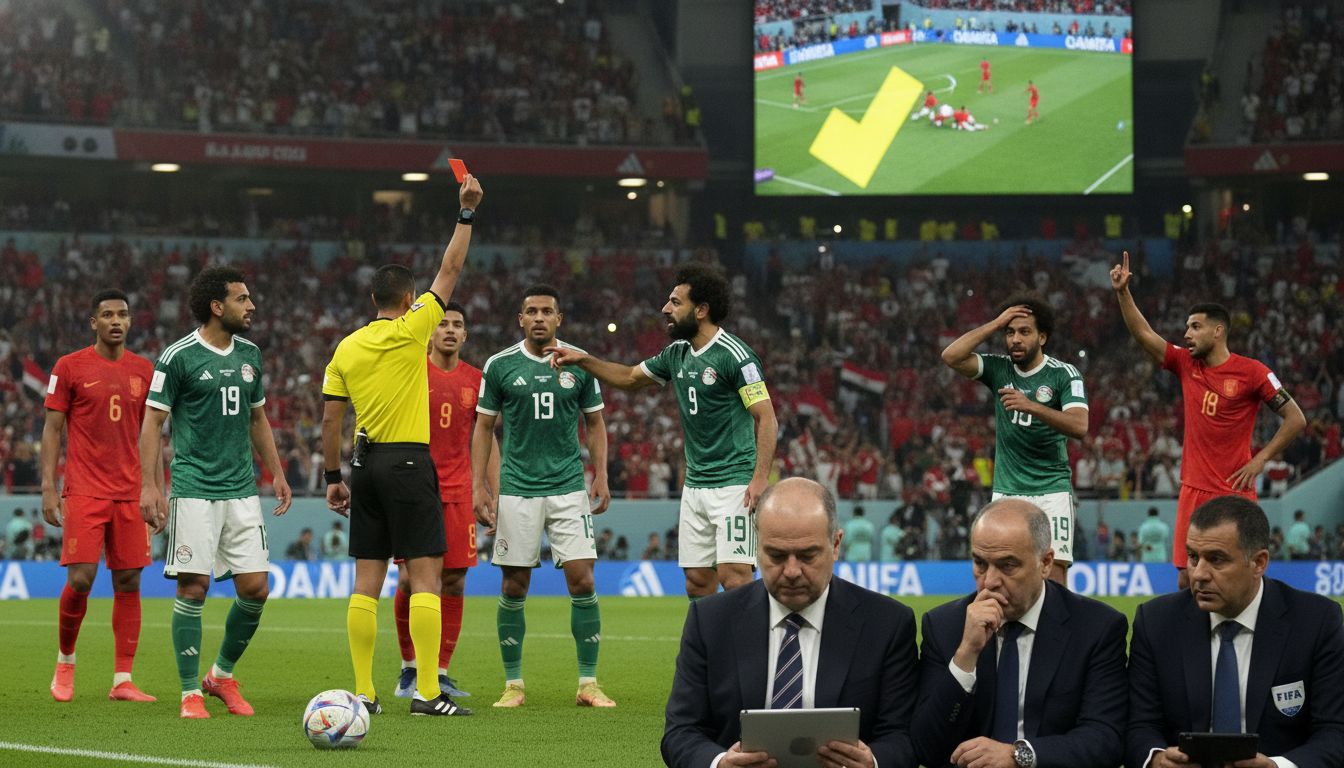
According to the complaint, the first contested incident occurred early in the second half when Mostafa Ziko’s goal was disallowed after Marwan Attia was penalized for a foul on Lisandro Martínez. The EFA argues that the foul call was incorrect and that the goal should have stood, which would have extended Egypt’s advantage at a crucial phase of the match. The second incident cited involves Mohamed Salah in stoppage time, when he went down under contact in the penalty area and no penalty was awarded.
Egypt’s players and staff immediately challenged the decisions on the field, and the EFA says both moments should have prompted VAR reviews or different on-field interpretations. The federation contends that neither incident received adequate scrutiny from the video officials and that the cumulative effect of those rulings swung momentum away from Egypt. These two events form the backbone of the grievance sent to FIFA.
Sequence of events and match turnaround
Egypt, managed by Hossam Hassan, led 2-0 late into the second half and appeared to be in control of the tie before a dramatic turnaround. Players and coaching staff surrounded the officials after the stoppage-time incident, creating a delay in play that preceded Argentina’s equalizer. Enzo Fernández capitalized on the opening and scored to make it 2-2, and Argentina completed the comeback shortly thereafter to advance 3-2.
The EFA’s submission emphasizes that the timing of the disputed calls and the subsequent delay contributed directly to the shift in momentum. The federation argues that the team’s capacity to regroup was undermined by what it describes as inconsistent officiating, which it believes altered the competitive balance. Egypt’s exit from the tournament came immediately after those pivotal moments, compounding the federation’s grievances.
EFA leadership and formal demands
Hany Abo Rida, the EFA president, is leading the push for a formal FIFA inquiry and has framed the complaint as a defense of fair play and equal treatment. In the document sent to FIFA, the EFA requests an examination of referee François Letexier’s performance alongside a review of the VAR team’s decisions. The federation has asked for clear findings and corrective action should any procedural or interpretive errors be identified.
The EFA is also asking FIFA to consider temporary steps, including removing the involved officiating crew from further matches in the tournament if the investigation confirms the alleged irregularities. That request places immediate pressure on FIFA’s refereeing governance structures to respond transparently and quickly. The federation’s approach signals it will pursue both formal adjudication and public accountability.
Potential responses from FIFA and refereeing authorities
FIFA’s disciplinary and refereeing bodies typically acknowledge receipt of such complaints and may open a preliminary review to establish whether a full investigation is warranted. If FIFA proceeds, the process would commonly include examination of the match footage, VAR recordings, and referee reports, as well as interviews with officials involved. Any findings could lead to guidance, reprimands, or procedural adjustments, depending on the assessment of whether errors occurred and whether they altered the match outcome.
The EFA’s request to remove match officials would be an extraordinary step and would hinge on the strength of the evidence uncovered by FIFA’s review. International football governing bodies generally balance the need for referee protection and the integrity of competitions with the responsibility to correct identifiable mistakes. How FIFA chooses to handle the complaint will be watched closely by national associations and refereeing bodies across the sport.
Broader implications for VAR, refereeing and competition integrity
The complaint highlights ongoing debates about the role of VAR and the consistency of officiating in high-stakes tournaments. National associations from other countries have raised similar concerns in past competitions, and FIFA has periodically adjusted VAR protocols and referee training in response. Egypt’s formal challenge adds to the pressure on governing bodies to clarify review triggers and communication standards between on-field refs and video officials.
If FIFA takes decisive action, it could prompt a broader review of VAR procedures and accountability mechanisms for referees in major tournaments. Conversely, a finding that officiating fell within acceptable margins would likely reinforce the status quo but may still leave calls for greater transparency. The outcome of this case could influence public confidence in officiating and shape how teams appeal contentious decisions going forward.
Egypt’s complaint also underscores how single-match rulings can have outsized consequences in knockout competition, where one game determines continuation or elimination. For players, coaches and federations, clarity and consistency in refereeing are essential to maintaining competitive fairness and the perception of legitimacy in tournament results.
FIFA’s standard timelines for such investigations vary and are influenced by the complexity of the case and the scheduling demands of an ongoing tournament. Immediate interim measures are rare but possible if preliminary findings suggest significant procedural failures. Any conclusions will likely be communicated through FIFA’s official channels once the governing body has completed its internal review.
The Greek of football governance requires balancing procedural correctness with the emotional intensity of fans and national federations seeking recourse after high-profile losses. How FIFA frames its response—whether as a technical clarification of existing rules or as a substantive rebuke of officiating performance—will be significant in setting expectations for future disputes.
The EFA has framed its action as a necessary step to protect its players and the integrity of competition, while also signaling a readiness to pursue further appeals should FIFA’s initial response be unsatisfactory. The federation’s public posture underscores a determination to seek redress through formal channels rather than through media commentary alone.
Egypt’s elimination will now be examined not only as a sporting outcome but as a case study in how modern football adjudicates contested decisions under the influence of VAR. The review process and any subsequent measures will be monitored by stakeholders eager for clearer standards in refereeing and video review.
As the investigation proceeds, both the EFA and FIFA face the immediate challenge of managing public expectations while conducting a methodical review. Clarity on what was reviewed and why will be crucial to preserving confidence in the sport’s governance and in the decisions that determine tournament progression.
Whether FIFA finds procedural lapses or affirms the match officials’ decisions, the episode will likely prompt renewed discussion about how VAR is used and how referees are evaluated in tournament settings. The balance between technological assistance and human judgment remains central to these debates.
The coming days are likely to see official statements from FIFA and further commentary from the Egyptian federation as both sides prepare their positions. Football observers will be watching for not only the outcome of the investigation but also for any changes in protocol that FIFA might announce to prevent similar controversies in future fixtures.
Egypt’s World Cup run ended on a contentious note, and the federation’s formal complaint ensures the dispute will be examined beyond the final whistle. The governing bodies of the sport will now be tasked with determining whether the officials simply made debatable calls or whether there were errors serious enough to warrant corrective action.
The match itself will remain a focal point for fans and analysts, but the procedural response to Egypt’s complaint may have a longer-lasting impact on how refereeing and VAR are governed in international football. The resolution of this case will be an important reference for federations considering formal challenges in future tournaments.
The outcome of FIFA’s review will shape immediate perceptions and could influence how similar incidents are handled going forward. For now, Egypt has placed an institutional spotlight on the decisions that decided their World Cup fate and asked football’s governing authority to provide accountability and clarity.